
On the Dorset coast of southern England, the dark mudstones of the Kimmeridge Clay Formation mostly hold sea creatures. Yet near Swanage, these marine rocks gave up the partial skeleton of a land predator—Juratyrant langhami. It lived early in the Tithonian, the final stage of the Late Jurassic. It also ranks among the most complete tyrannosauroid fossils from that period. Tyrannosauroids include Tyrannosaurus and its earlier, smaller relatives.
Paleontologist Roger B.J. Benson named the species in 2008, placing it in the North American genus Stokesosaurus. That arrangement did not last. In 2013, Stephen L. Brusatte and Benson found no firm support for the link and gave the Dorset animal its own genus. Since then, studies have moved Juratyrant around the early tyrannosauroid family tree more than once. Its story shows how a single specimen—part of a backbone, hips and legs, with no skull—can anchor years of debate.
Juratyrant Key Facts
| Keyword | Fact |
|---|---|
| Pronunciation | Not specified |
| Meaning of name | Jurassic Tyrant |
| Group | Theropoda |
| Type Species | Juratyrant langhami |
| Diet | Carnivore (inferred from its tyrannosauroid relatives) |
| When it Lived | Early Tithonian, within the Tithonian span of 149.2 to 143.1 MYA |
| Period | Jurassic |
| Epoch | Late Jurassic (Tithonian stage) |
| Length | Not specified |
| Height | Not specified |
| Weight | About 1,090 to 1,429 pounds (494 to 648 kilograms), two estimates from leg bones |
| Mobility | Not specified |
| First Discovery | 1984 by P. Langham, according to the Paleobiology Database (citing museum records) |
| Described by | 2008 by R.B.J. Benson, as Stokesosaurus langhami, with the new genus named in 2013 by S.L. Brusatte and R.B.J. Benson |
| Holotype | OUMNH J.3311-1 to J.3311-30 |
| Location of first find | Kimmeridge Ledges between Rope Lake Head and Freshwater Steps, Kimmeridge Clay Formation, Dorset, England, UK |
Juratyrant Origins, Taxonomy and Timeline
The name Juratyrant is refreshingly plain. In their 2013 paper, Brusatte and Benson explained that “Jura” refers to the Jurassic age of the animal. “Tyrant” is an Anglicized form of the Greek tyrannos and Latin tyrannus—a nod to the popular label “tyrant dinosaurs,” which goes back to Tyrannosaurus rex. Benson coined the species name, langhami, in 2008, but none of our sources explains it. Together, the genus name reads simply as “Jurassic tyrant”—a record of its age and its lineage.
Brusatte and Benson placed Juratyrant within Theropoda, the mostly meat-eating dinosaurs, then within Tetanurae and finally Tyrannosauroidea. Their analysis grouped it with Stokesosaurus clevelandi from North America and with Eotyrannus. Juratyrant langhami is the type and only known species.
The fossil comes from the eastlecottensis Subzone of the Pectinatites pectinatus ammonite zone—a slice of rock defined by its ammonites. Brusatte and Benson dated this level to the early Tithonian, and two independent studies of the same coastline agree. However, the Paleobiology Database and a 2014 body-mass dataset list it as Late Tithonian, which conflicts with Brusatte and Benson’s early-Tithonian placement. The Tithonian spans roughly 149.2 to 143.1 million years ago. Still, no direct date exists for the bed itself.
Discovery & Fossil Evidence
The skeleton came from the shore between Rope Lake Head and Freshwater Steps, a stretch marked as Kimmeridge Ledges on Ordnance Survey maps. This coast, about 6 miles (9.7 kilometers) west of Swanage, now lies within the Jurassic Coast World Heritage Site. According to the Paleobiology Database record, which cites museum records, P. Langham collected the bones in 1984. The Oxford museum then purchased them in 1992. The same record also places them just below the Freshwater Steps Stone Band. Benson first reported the fossil in a 2007 conference abstract, and his full description followed in 2008.
The holotype, OUMNH J.3311-1 to J.3311-30, is an associated partial skeleton from a mature individual, held by the Oxford University Museum of Natural History. The backbone includes one cervical (neck) vertebra, five dorsal (back) vertebrae, a complete sacrum—the hip section of the spine—and five caudal (tail) vertebrae. Four isolated transverse processes, the side projections of vertebrae, also survive. Best of all, the entire pelvic girdle is present, with both ilia (upper hip bones), pubes and ischia. Both femora (thigh bones), both tibiae (shin bones) and one unidentified bone fragment complete the set.
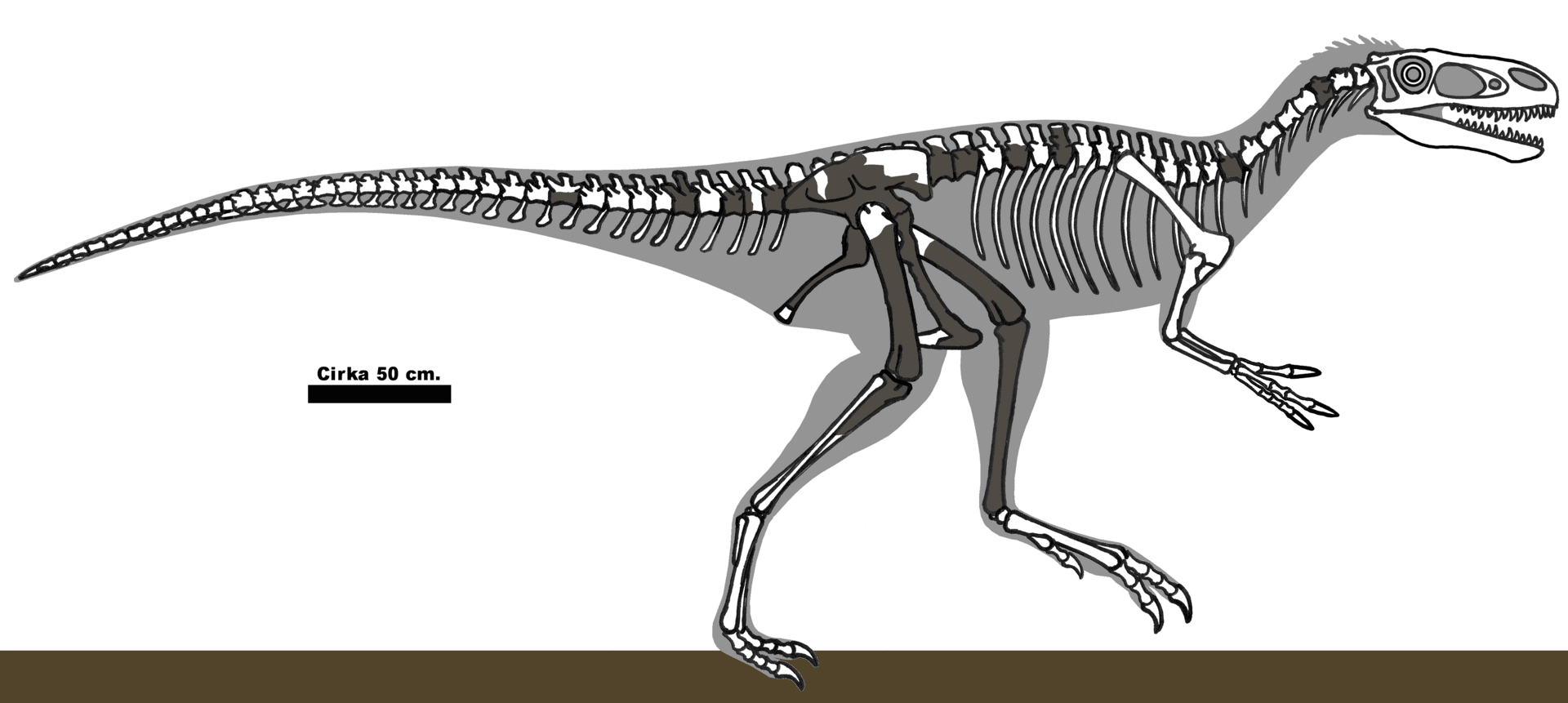

Equally telling, nothing from the skull or forelimbs is among these bones. Both femora are deformed—the right crushed from side to side and the left from front to back. Even so, Benson ranked it in 2008 as one of only two definitive Jurassic tyrannosauroids known from more than isolated bones.
Juratyrant Size and Description
Only parts of the backbone, hips and hind limbs survive, so the shape of the head and arms remains unknown.
Short description of Juratyrant
The preserved skeleton starts with a neck vertebra whose centrum, or vertebral body, is slightly hollowed at the back. The back vertebrae are only a little longer than tall, with length-to-height ratios averaging 1.16 across three measured bones. Near the hips, the rear joints of these vertebrae sit raised above the front ones. Meanwhile, the sacrum carries openings at mid-body along the suture between the centrum and the arch. Its fifth vertebra also bears a prominent hyposphene—an extra locking joint—that extends backward as a thin sheet.
By far the best-known region, though, is the hips. A thin ridge runs up the side of the ilium, slanting backward and stopping short of the upper edge. The iliac blade is semi-oval, and the notch at its front end is narrow, as in Stokesosaurus clevelandi. The brevis fossa, a groove under the rear of the ilium, faces down and inward. It is hidden in side view, as in S. clevelandi and Aviatyrannis. Only bones are preserved, so any skin or feathers shown in restorations are speculative.
Size and Weight of Type Species
No length or hip height appears in the peer-reviewed sources we consulted. Instead, the best direct guide is the leg, with a femur 667 millimeters (26.3 inches) long and 210 millimeters (8.3 inches) around. The tibia reaches 680 millimeters (26.8 inches), slightly longer than the femur—a proportion Benson highlighted in 2008.
Two teams have since turned those bones into body mass. In 2013, paleontologists L.E. Zanno and P.J. Makovicky used femur length to estimate about 1,429 pounds (648 kilograms). A year later, Benson and colleagues used shaft circumference instead and reached about 1,090 pounds (494 kilograms). Either way, both figures are indirect.
Zanno and Makovicky’s table places it in the same 500 to 1,499 kilogram size class as the tyrannosaurid Teratophoneus. That animal, however, came out at 974 kilograms (about 2,150 pounds). In 2008, Benson called Juratyrant the largest Jurassic tyrannosauroid reported to that date. Brusatte and Benson later placed it among Late Jurassic tyrannosauroids of intermediate size—larger than Dilong and Guanlong, yet far smaller than the biggest tyrannosaurids.
The Dinosaur in Detail
What sets this dinosaur apart lies mostly in its hips. In 2013, Brusatte and Benson listed four autapomorphies—traits unique to a single species—two of them first noted by Benson in 2008. First, the ischial apron, a sheet of bone on the lower rear hip bone, has a folded appearance. Second, a flange for the fibula continues as a distinct low ridge up to the top of the tibia. Third, its ischial tubercle forms a convex bulge, and J. langhami is the only taxon with that condition.
The fourth trait is a deep fossa, or pit, on the outer pubis below the hip socket. In front, a stout ridge separates it from the rough pubic tubercle. According to Brusatte and Benson, this pit is absent in all other tyrannosauroids known from well-preserved pubes. They also listed two probable autapomorphies—the sacral hyposphene and a broad, concave extensor groove at the knee end of the femur. Because the femora are crushed, however, they put the groove forward only hesitantly.
A Shifting Place on the Family Tree
Initially, Benson had tied the Dorset animal to Stokesosaurus through four hip features unique to the pair. In 2013, however, Brusatte and Benson found the semi-oval iliac blade in Dilong, Sinotyrannus and Xiongguanlong, and a backward-sloping ridge in Eotyrannus. A furrow inside the ilium could not be checked in close relatives, and the narrow notch is broken in other candidate taxa. They also flagged Aviatyrannis as a possible close relative, or perhaps the same genus. After removing it, their 24-taxon run recovered Juratyrant and Eotyrannus as sister taxa, with S. clevelandi just outside, although support was weak.
Later studies have reshuffled that picture. In 2013, M.A. Loewen and colleagues grouped it with Stokesosaurus and Sinotyrannus inside Proceratosauridae, a family of early tyrannosauroids. Three years later, Brusatte and T.D. Carr recovered Juratyrant, Stokesosaurus and Eotyrannus as a clade by parsimony, one of two tree-building methods they used. Their Bayesian tree, however, moved Eotyrannus closer to tyrannosaurids. In 2020, C.-G. Yun and Carr noted that most analyses of the previous decade found this trio together. Moreover, they formally named it Stokesosauridae, a name Carr and colleagues had used informally in 2017.
In contrast, D. Naish and A. Cau in 2022 placed Juratyrant and Stokesosaurus outside all remaining tyrannosauroids and found no support for a close tie to Eotyrannus. Most recently, a 2025 analysis by R. Delcourt and colleagues made it the first-branching member of an early maniraptoromorph clade—theropods on the line toward birds. That came from implied weighting, the authors’ preferred analysis. Its companions there were Tanycolagreus, Santanaraptor and Mirischia, a result that would put it outside Tyrannosauroidea. Taken together, no later study we consulted doubts that Juratyrant is a valid genus, but its exact branch remains an open question.
Interesting Points about Juratyrant
- Its name means “Jurassic tyrant,” and the “tyrant” part echoes the vernacular “tyrant dinosaurs” that traces back to Tyrannosaurus rex.
- The title of Benson’s 2007 conference abstract already presented the Dorset fossil as a large-bodied species of the American genus Stokesosaurus.
- In 2008, Benson used its Stokesosaurus link to argue for a Late Jurassic tie between North America and Europe.
- Although only one specimen is known, Brusatte and Benson ranked it among the most complete Jurassic tyrannosauroid fossils.
Juratyrant in its Natural Habitat
The rocks that hold Juratyrant record a sea, not a forest. In Dorset, the Kimmeridge Clay is a rhythmic sequence of mudstones and black shales rich in kerogen, or fossil organic matter. Thin limestone and dolostone bands break up the sequence. These layers settled in the calm bottom waters of a shallow epeiric sea—one spread across a continent. At times, its layered water column lacked oxygen. Although its sediment washed in from a nearby landmass, plant fossils other than wood are rare, which points to deposition some distance offshore. No study we consulted explains how a land predator’s skeleton came to rest in these muds.
As a tyrannosauroid, Juratyrant was likely a meat-eater, although no study addresses its diet directly. Brusatte and Benson suggest that Jurassic tyrannosauroids were widespread yet lived in the shadow of giant predatory dinosaurs, the basal tetanurans. Benson argued in 2008 that this skeleton adds to evidence for small- to medium-sized basal tyrannosauroids across Asia, North America and Europe. While no source we consulted discusses its behavior, its iliac ridge probably separated major hind-limb muscles, as in other tyrannosauroids.
Sea life here is far better documented than life on land. From the same coast and subzone comes the ichthyosaur Thalassodraco etchesi, an ophthalmosaurid up to 2.25 meters (7.4 feet) long. Similarly, the shark-like hybodont Durnonovariaodus maiseyi turned up near Freshwater Steps in the same ammonite zone. Across England, over 60 localities have produced fishes, pliosaurs, ichthyosaurs and crocodiles, while pterosaurs and dinosaurs appear only as partial remains.
Frequently Asked Questions
It means “Jurassic tyrant,” referring to its age and to the “tyrant dinosaurs” label that goes back to Tyrannosaurus rex.
It lived early in the Tithonian stage of the Late Jurassic, a stage spanning roughly 149.2 to 143.1 million years ago.
Its length is not known, but two estimates from its leg bones put its weight at about 1,090 to 1,429 pounds (494 to 648 kilograms).
As a tyrannosauroid it was likely a carnivore, although no study has examined its diet directly.
It comes from the Kimmeridge Clay between Rope Lake Head and Freshwater Steps, west of Swanage in Dorset, England.
Four unique traits set it apart—three in its hips and one on its shin bone—including a folded ischial apron and a deep pit on the pubis.
Sources
The information in this article is based on various sources, drawing on scientific research, fossil evidence, and expert analysis. The aim is to provide a comprehensive and accurate overview of Juratyrant. However, please be aware that our understanding of dinosaurs and their world is constantly evolving as new discoveries are made.
- https://doi.org/10.4202/app.2011.0141
- https://www.app.pan.pl/archive/published/app58/app20110141.pdf
- https://app.pan.pl/SOM/app58-Brusatte_Benson_SOM.pdf
- https://doi.org/10.1671/0272-4634(2008)28[732:NIOSAT]2.0.CO;2
- https://doi.org/10.7717/peerj.12727
- https://doi.org/10.1371/journal.pone.0079420
- https://doi.org/10.1038/srep20252
- https://doi.org/10.11646/zootaxa.4755.1.13
- https://doi.org/10.1002/ar.70085
- https://doi.org/10.1038/ncomms3827
- https://doi.org/10.1371/journal.pbio.1001853
- https://doi.org/10.1371/journal.pone.0241700
- https://doi.org/10.7717/peerj.11362
- https://stratigraphy.org/ICSchart/ChronostratChart2024-12.pdf
- https://paleobiodb.org/data1.2/colls/single.json?id=48688&show=full
- https://paleobiodb.org/data1.2/occs/list.txt?base_name=Juratyrant,Stokesosaurus%20langhami&show=strat,loc,ident,ref,coords
- https://www.smithsonianmag.com/science-nature/englands-jurassic-tyrant-106555840/
This article was last fact checked: TheDinosaurs Team, 16-11-2026
Featured Image Credit: N. Tamura, CC BY-SA 3.0, via Wikimedia Commons
