
On the Dorset coast just north of Weymouth, the gray mudstones of Jordan Cliff—also called Furzy Cliff—belong to the Oxford Clay Formation. From these marine beds came the partial skeleton of Metriacanthosaurus parkeri, a large theropod of the Late Jurassic. The Paleobiology Database places it roughly 161.5 to 159 million years ago, in the Oxfordian stage. It is also the type genus of Metriacanthosauridae, the family that carries its name. Yet the animal behind that family remains poorly known, and its bones have never been fully described.
The bones once sat in the private collection of James Parker of Oxford. In 1908, Parker had his “Megalosaurian remains” brought up from the cellar for paleontologist Friedrich von Huene to examine. Von Huene introduced the name Megalosaurus parkeri in a short 1923 note and described the bones in detail in 1926. Then, in 1964, paleontologist Alick D. Walker gave it a genus of its own. According to Monvoisin and colleagues (2022), it was the only firmly identified allosauroid from Europe’s Middle-to-Late Jurassic “transition period.” That held until their study of finds from Normandy—a sign of how thin that record still is.
Metriacanthosaurus Key Facts
| Keyword | Fact |
|---|---|
| Pronunciation | met-ree-a-kan-tho-sore-us |
| Meaning of name | Moderately-Spined Lizard |
| Group | Theropoda |
| Type Species | Metriacanthosaurus parkeri (originally Megalosaurus parkeri) |
| Diet | Carnivore |
| When it Lived | About 161.5 to 159 MYA (Early Oxfordian, Paleobiology Database) |
| Period | Jurassic |
| Epoch | Late Jurassic (Oxfordian stage) |
| Length | About 27 feet (8.2 meters), Natural History Museum estimate |
| Height | Not specified |
| Weight | Not specified |
| Mobility | Not specified |
| First Discovery | Probably before 1871, when Phillips listed megalosaur remains from the Oxford Clay at Weymouth, in the collection of James Parker of Oxford |
| Described by | 1923 by F. von Huene as Megalosaurus parkeri (some authors cite 1926), genus named 1964 by A.D. Walker |
| Holotype | OUMNH J.12144 |
| Location of first find | Jordan Cliff (Furzy Cliff), Overcombe, near Weymouth, Weymouth Member of the Oxford Clay Formation, Dorset, England |
Metriacanthosaurus Origins, Taxonomy and Timeline
According to London’s Natural History Museum, the name Metriacanthosaurus means “moderately-spined lizard.” The name reflects spines that are tall but not extreme. Von Huene measured them at about two vertebral lengths, against four in the Wealden Altispinax. Meanwhile, the species name parkeri comes from the Parker collection, where von Huene studied the bones. Together, the name links the animal to its most striking anatomy and to the man who kept its remains.
In 2022, a team led by paleontologist E. Monvoisin summed up its modern placement, citing earlier analyses. It is the type genus of Metriacanthosauridae, a subgroup of Allosauroidea—the broad theropod group named for Allosaurus. The Paleobiology Database files it further down, in the subfamily Metriacanthosaurinae. However, Monvoisin’s team cautioned that because the genus is so fragmentary, the status of the family itself “is likely not definitive.” In 2024, paleontologist Oliver W. M. Rauhut and colleagues described the metriacanthosaurid Alpkarakush from Kyrgyzstan. In that paper, they called Metriacanthosaurus “the poorly known name-giving genus of the clade.” Metriacanthosaurus parkeri is the type and only known species.
The holotype comes from the Weymouth Member, the upper of the Oxford Clay’s three members. As a whole, the formation spans the Callovian and Oxfordian stages and runs from Dorset to North Yorkshire. Within that span, the Paleobiology Database assigns the Weymouth site to the Early Oxfordian, just after the boundary between the Middle and Late Jurassic. However, it notes that the exact level in the upper Oxford Clay is uncertain, and the Natural History Museum gives a broader 159 to 154 million years ago. Meanwhile, Cetiosauriscus and Eustreptospondylus come from the older Peterborough and Stewartby members. Both are Callovian, so they predate it.
Discovery & Fossil Evidence
The GB3D type-fossil record names no collector, although the Paleobiology Database lists “W. Parker.” No exact date survives, but Phillips’s Geology of Oxford listed megalosaur remains from the Oxford Clay at Weymouth as early as 1871. Either way, the trail leads to James Parker, whose collection later passed to the Oxford Museum. GB3D lists him as donor, with the year 1913. In his 1926 specimen list, von Huene placed the bones about 1.5 miles (2.4 kilometers) north of Weymouth, in the Oxford Clay. Modern records pin the site to Jordan Cliff at Overcombe, also known as Furzy Cliff. Fittingly, that cliff is also a partial type section, or reference outcrop, for the Weymouth Member.
The holotype—the name-bearing specimen—is OUMNH J.12144 at the Oxford University Museum of Natural History. Von Huene’s 1926 inventory lists three dorsal (back) vertebrae with high neural spines and four caudal vertebrae from the base of the tail. It also lists the right ilium (upper hip bone) and fragments of both ischia (rear hip bones). Both pubes (forward hip bones), the right femur (thigh bone), and the upper part of the left tibia (shin bone) complete the list. One dorsal vertebra still adheres to the ilium. Notably, no skull or teeth appear.
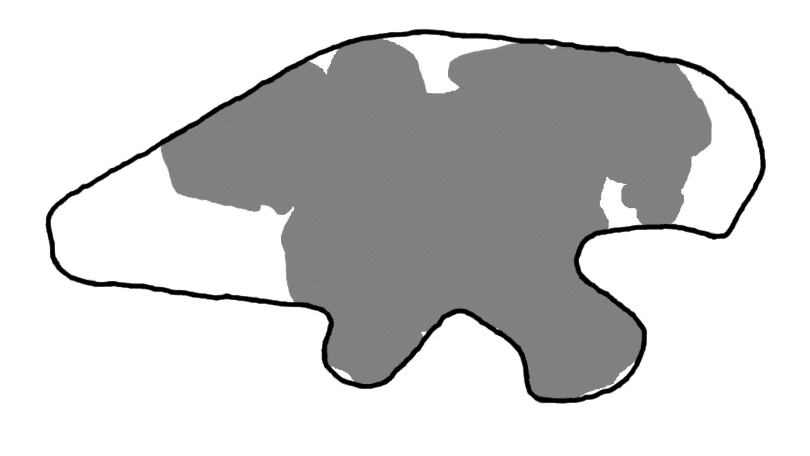

The Paleobiology Database records only a single occurrence of the genus. In 2022, Monvoisin and colleagues re-examined a tail vertebra from the Vaches Noires cliffs of Normandy, first described by Eric Buffetaut in 1994. They called its fossa (shallow depression) “very similar” to the condition in a Metriacanthosaurus caudal, OUM J.12144/11. Even so, they classed that vertebra only as an indeterminate tetanuran, not as Metriacanthosaurus. No additional specimens of Metriacanthosaurus have been confirmed outside the Weymouth locality.
Metriacanthosaurus Size and Description
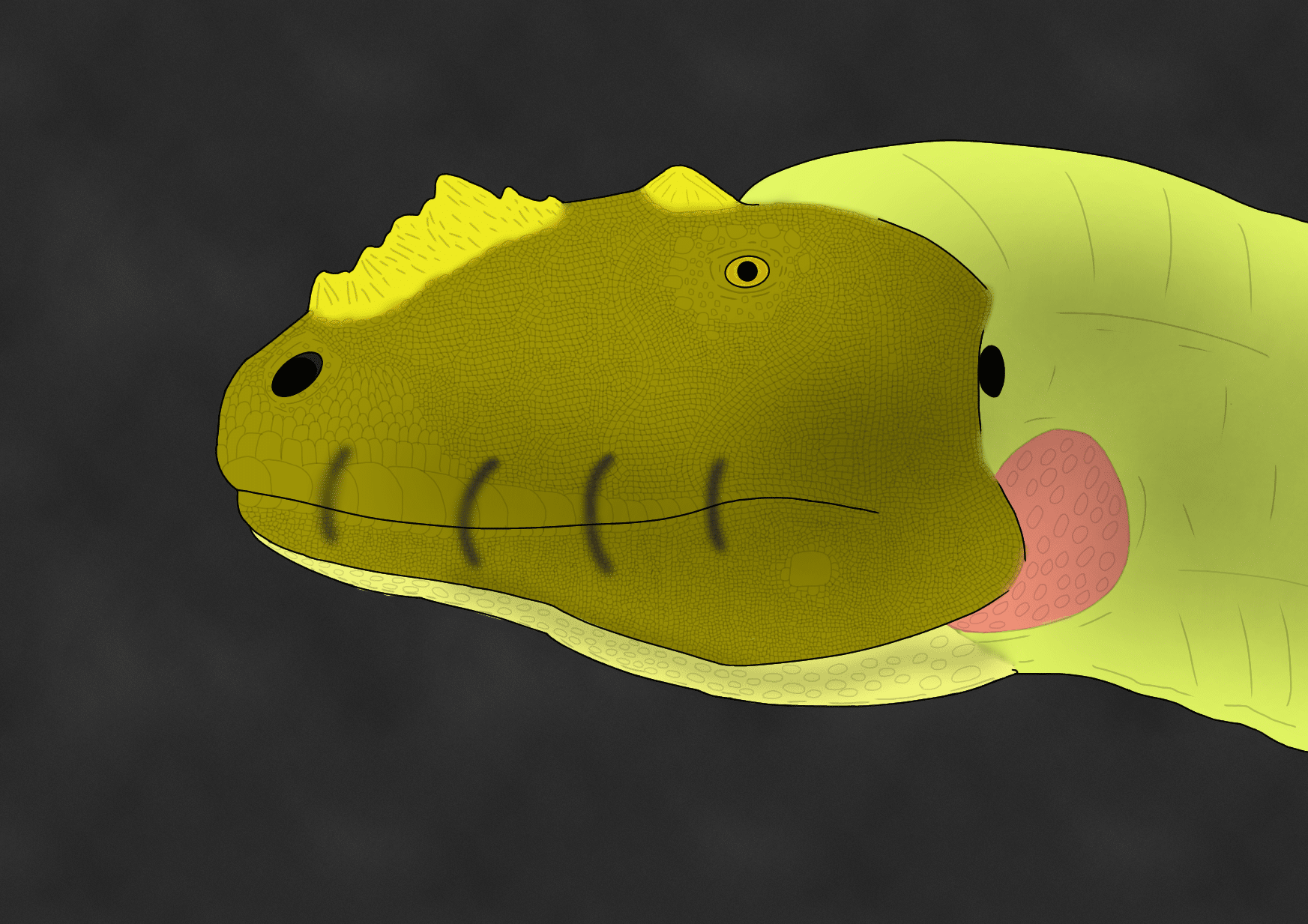
Because only part of the skeleton survives, any picture of the living animal rests on its back, hips, and legs.
Short description of Metriacanthosaurus
No skull is known, so every restoration of the head borrows from related animals. The back carried high neural spines, about two vertebral lengths tall in von Huene’s description. In his measurements, a dorsal vertebra stood 14.6 inches (37 centimeters) high, and 8.3 inches (21 centimeters) of that was spine. Its centrum (vertebral body) was 4.3 inches (11 centimeters) long, while the spine was 3.5 inches (9 centimeters) broad. Toward the tail, the broken spines of the first caudal vertebrae led von Huene to conclude that they, too, stood high and tilted backward.
The ilium is incomplete, with both its front and rear ends missing. Even so, it measures 17.7 inches (45 centimeters) from the pubic peduncle—the strut in front of the hip socket that meets the pubis—to the upper edge. Its acetabulum (hip socket) is 7.9 inches (20 centimeters) wide and 4.3 inches (11 centimeters) high. The pubic peduncle is 4.7 inches (12 centimeters) long at its front.
Below the hips, von Huene identified a separate piece, tentatively, as the pubes fused at their tips into a thick, backward-pointing hook, most of which has broken away. On the femur, the lower end of the fourth trochanter, a muscle-anchoring flange, sits 14.2 inches (36 centimeters) below the head. Further down, the tibia’s cnemial crest—a ridge at the front of the shin—projects strongly forward. The head of that tibia is 7.9 inches (20 centimeters) across. Since only bone appears in the material, any discussion of skin or soft tissue is speculative.

Size and Weight of Type Species
The Natural History Museum lists Metriacanthosaurus at about 27 feet (8.2 meters) long—roughly two small cars parked end to end. However, the museum does not say who made that estimate or how. Its height at the hips, too, has not been specified.
Body mass is likewise not specified, and without a complete skeleton, any estimate of weight must come from comparisons with better-known relatives.
The firmest number is the femur, which von Huene measured directly at 31.5 inches (80 centimeters) long. Its upper end, he noted, is “much corroded.” Even so, he called the Weymouth theropod “a rather big and heavy animal.”
The Dinosaur in Detail
What sets this dinosaur apart, at least in von Huene’s original account, is the height of its back spines. In 1923, he listed the traits that separated M. parkeri—high dorsal spines, an ilium unlike that of Megalosaurus bucklandi, and a very narrow pubis. That pubis had a large obturator foramen, an opening in the hip bone, and a thick, hooked end. He also cited a lengthwise ridge on the ischium and a strongly projecting cnemial crest.
Later work put those spines in context. In 2010, paleontologists R.B.J. Benson and J.D. Radley noted that its dorsal neural spine stands over 1.5 times the height of the centrum. However, they found the same proportion in Megalosaurus, Ceratosaurus, and Sinraptor. Tall spines, in other words, are not unique to it.
Von Huene kept it in Megalosaurus while stressing how different it was. In 1923, he judged that it “differs more from the true Megalosaurus than does M. cuvieri.” By 1926, he still kept it there, seeing “no forcing reasons to give a new generic name.” He also grouped it with M. insignis, Altispinax dunkeri, and A. oweni as a possible “branching-off line,” though he admitted this was uncertain.
Walker took the opposite view in 1964 and gave it a new genus. Even the species date remains debated. Monvoisin’s team and the Paleobiology Database credit von Huene with naming it in 1923. In contrast, the GB3D type-fossil database uses 1926, calling the 1923 description “apparently insufficient.” Taken together, Metriacanthosaurus is a family’s namesake built on a partial skeleton—one whose “entire material lacks a complete review,” as Monvoisin’s team put it.
Interesting Points about Metriacanthosaurus
- Its name means “moderately-spined lizard”—its spines were tall, about two vertebral lengths, but only half as tall, relative to the vertebrae, as those of Altispinax.
- Von Huene examined the bones in 1908, after their owner, James Parker, had them brought up from his cellar.
- The same 1964 paper that named Metriacanthosaurus also named Eustreptospondylus, although its main subject was the reptile Ornithosuchus.
- In 1923, von Huene suggested that his new high-spined genus Altispinax “apparently develops from Megalosaurus parkeri.”
Metriacanthosaurus in its Natural Habitat
The world that preserved Metriacanthosaurus was a sea floor. Today the Weymouth Member consists mostly of pale gray, blocky, calcareous mudstones, with large Gryphaea oysters and pyritized ammonites. Likewise, the Paleobiology Database records the holotype site as marine claystone, with the oyster Gryphaea dilatata in the same collection. At that time, according to Monvoisin and colleagues, Europe was an archipelago in the Tethys Sea.
The Natural History Museum lists Metriacanthosaurus as a carnivore. With no skull or teeth preserved, however, its prey and feeding style remain unknown. Monvoisin’s team noted that dinosaur remains in such marine deposits came from carcasses floating out from the nearest land. Citing earlier work, they named the London–Brabant Massif as the supposed source of Oxford Clay dinosaurs.
While there is no direct evidence of its social life, a single partial skeleton cannot show whether it lived alone or in groups. Drawing on work by Allain (2005) and Rauhut and colleagues (2016), Monvoisin’s team suggested that megalosauroids may have favored nearshore settings and allosauroids inland ones. This idea concerns the groups as a whole, but it could help explain why allosauroids are rare in the European archipelago. For now, the best clues to the life of Metriacanthosaurus come from its hips and legs—and from the mud that held them.
Frequently Asked Questions
It means “moderately-spined lizard,” and the species name parkeri comes from the collection of James Parker.
It lived in the Oxfordian stage of the Late Jurassic, roughly 161.5 to 159 million years ago.
The Natural History Museum estimates a length of about 27 feet. Its thigh bone measures 31.5 inches long.
It is listed as a carnivore, but no skull or teeth are known that could show what it ate.
Its bones come from Jordan (Furzy) Cliff near Weymouth, Dorset, in the Weymouth Member of England’s Oxford Clay Formation.
It gives its name to the family Metriacanthosauridae, yet its only skeleton is partial and has never been fully described.
Sources
The information in this article is based on various sources, drawing on scientific research, fossil evidence, and expert analysis. The aim is to provide a comprehensive and accurate overview of Metriacanthosaurus. However, please be aware that our understanding of dinosaurs and their world is constantly evolving as new discoveries are made.
- https://archive.org/details/sim_geological-society-of-america-bulletin_1923_34
- https://publicaciones.fcnym.unlp.edu.ar/rmlp/article/view/1393
- https://doi.org/10.1098/rstb.1964.0009
- https://sciencepress.mnhn.fr/en/periodiques/geodiversitas/44/12
- https://archive.org/details/cu31924004667436
- https://www.app.pan.pl/archive/published/app55/app20090083.pdf
- https://academic.oup.com/zoolinnean/article/doi/10.1093/zoolinnean/zlae090/7731071
- https://paleobiodb.org/classic/basicTaxonInfo?taxon_no=38584
- https://www.3d-fossils.ac.uk/fossilType.cfm?typSampleId=15000859
- https://webapps.bgs.ac.uk/lexicon/lexicon.cfm?pub=WEY
- https://webapps.bgs.ac.uk/lexicon/lexicon.cfm?pub=OXC
- https://www.nhm.ac.uk/discover/dino-directory/metriacanthosaurus.html
This article was last fact checked: TheDinosaurs Team, 02-11-2026
Featured Image Credit: FunkMonk, CC BY-SA 3.0, via Wikimedia Commons
