
Northeast of Henrieville in southern Utah, the river-laid rocks of the Kaiparowits Formation hold a tyrannosaur with an unusually short face. Named Teratophoneus curriei in 2011, it lived in the late Campanian—roughly 76.5 to 75.5 million years ago. Its describers called it the most basal North American tyrannosaurine, placing it near the root of the subfamily that also contains Tyrannosaurus. Later studies, however, have reshuffled that placement more than once.
The first bones were known by 1981, when a newspaper article described the site, yet no available source names the finder. In 2011, paleontologist Thomas D. Carr and three colleagues named the animal from a partial skull and skeleton. Later finds from the same formation include an articulated skeleton and a bonebed holding several individuals of different ages. Together, these finds offer a rare glimpse of how a southern tyrannosaur may have grown and lived.
Teratophoneus Key Facts
| Keyword | Fact |
|---|---|
| Pronunciation | Not specified |
| Meaning of name | Monstrous Murderer |
| Group | Theropoda |
| Type Species | Teratophoneus curriei |
| Diet | Carnivore |
| When it Lived | 76.5 to 75.5 MYA |
| Period | Cretaceous |
| Epoch | Late Cretaceous (Campanian stage) |
| Length | About 24.9 feet (7.6 meters) for an articulated, still-undescribed skeleton, with the largest provisionally referred (cf. Teratophoneus) bonebed individual estimated at about 28.5 feet (8.7 meters) |
| Height | Not specified |
| Weight | About 1,470 pounds (667 kilograms) in 2011, revised to about 2,180 pounds (989 kilograms) in 2021, both for a subadult |
| Mobility | Moved on two legs (bipedal) |
| First Discovery | Year not specified (known by 1981) |
| Described by | 2011 by T.D. Carr, T.E. Williamson, B.B. Britt, and K. Stadtman |
| Holotype | BYU 8120 |
| Location of first find | Middle unit of the Kaiparowits Formation, probably “The Blues” northeast of Henrieville (placed from a 1981 newspaper report), Grand Staircase-Escalante National Monument, southern Utah, USA |
Teratophoneus Origins, Taxonomy and Timeline
The name Teratophoneus has a fittingly dramatic ring. In 2011, Smithsonian magazine reported that it roughly translates as “monstrous murderer.” The Natural History Museum of Utah gives the same meaning. Together, the name casts the animal as a fearsome predator—even though the specimen behind it was not yet fully grown.
In terms of classification, Teratophoneus belongs to Theropoda and, within it, to the tyrannosaur family Tyrannosauridae. More specifically, it sits in Tyrannosaurinae—the branch of tyrannosaurids that includes Daspletosaurus and Tyrannosaurus. Carr and colleagues originally made it the sister taxon, or closest relative, of the group formed by those two giants. Teratophoneus curriei is the type and only known species.
The original paper dated the beds to the late Campanian, while news reports at the time spoke of 75-million-year-old rock. In 2013, Loewen and colleagues then constrained the specimens with volcanic ash layers dated to 76.46 and 75.51 million years ago. Later, Ramezani and colleagues placed the formation’s middle unit between about 76.6 and 75.4 million years ago. Taken together, these dates put Teratophoneus roughly 76.5 to 75.5 million years ago, deep in the Late Cretaceous.
Discovery & Fossil Evidence
The holotype came from the middle unit of the Kaiparowits Formation in Grand Staircase-Escalante National Monument. Lacking exact locality data, Loewen’s team placed the site in “The Blues” exposures using that 1981 newspaper article—a probable spot, not a confirmed one.
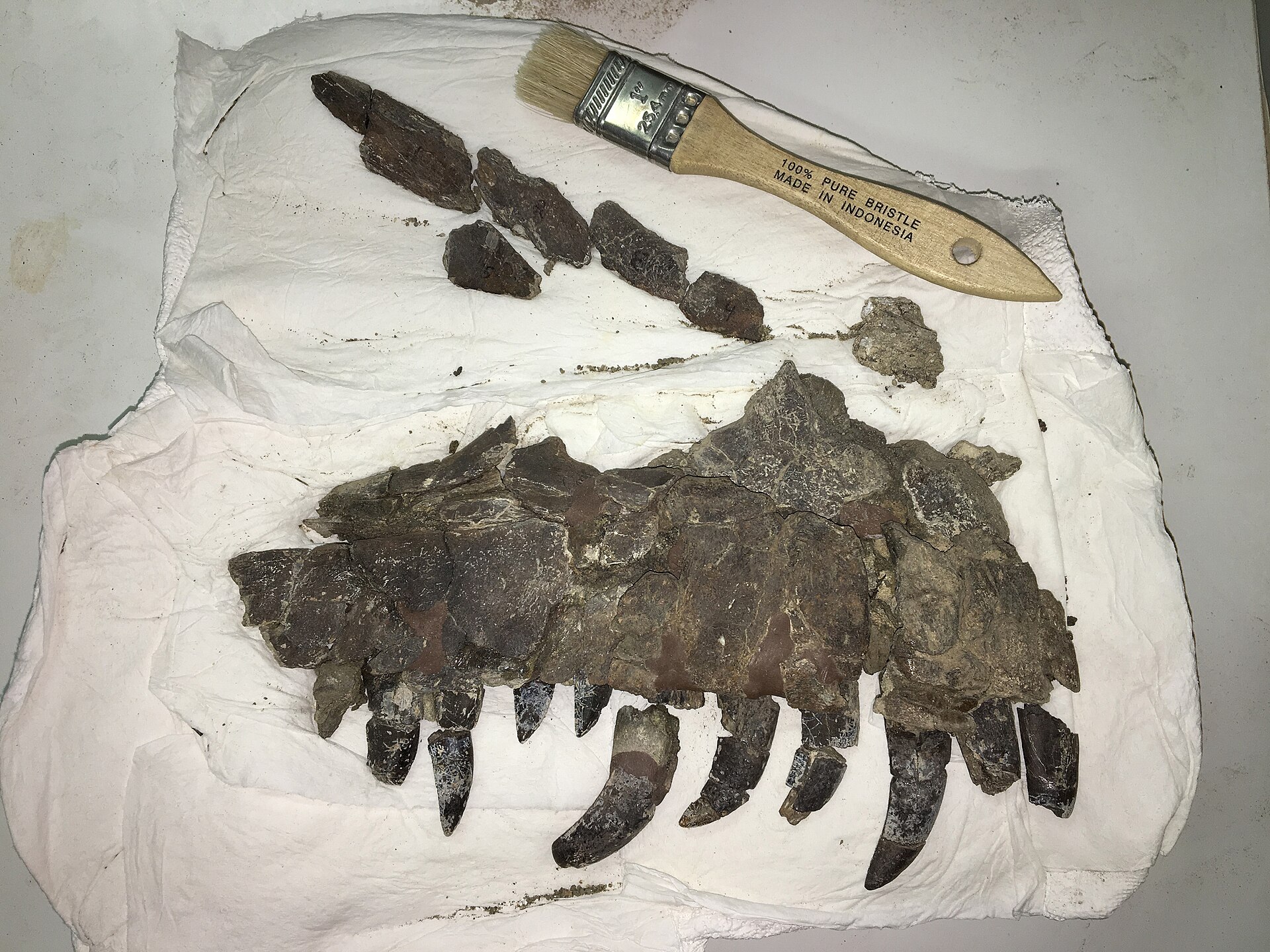
Catalogued as BYU 8120, the holotype is housed at the Brigham Young University Museum of Paleontology in Provo. Its bones carry several catalogue numbers, but Loewen’s team stated in 2013 that they belong to a single individual. The original description called it “an incomplete skull and postcranial skeleton”—the postcranium being everything behind the head. Measured skull bones range from the maxilla (upper jaw), jugal (cheek bone), and dentary (lower jaw) to the skull roof and braincase. Behind the head, they include a neck and a tail vertebra, the scapula (shoulder blade), humerus (upper arm), and femur (thigh bone).
Loewen’s team also described a second subadult, UMNH VP 16690, which Jelle Wiersma found near Horse Mountain. Lying about 950 feet (290 meters) up the formation, it preserves most of the skull and backbone. The pelvis and part of a hind limb survive too. In addition, an isolated jugal, UMNH VP 16691, shares a unique roughened patch with the holotype’s cheek bone. Later, Titus and colleagues mentioned an articulated skeleton, UMNH VP 21100, which was still undescribed in 2021.
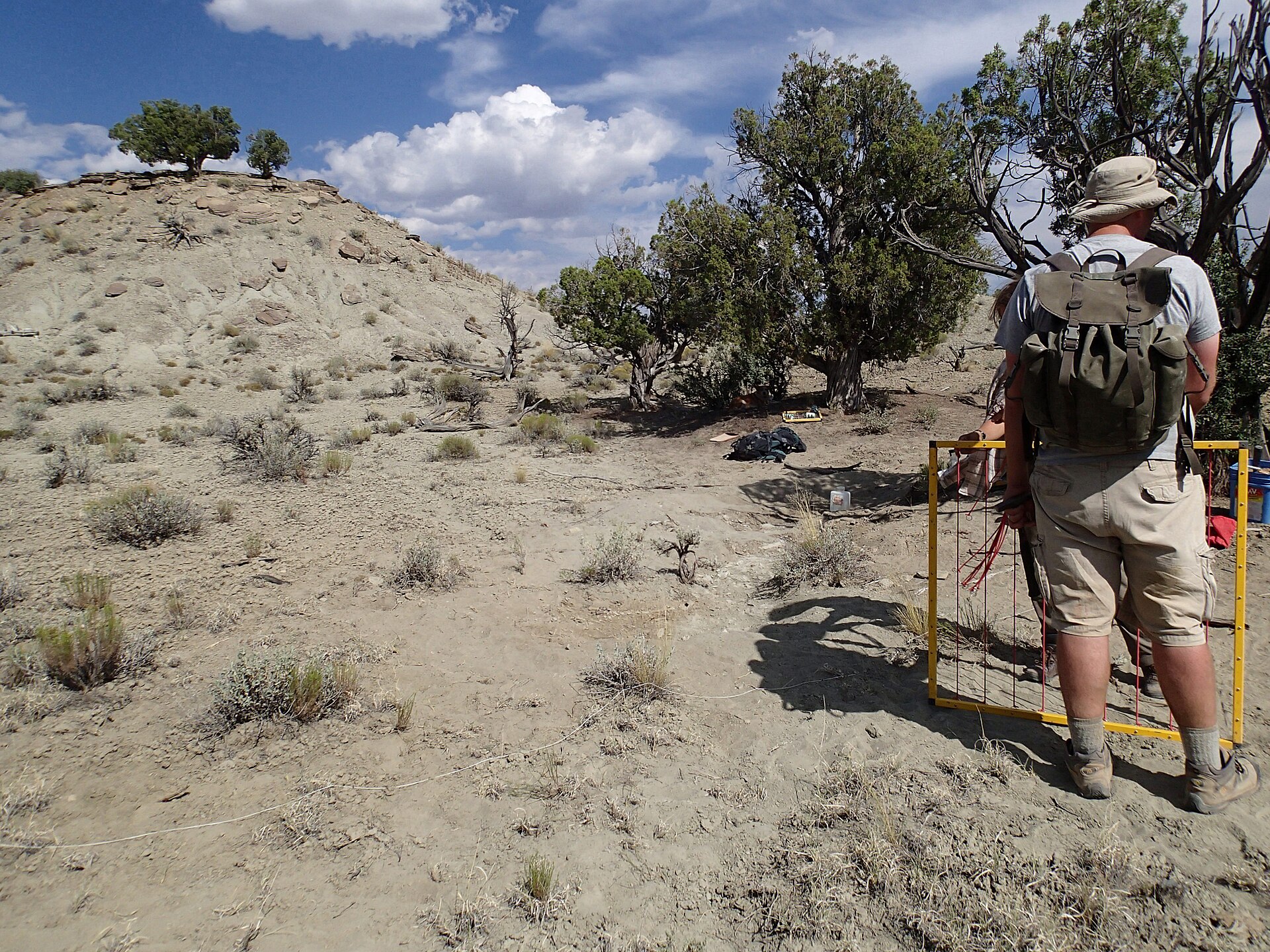
Most striking of all is the “Rainbows and Unicorns Quarry.” In July 2014, paleontologist Alan Titus found tyrannosaurid bone there with two colleagues. Lying 454 feet (138.5 meters) above the base, the bonebed holds at least four tyrannosaurids—two juveniles, a subadult, and a presumed adult. In 2021, Titus and colleagues referred them all to cf. Teratophoneus curriei—”cf.” marking a provisional identification. Thus, the holotype, the referred specimens, and the quarry individuals all come from the Kaiparowits Formation.

Teratophoneus Size and Description
A short skull set Teratophoneus apart from the start, and later skeletons have since filled in much of its body.
Short description of Teratophoneus
The original diagnosis listed a short, steep maxilla, an abruptly angled cheek bone behind the eye, and sideways-pointing struts at the back of the skull. It also noted a short basicranium (braincase floor) and a reduced number of teeth. Like other tyrannosaurids, it had a short snout—under 0.65 of total skull length—and a broad skull, according to Loewen and colleagues. Overall, they found its skull closer to those of more basal tyrannosaurids, with only a modestly expanded rear.
Behind the head, the skeleton resembled those of other tyrannosaurids in overall form. Its neck vertebrae, however, bore neural spines (upper bony projections) taller than the face of each vertebral body. The holotype’s humerus measures just 9.5 inches (241.9 millimeters), against a femur of 29.8 inches (757 millimeters).

Size and Weight of Type Species
Titus and colleagues reported that UMNH VP 21100, the only known articulated skeleton, measures 24.9 feet (7.6 meters) from snout to tail. By scaling from that skeleton, they estimated the largest quarry individual at about 28.5 feet (8.7 meters). Still, they cautioned that treating that animal as a full adult is speculation.
Weight estimates, by contrast, rest on the holotype’s femur. According to Yun in 2021, Carr’s team estimated about 1,470 pounds (667 kilograms) without giving a method. Yun then recalculated from the femur’s 10.5-inch (266-millimeter) circumference, arriving at about 2,180 pounds (989 kilograms), give or take 25 percent. Both figures describe a subadult rather than a fully grown animal.
The quarry also offers a rough sense of growth. One animal there, about 40 percent the size of the largest, had a femur 22 inches (560 millimeters) long. Titus and colleagues suggested it was about six years old, if it grew like other tyrannosaurids.
The Dinosaur in Detail
What sets this dinosaur apart is a pair of skull details that Loewen and colleagues identified in 2013 as autapomorphies—traits unique to a single species. First, the maxillary fenestra, an opening in the snout, sits unusually far back within its hollow. Second, a raised, roughened patch marks the cheek bone where it met the quadratojugal (a rear skull bone).
Teeth, however, tell a more tangled story. Loewen’s team counted 11 tooth sockets in the upper jaw, a count shared only with Bistahieversor and Lythronax. In contrast, Titus and colleagues described the 13 sockets in the quarry maxillae as typical of southern tyrannosaurids such as Teratophoneus. Yun’s study of a cast and scan found a narrow nasal process on the holotype’s frontal, as in derived tyrannosaurines. Yun also found no support for Gregory Paul’s 2016 claim that the rear skull rivaled T. rex in breadth.
Its family tree has shifted more than once. Carr’s team placed it just outside the Daspletosaurus plus Tyrannosaurus clade, a sign that tyrannosaurine skulls varied widely. In contrast, Loewen’s 2013 analysis made Lythronax, Bistahieversor, and Teratophoneus successive sister groups to Tarbosaurus and Tyrannosaurus—closer to them than to Daspletosaurus. In 2016, Brusatte and Carr linked it to Alaska’s Nanuqsaurus in one analysis, while another left it poorly resolved. A year later, Carr and colleagues found Lythronax, Teratophoneus, and Nanuqsaurus in an unresolved three-way split. In 2022, Warshaw and Fowler again found it unresolved—this time alongside Lythronax and Dynamoterror.
In his 2016 popular field guide, Paul went further and folded Teratophoneus into Tyrannosaurus itself. According to Yun, however, studies from 2017 to 2020 did not accept that synonymy and kept Teratophoneus as a valid genus. Taken together, the evidence points to a distinctive, short-faced tyrannosaurine whose exact branch on the family tree remains open.
Interesting Points about Teratophoneus
- The holotype was known by 1981 but went unnamed until 2011, although Carr had described it in his unpublished 2005 doctoral thesis.
- Its describers argued that Teratophoneus suggests western dinosaur faunas were regionally endemic, or confined to their own regions, during the late Campanian.
- The Rainbows and Unicorns Quarry offers the first chance to study possible group living in a tyrannosaur unique to southern Laramidia, a western landmass.
- Loewen and colleagues’ 2013 biogeographic analysis traced the Teratophoneus lineage to a dispersal from northern Laramidia into the south.
- On October 15, 2017, a helicopter airlifted a tyrannosaur skeleton from the monument, which the Natural History Museum of Utah called likely Teratophoneus.
Contemporary Dinosaurs
Sharing the Kaiparowits floodplain was Kosmoceratops, a chasmosaurine ceratopsid (horned dinosaur) with what its describers called the most ornate skull of any known dinosaur. Sampson and colleagues reported it from the lower and middle units, in sediments dated to about 76.4 to 75.5 million years ago. That overlaps the time and rock unit of Teratophoneus, although no fossil records any contact between the two.
Alongside it lived Utahceratops gettyi, a second chasmosaurine with short, rounded brow horns that jutted sideways and an elongate frill. Sampson’s team found that their stratigraphic ranges overlap considerably, indicating the two horned dinosaurs were contemporaries. Utahceratops, too, shared the landscape with Teratophoneus—with no interaction on record.
Among the duck-billed dinosaurs was Gryposaurus monumentensis, a saurolophine hadrosaurid with a more robust skull than other Gryposaurus species. Gates and Sampson named it in 2007 from the Kaiparowits Formation. Later, Zanno and colleagues listed it in the same fauna as Teratophoneus. Moreover, one Gryposaurus skeleton lies about 623 feet (190 meters) up, within the levels that yielded Teratophoneus fossils.
Rounding out the group was Talos sampsoni, a troodontid—a small, sickle-clawed theropod. It came from the middle unit, about 853 feet (260 meters) above the base, in “The Blues.” That is the same named exposure area that yielded the Teratophoneus holotype, although no evidence connects the two animals directly.
Teratophoneus in its Natural Habitat
The world Teratophoneus roamed was a low-relief alluvial plain laced with stream channels, levees, ponds, and lakes. These river and floodplain deposits stack up about 3,300 feet (1,005 meters) thick. Sediment also piled up fast—about 1,220 feet (372 meters) per million years. Titus and colleagues describe a humid, tropical to subtropical wet-dry setting, whereas Ramezani’s team called it warm and subhumid. The basin lay at roughly 45 degrees north on Laramidia, a landmass under 20 percent the size of modern North America. To the east, the Western Interior Seaway separated it from Appalachia.
Like other tyrannosaurids, Teratophoneus was a carnivore, and Yun describes the family as a group of gigantic carnivorous dinosaurs. While there is no direct evidence of its diet, its meat-eating habits are inferred from the family it belongs to.
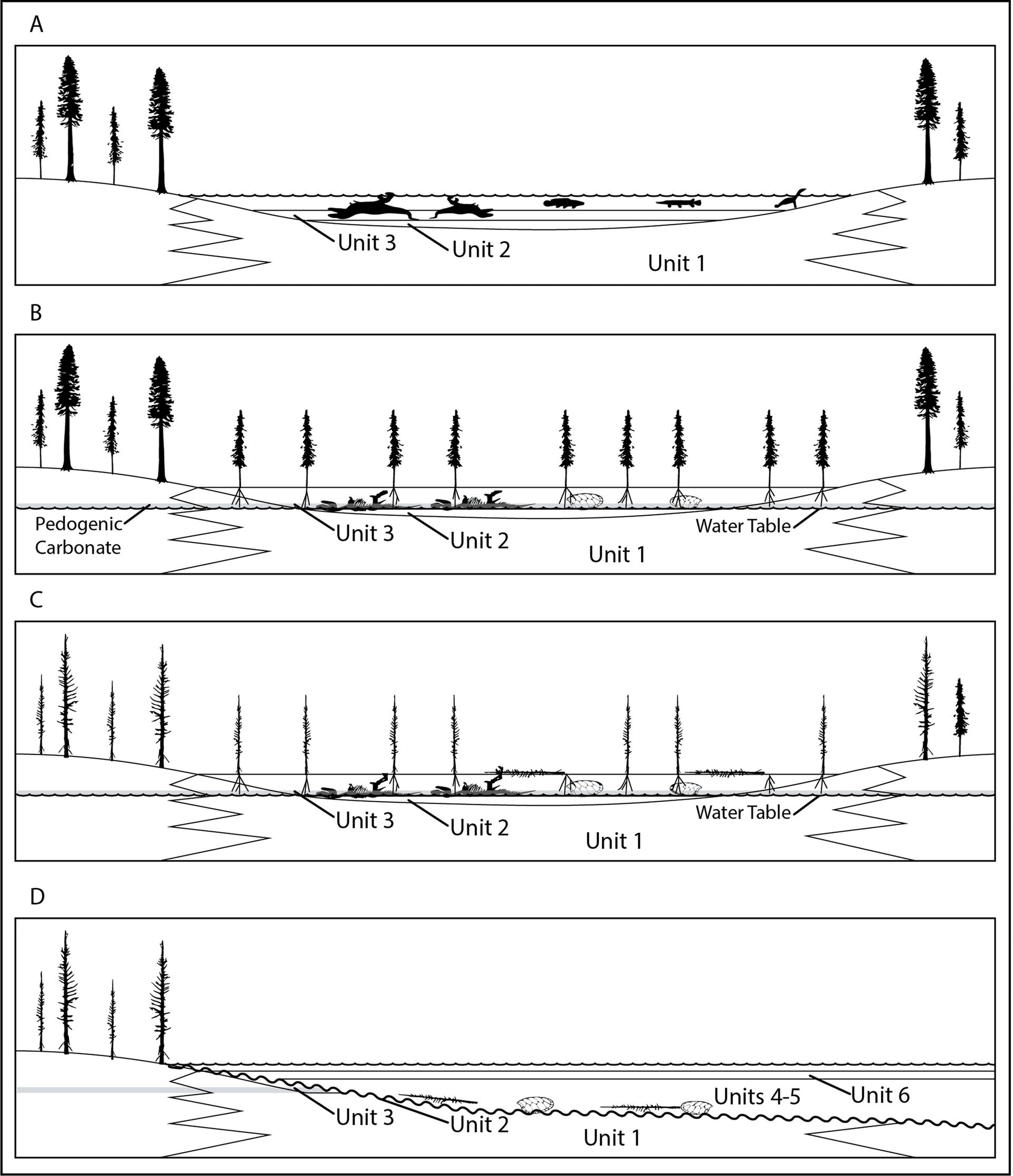

The quarry itself was a probable oxbow lake, with conifer charcoal in its main bone layer. Titus and colleagues suggested that its mass burial could reflect habitual gregariousness—living in groups—among tyrannosaurids. They preferred flooding as the cause of death and burial and considered toxicosis and fire much less likely. Even so, they could not tell whether the animals died together or were carried in from separate places over a short span. Still, the bones show their deaths were not widely separated in time.
Frequently Asked Questions
News and museum sources translate it as “monstrous murderer.”
It lived about 76.5 to 75.5 million years ago, during the Campanian stage of the Late Cretaceous.
An articulated, still-undescribed skeleton is about 24.9 feet (7.6 meters) long, and the largest provisionally referred individual is estimated at about 28.5 feet (8.7 meters). The subadult holotype is estimated at about 1,470 to 2,180 pounds (667 to 989 kilograms).
It was a carnivore, a diet inferred from its place among the tyrannosaurids.
Its fossils come from the Kaiparowits Formation in Grand Staircase-Escalante National Monument, southern Utah.
It had a short skull, plus two features of the snout and cheek bone that are unique to this species.
Sources
The information in this article is based on various sources, drawing on scientific research, fossil evidence, and expert analysis. The aim is to provide a comprehensive and accurate overview of Teratophoneus. However, please be aware that our understanding of dinosaurs and their world is constantly evolving as new discoveries are made.
- https://doi.org/10.1007/s00114-011-0762-7
- https://static-content.springer.com/esm/art%3A10.1007%2Fs00114-011-0762-7/MediaObjects/114_2011_762_MOESM1_ESM.doc
- https://doi.org/10.1371/journal.pone.0079420
- https://doi.org/10.1038/srep20252
- https://doi.org/10.1038/srep44942
- https://doi.org/10.7717/peerj.11013
- https://doi.org/10.35463/j.apr.2022.01.06
- https://doi.org/10.1038/s41598-022-19896-w
- https://doi.org/10.1371/journal.pone.0012292
- https://doi.org/10.1371/journal.pone.0024487
- https://doi.org/10.7717/peerj.5016
- https://doi.org/10.1111/j.1096-3642.2007.00349.x
- https://doi.org/10.7717/peerj.14461
- https://www.smithsonianmag.com/science-nature/teratophoneus-utahs-monstrous-murderous-new-tyrannosaur-93169649/
- https://nhmu.utah.edu/articles/utah-tyrannosaur-discovered-after-76-million-year-slumber
This article was last fact checked: TheDinosaurs Team, 03-11-2026
Featured Image Credit: BLMUtah, Public domain, via Wikimedia Commons
