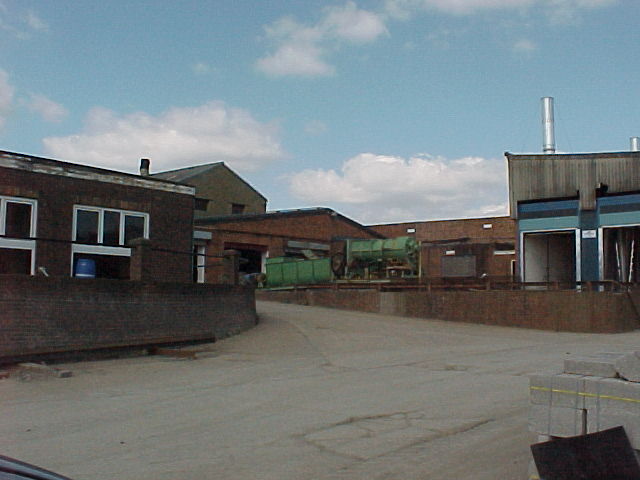
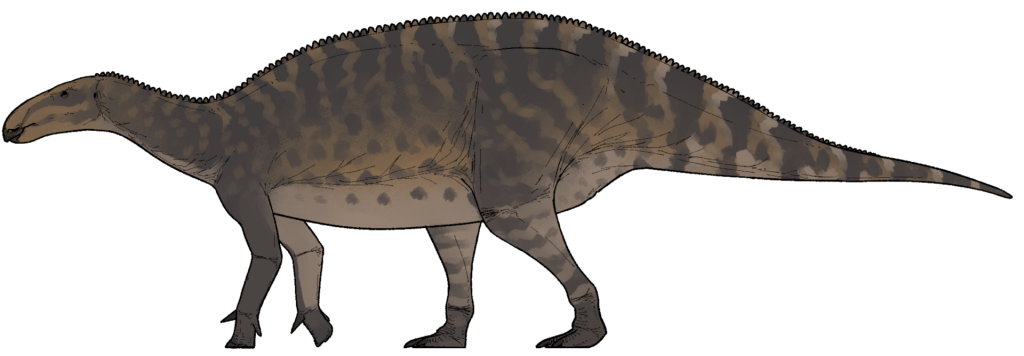
At Smokejacks Brickworks in Surrey, southern England, the dark mudstones of the Weald Clay Formation hold a long-overlooked plant-eater. Named Paludohadros proudlovii in 2026, it was an early-diverging hadrosauroid—an early branch of the lineage that led to the duck-billed dinosaurs. It lived during the Barremian stage of the Early Cretaceous, about 125 million years ago. Its describers call it the only valid iguanodontian—a member of the plant-eating group named after Iguanodon—reported so far from the Barremian Weald Clay.
After leaving the brickworks clay in 2001, the bones sat for years at the Natural History Museum in London. Press coverage says iguanodontian finds from southern England were long classified as Iguanodon or its smaller relative Mantellisaurus. According to the same coverage, a 2023 museum restudy of Mantellisaurus prompted a fresh look. In 2026, paleontologist Ricardo Sacamoto and six colleagues named the bones as a new genus and species in the Journal of Systematic Palaeontology. Their story shows that a museum collection can still hold a species nobody has named.
Paludohadros Key Facts
| Keyword | Fact |
|---|---|
| Pronunciation | Not specified |
| Meaning of name | From the Latin palus (“swamp”), according to press coverage |
| Group | Ornithischia (early-diverging hadrosauroid) |
| Type Species | Paludohadros proudlovii |
| Diet | Herbivore |
| When it Lived | Around 125 MYA |
| Period | Cretaceous |
| Epoch | Early Cretaceous (Barremian stage) |
| Length | About 16 feet (5 meters) for the juvenile specimen, Natural History Museum estimate |
| Height | Not specified |
| Weight | About 3,300 to 4,400 pounds (1.5 to 2 metric tons) for the juvenile specimen, Natural History Museum estimate |
| Mobility | Not specified |
| First Discovery | 2001 for the described specimen (excavator not named). Press reports say material collected as early as the 1950s has also been referred |
| Described by | 2026 by R.J. Sacamoto, J.A.F. Lockwood, M.C. Langer, B. Clark, P.M. Barrett, A. Turner, and S.C.R. Maidment |
| Holotype | Not specified (fossils held at the Natural History Museum, London) |
| Location of first find | Smokejacks Brickworks, Weald Clay Formation, Surrey, England, United Kingdom |
Paludohadros Origins, Taxonomy and Timeline
Press coverage says the genus name draws on the Latin palus, “swamp,” after the wetlands of the time. News reports also say the species name proudlovii honors the late Will Proudlove, a former manager of the site, who died at 35 shortly before the excavation. His family received an invitation to watch the dig in 2001. Together, the name ties the animal to its marshy world and to the works where it was found.
Paludohadros was an ornithischian and, more specifically, an iguanodontian. Within that group, Sacamoto and colleagues place it among the early-diverging hadrosauroids rather than with the hadrosaurids, the duck-billed dinosaurs proper. Their analysis drew 323 characters from Poole’s 2022 matrix and rescored Cumnoria and the Mantellisaurus holotype after 2023 studies. Paludohadros proudlovii is the type and only known species.
The describers date the animal to the Barremian stage. The International Commission on Stratigraphy places that stage at roughly 125.8 to 121.4 million years ago. In 1997, paleontologists Alan Charig and Angela Milner, citing Ross and Cook, described the Smokejacks exposure as 23 meters of early Barremian Upper Weald Clay. Press accounts round the age of Paludohadros to about 125 million years. At that time, this corner of England was a low, wet landscape of rivers or mudplains, lagoons, and marsh.
Discovery & Fossil Evidence
Smokejacks Brickworks lies at Wallis Wood, Ockley, near Dorking in Surrey. Its pit is one of the British Geological Survey’s reference sections for the Weald Clay Formation. News reports now call the site the Ewhurst brick and roof-tile works. In 2001, a partial skeleton came out of the clay there. Senior author Susannah Maidment, a paleontologist, has said it lay just 100 meters (330 feet) from where the spinosaurid Baryonyx turned up in 1983.

The full description is not openly available, so this article cannot give the holotype number or describe the anatomy beyond the abstract. Still, that abstract reveals which bones the diagnosis rests on—dentary (lower jaw) teeth, the surangular (a rear lower-jaw bone), and the humerus (upper arm bone). The ischium (a rear hip bone) and the tibia (shin bone) complete the list. Press photographs also show skull bones attributed to Paludohadros.
According to news reports, researchers now also assign fossils collected as early as the 1950s to Paludohadros. Those reports give no catalog numbers, however, so the full extent of the referred material remains unclear.
Paludohadros Size and Description
Every figure below describes a youngster, because the bones come from an animal that had not finished growing.
Short description of Paludohadros
Because the abstract lists only diagnostic details, a full head-to-tail portrait is not yet possible. Its dentary crowns bore two secondary ridges and a variable number of accessory ones on the lingual (tongue-facing) side. Meanwhile, the surangular had an upward-projecting lateral process, offset to the side of the bone’s front process.
In the arm, a ridge on the humerus’s inner front face ran up from the distal condyle—the rounded elbow joint. The ischium had a shaft curving down and back to a well-developed “boot.” An oblique crest also ran above its obturator process (a flange on the upper shaft) on the outer face. Lower down the leg, the tibia carried bosses—small knobs—on both sides near the knee.
Whether Paludohadros walked on two legs or four has not yet been reported. The science magazine Nautilus reported that, like its iguanodontian relatives, it had thumb spikes. However, the abstract lists no hand bones, so the described fossils do not yet confirm that detail.
Size and Weight of Type Species
The Natural History Museum estimates that the described individual was about 16 feet (5 meters) long. It puts the weight at roughly 1.5 to 2 metric tons (3,300 to 4,400 pounds). Press coverage likened that to the size of a rhinoceros.
These figures come from press coverage rather than the paper, and no hip height has been published.
The researchers noted that the bones did not appear fully developed or fused—a sign the animal was still growing. According to the museum, an adult could potentially have reached twice that size, although adult size remains unknown.

The Dinosaur in Detail
What sets this dinosaur apart is an unranked set of features in the teeth, jaw, arm, hip, and shin.
The describers also set it against older iguanodontians from the same Weald Sub-basin. Barilium dawsoni, Hypselospinus fittoni, and Kukufeldia tilgatensis all come from Valanginian strata—an earlier stage of the Early Cretaceous. In contrast, the iguanodontians of the Wessex Formation on the Isle of Wight are broadly contemporaneous but belong to different taxa. That difference led Sacamoto and colleagues to suggest that the two formations may have formed at slightly different times.
In the describers’ analysis, Paludohadros pairs with Istiorachis from the Wessex Formation itself, according to the open supplementary file. The Chinese Xuwulong branches off next, then Kukufeldia, and all of them sit well outside the hadrosaurids. Since the species was named in October 2026, no published study has questioned it. Taken together, these details describe a young plant-eater with a distinctive skeleton—one that sits among the early branches of the hadrosauroid family tree.
Interesting Points about Paludohadros
- Press coverage says the genus name comes from the Latin palus, “swamp,” a nod to southern England’s Early Cretaceous wetlands.
- Dug up in 2001, its bones waited years in the museum before researchers named them in 2026.
- It turned up about 100 meters from the spot where Baryonyx was found in 1983, at the same Surrey brickworks.
- In the describers’ analysis, its closest relative is Istiorachis, an iguanodontian from the Wessex Formation of the Isle of Wight.
- Its describers call it the only valid iguanodontian taxon yet reported from the Barremian Weald Clay Formation.
Dinosaurs from the Same Formation
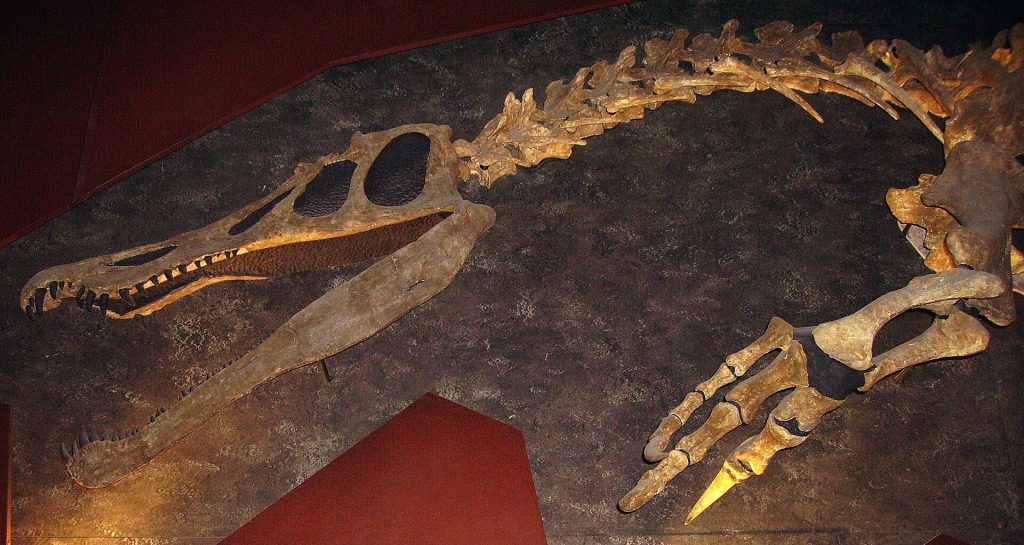
Also known from the Weald Clay Formation (exact level relative to Paludohadros not known): Baryonyx walkeri and Polacanthus rudgwickensis. Baryonyx was a large theropod with a spatulate (spoon-tipped) snout and huge hand claws. Charig and Milner placed its holotype in the Upper Weald Clay at Smokejacks, near the base of the Barremian. Polacanthus rudgwickensis, an armored ankylosaur, comes from Barremian Weald Clay at Rudgwick, West Sussex, according to Blows and Honeysett. It has since been placed by some in its own genus, Horshamosaurus. However, in 2020, Raven and colleagues judged that name a nomen dubium—one that rests on remains too incomplete to diagnose.
The formation spans the Hauterivian and Barremian stages—up to about 11 million years—so these animals may not all have lived at the same time. Because Charig and Milner described the whole Smokejacks exposure as early Barremian, however, any gap at that site may be much smaller.

Paludohadros in its Natural Habitat
The world of the Smokejacks fossils lay near a sub-tropical delta, according to Charig and Milner. Following Ross and Cook, they pictured a river or mudplain setting with shallow water, lagoons, and marsh. Ferns such as Weichselia reticulata grew there with horsetails, club mosses, conifers, and the aquatic or marsh herb Bevhalstia pebja. Still, the plants, animals, and conditions varied significantly from one level of the sequence to the next.
While there is no direct evidence of what this herbivore ate, the local ferns and horsetails may have featured on its menu. Its ridged teeth form part of its diagnosis, although the abstract does not tie them to any particular food.
Life crowded these wetlands. The pit has yielded insects from ten orders, along with ostracods (tiny shelled crustaceans), isopods (relatives of woodlice), conchostracans (clam shrimp), and bivalves. Sharks, bony fishes such as Scheenstia mantelli (formerly Lepidotes mantelli), crocodiles, and pterosaurs completed the scene. A very few isolated bones of small sauropods also come from the site.
Charig and Milner also reported a considerable quantity of iguanodontian bones from the pit, assigned at the time to Iguanodon atherfieldensis. Fragments assigned to Iguanodon bernissartensis came from a higher level. How the 2026 study treats these older finds has not been reported. In the Baryonyx holotype’s stomach region, Charig and Milner found acid-etched fish scales and teeth, plus bones of a young iguanodontian that they identified as Iguanodon. Maidment has said nobody can tell for certain which species those bones came from. She has suggested that Baryonyx may have scavenged young Paludohadros or even hunted them. That idea remains speculation, though—no evidence ties the stomach bones to Paludohadros.
Frequently Asked Questions
Press coverage says the genus name draws on the Latin palus, “swamp,” while proudlovii honors former site manager Will Proudlove.
It lived in the Barremian stage of the Early Cretaceous, about 125 million years ago.
The Natural History Museum estimates the juvenile specimen was about 16 feet long and weighed about 3,300 to 4,400 pounds.
It was an early-diverging hadrosauroid, a plant-eating iguanodontian within Ornithischia.
Its fossils come from the Weald Clay Formation at Smokejacks Brickworks in Surrey, southern England.
Its describers say it is the only valid iguanodontian reported so far from the Barremian Weald Clay. Distinctive features of its teeth, jaw, arm, hip, and shin set it apart.
Sources
The information in this article is based on various sources, drawing on scientific research, fossil evidence, and expert analysis. The aim is to provide a comprehensive and accurate overview of Paludohadros. However, please be aware that our understanding of dinosaurs and their world is constantly evolving as new discoveries are made.
- https://doi.org/10.1080/14772019.2026.2726221
- https://doi.org/10.6084/m9.figshare.34799934
- https://ndownloader.figshare.com/files/70701120
- https://api.crossref.org/works/10.1080/14772019.2026.2726221
- https://archive.org/download/biostor-110558/biostor-110558.pdf
- https://webapps.bgs.ac.uk/lexicon/lexicon.cfm?pub=WC
- https://stratigraphy.org/ICSchart/ChronostratChart2024-12.pdf
- https://openaccess.city.ac.uk/id/eprint/3610/
- https://doi.org/10.1080/02724634.2020.1826956
- https://library.naturalsciences.be/pdfs-open-access/2019/Cavin_et_al_2019-Scheenstia-bernissartensis.pdf/view
- https://www.sci.news/paleontology/paludohadros-proudlovii-15156.html
- https://discoverwildlife.com/dinosaurs/paludohadros-proudlovii-discovery
- https://www.openaccessgovernment.org/?p=215933
- https://nautil.us/spike-thumbed-dino-discovered-in-the-united-kingdom-1286098/
- https://www.sciencenewstoday.org/this-125-million-year-old-dinosaur-may-have-grown-twice-as-large-as-the-fossil-found-in-england
- https://techyorker.com/new-dinosaur-paludohadros-proudlovii-discovered-at-surrey-brickworks/
- https://dailygalaxy.com/2026/11/english-clay-quarry-bones-unknown-dinosaur/
- https://a-z-animals.com/blog/a-new-dinosaur-sat-in-a-london-museum-for-25-years-mislabeled-as-iguanodon/
This article was last fact checked: TheDinosaurs Team, 18-11-2026
Featured Image Credit: Guilherme Gehr in Sacamoto et al., CC0, via Wikimedia Commons
