
Near Zhucheng, in China’s Shandong Province, the Late Cretaceous rocks of the Wangshi Group hold a wealth of dinosaur bones—in 2008, a single pit there yielded some 7,600 fossils in just seven months. Among them is Sinoceratops zhuchengensis, a horned dinosaur from rocks now assigned to the Hongtuya Formation. It lived sometime between about 77 and 73.5 million years ago, during the Campanian stage. When it was named in 2010, its describers called it the only known ceratopsid—the family of large horned dinosaurs—from outside North America. Later studies still treat it as the one undisputed exception.
Field crews dug its bones out of the Zangjiazhuang quarry in 2008. Two years later, paleontologist Xu Xing and three colleagues described the animal in the Chinese Science Bulletin. Only parts of the skull are documented, yet they show a surprising blend of features. In the describers’ view, this horned face blurred the line between the two great branches of its family. It also showed how strongly patchy fossil sampling shapes our map of dinosaur history.
Sinoceratops Key Facts
| Keyword | Fact |
|---|---|
| Pronunciation | Not specified |
| Meaning of name | Chinese Horned Face from Zhucheng City |
| Group | Ceratopsia (Centrosaurinae) |
| Type Species | Sinoceratops zhuchengensis |
| Diet | Herbivore |
| When it Lived | About 77 to 73.5 MYA |
| Period | Cretaceous |
| Epoch | Late Cretaceous (Campanian stage) |
| Length | Not specified |
| Height | Not specified |
| Weight | Not specified |
| Mobility | Not specified |
| First Discovery | 2008 (January 2008 in news reports), finder not specified |
| Described by | 2010 by X. Xu, K.-B. Wang, X.-J. Zhao, and D.-J. Li |
| Holotype | ZCDM V0010 (the main specimen cited in later studies) |
| Location of first find | Zangjiazhuang locality, Hongtuya Formation (as assigned in 2016), Wangshi Group, Zhucheng, Shandong Province, China |
Sinoceratops Origins, Taxonomy and Timeline
News reports of the 2010 Chinese Academy of Sciences announcement gave the name’s meaning as “Chinese Horned Face from Zhucheng City.” The genus name places the animal in China, while the species name zhuchengensis points to the city where it was found. Together, the name ties a horned dinosaur to a corner of the world where none had been found before.
In 2010, Xu and colleagues ran a cladistic analysis, a method that groups species by shared anatomical features. It placed Sinoceratops in a basal, or early-branching, position within Centrosaurinae. That subfamily of ceratopsids stands alongside the Chasmosaurinae, the branch that includes Chasmosaurus. However, the describers noted that Sinoceratops resembles chasmosaurines more than other centrosaurines in several features. Sinoceratops zhuchengensis is the type and only known species.
Its age comes from the rocks around it, and it has not always been clear. In 2016, An and colleagues dated the youngest zircon crystal in a sample from these beds to 77.3 million years. That sets a maximum age—the rocks can be no older—and places them in the Campanian. Citing that work, Mark Loewen and colleagues gave the Hongtuya Formation a range of about 77.3 to 73.5 million years in 2024. Earlier studies, by contrast, had treated the age of these beds as uncertain.
Discovery & Fossil Evidence
Sinoceratops was excavated in 2008 at the Zangjiazhuang locality near Zhucheng. News reports citing the Xinhua agency give January 2008 for the find. Since then, teams from the Zhucheng Dinosaur Museum, Beijing’s Institute of Vertebrate Paleontology and Paleoanthropology and other institutions have run several major digs nearby. The accounts we found, however, do not name the person who spotted the bones. Xu Xing, Wang Kebai, Zhao Xijin, and Li Dunjing then published the description online on 13 June 2010. Xu later told reporters that the species had been “identified only quite recently.”
The main specimen, ZCDM V0010, belongs to the Zhucheng Dinosaur Museum. In 2010, news coverage described the fossil as the top portion of a skull with a partial frill—the bony shield at the back of the head. Later comparisons by Loewen’s team draw on its orbit (eye socket), its lacrimal fossae (hollows in front of the eye), and its nasal region. Only skull material is documented for the genus.
In addition, Loewen and colleagues listed two further specimens, ZCDM V0011 and ZCDM V0012, under the same species in 2024. However, that paper only lists them and does not detail what they preserve. Meanwhile, the Zangjiazhuang quarry also produced several tyrannosaurid bones. Beyond these, no study has described further Sinoceratops material.

Sinoceratops Size and Description
With only skull material to work from, any picture of the whole animal rests on its relatives.
Short description of Sinoceratops
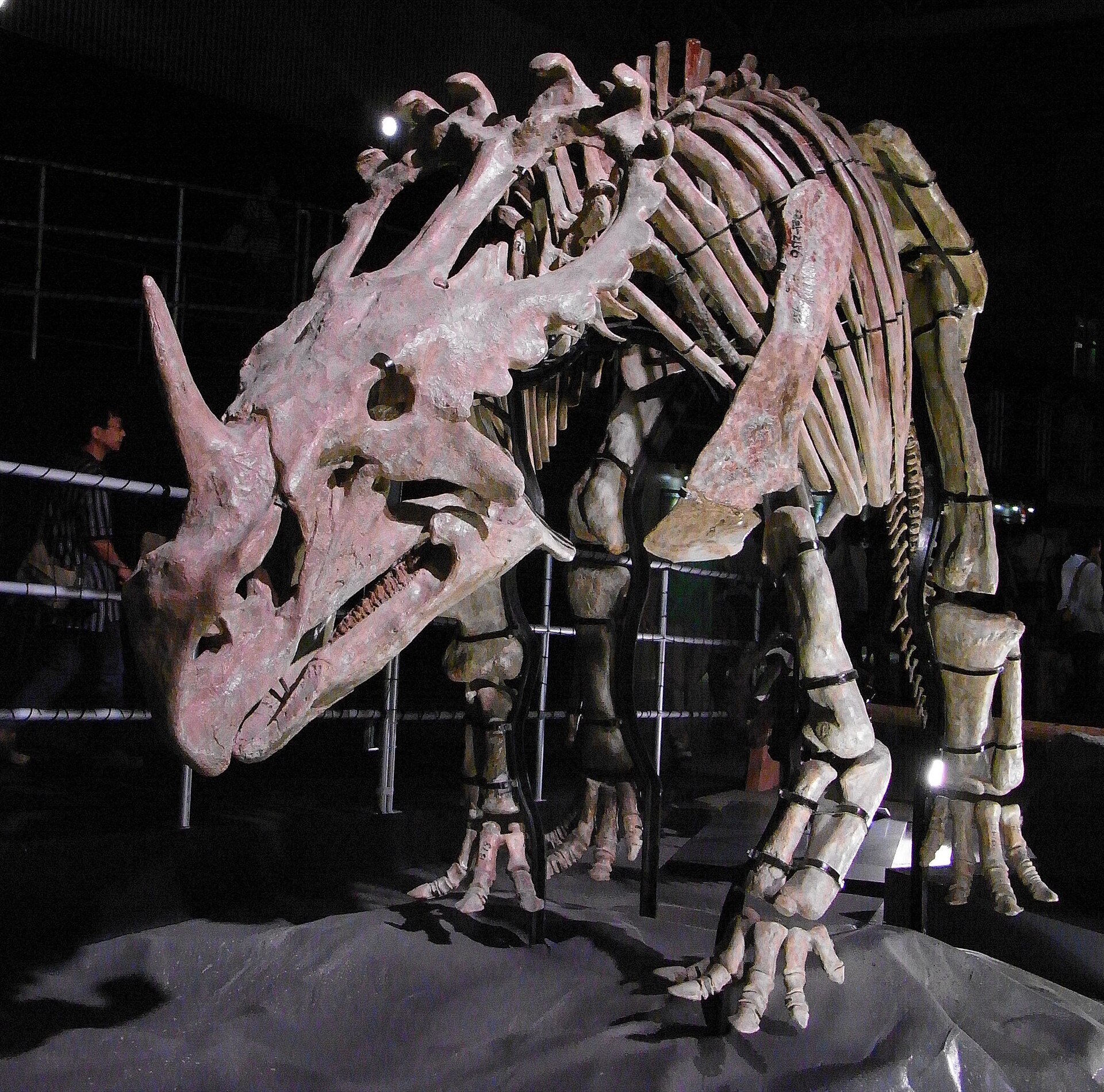
At the front of the skull sat a single nasal horn, set farther forward than in its close relative Wendiceratops. In 2011, paleontologist Andrew McDonald described that horn core as elongate, tapering, and erect—like those of Centrosaurus and Styracosaurus. Inside the snout, the dorsal narial sinus, an air space in the nasal region, formed an elongate rectangular chamber. In 2010, Xu told reporters of a 30-centimeter (11.8-inch) horn on the face—and at least ten crooked hornlets on the top of the head. Unlike Lokiceratops, Sinoceratops lacks a well-developed antorbital buttress, a bony ridge in front of the eye.
The frill was rounder than the elongated, asymmetrical frills of Diabloceratops, Albertaceratops, and Medusaceratops. Its edge carried epiparietals—bony hornlets along the rear margin—and those near the midline bend upward, though less strongly than in Wendiceratops. A midline hornlet sat at the center of the rear edge. In addition, a row of knobs near the hornlet bases is found in no other known species.
No study has yet described the body, limbs, or tail, so mounted skeletons like the one pictured here are largely reconstruction. The skin is unknown too, and any discussion of its covering is speculative.
Size and Weight of Type Species
No peer-reviewed study we found gives a body length, hip height, or weight for Sinoceratops. Instead, the original paper offered a comparison. It called the animal considerably larger than most other centrosaurines, yet similar in size to basal chasmosaurines.
In 2010, Xu Xing gave reporters a figure for the skull itself. By his account, it is at least 5.9 feet (1.8 meters) long and 3.4 feet (1.05 meters) wide. These are minimums from an incomplete skull, and they come from an interview rather than a published measurement table.
Xu also framed the animal as a size puzzle. He said its size resembled Chasmosaurus, “the giants of ceratops,” even though it carried features of the smaller centrosaurines. Until more of the skeleton turns up, its full size remains open.
The Dinosaur in Detail
What sets this dinosaur apart is its frill ornament, studied closely by several later teams. In 2015, paleontologists David Evans and Michael Ryan highlighted a series of raised knobs on the rear of the frill—a feature earlier work had flagged as unique to Sinoceratops. In 2024, Loewen and colleagues counted six epiparietal positions on each side of the frill, as in Xenoceratops, plus one on the midline. They also described the hornlets as blade-like, with a large second one turned out of the plane of the frill.
The nasal horn has drawn mixed descriptions. Evans and Ryan grouped it with the “large, upright” horns of derived centrosaurines. Yet the same paper also called it “diminutive,” possibly a transitional or independently evolved form, and placed it far forward on the snout.
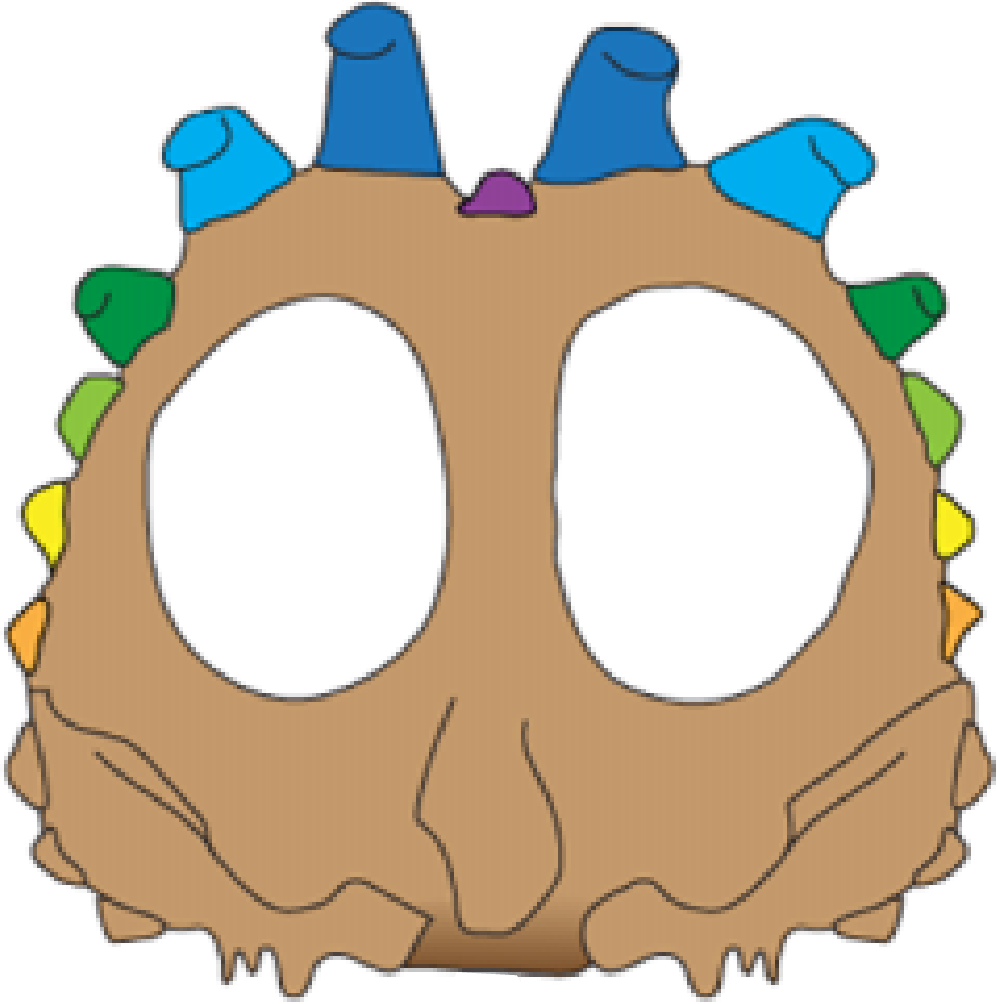

Its family tree has never settled. In 2013, Loewen and colleagues called it a close relative of Centrosaurus and cited it as evidence of dispersal into Asia. By contrast, Evans and Ryan recovered it as the sister of Wendiceratops, outside the group containing Centrosaurus and Pachyrhinosaurus. A year later, Lund and colleagues found it in a polytomy—an unresolved cluster of branches—or weakly paired with Xenoceratops. They blamed missing material and few overlapping bones for this instability.
Loewen’s team added in 2024 that its position shifts because of missing data and, likely, homoplasy—the independent evolution of similar traits. Taken together, Sinoceratops looks like a mosaic of traits—a centrosaurine with the size of a basal chasmosaurine and several chasmosaurine-like features.
Interesting Points about Sinoceratops
- When it was described in 2010, Sinoceratops was the only ceratopsid known from outside North America, where undisputed records had been confined to the western part of the continent.
- A 2010 Smithsonian report suggested it might mean ceratopsids evolved in Asia first, though the paper’s abstract makes no such claim.
- Xu Xing told reporters the skull was at least 5.9 feet (1.8 meters) long, a minimum figure because the skull is incomplete.
- A row of small knobs along the back of its frill is found in no other known horned dinosaur.
- Its describers concluded that patchy fossil sampling can have profound effects on how scientists reconstruct dinosaur biogeography.
Contemporary Dinosaurs
Sharing the Zangjiazhuang quarry was Zhuchengtyrannus, a giant tyrannosaurine known from an upper and a lower jaw bone. In 2015, He Yiming and colleagues noted tyrannosaurid bones and Sinoceratops material from the same locality. Both come from the same quarry, now dated to the Campanian. No direct evidence connects them, so any contact remains unrecorded.
Dominating the Zhucheng bone beds was Shantungosaurus, a hadrosaurid, or duck-billed dinosaur, that Xu and colleagues called the largest known in 2010. Its bones are abundant at Kugou, just 5 kilometers (3.1 miles) from Zangjiazhuang. The Paleobiology Database also lists hadrosaurid material from the Sinoceratops quarry under this species. These animals shared the landscape, but no interaction is recorded.
Also from the Zangjiazhuang quarry came Zhuchengtitan zangjiazhuangensis, a titanosaurian sauropod known from a nearly complete humerus (upper arm bone). In 2017, Mo and colleagues reported it from the Wangshi Group of Zhucheng, and its species name refers to Zangjiazhuang. It was the first titanosaurian reported from Shandong’s Upper Cretaceous. Its link to Sinoceratops rests on that shared quarry and age.
Smaller and hornless was Zhuchengceratops inexpectus, a leptoceratopsid from Kugou known from a partial skeleton. In 2010, Xu and colleagues stated that leptoceratopsids and ceratopsids coexisted in Shandong. In 2018, Yu and colleagues described Kugou and Zangjiazhuang as close in both place and rock layer. On his blog, paleontologist David Hone nevertheless suspected in 2014 that this skeleton came from a different level within Kugou.
Sinoceratops in its Natural Habitat
The rocks around Sinoceratops point to a landscape shaped by running water. According to An and colleagues, sediment reached the Zhucheng Basin mainly from the north-northwest. The Paleobiology Database records the quarry itself as a river deposit—medium sandstone below, calcic siltstone above.
Sinoceratops was a herbivore, but no study has examined what it ate or how it fed. With no jaws or teeth yet described, its feeding habits remain an open question. Its neighbors hint at a crowded plant-eating guild, from the colossal Shantungosaurus to the medium-sized Zhuchengceratops.
While there is no direct evidence of how Sinoceratops used its horns, later work offers a group-level idea. In 2026, Eric Ames and colleagues linked later centrosaurines, including Sinoceratops, to a possible shift toward stabbing combat. They did not, however, model Sinoceratops itself, so the idea remains a hypothesis for the wider group. Meanwhile, a 2010 Smithsonian report suggested that geographic or environmental barriers may explain why ceratopsids were so rare in Asia.
Frequently Asked Questions
News reports of the 2010 Chinese Academy of Sciences announcement gave its meaning as “Chinese Horned Face from Zhucheng City.”
It lived in the Campanian stage of the Late Cretaceous, sometime between about 77 and 73.5 million years ago.
No peer-reviewed study gives a body-size estimate. Xu Xing told reporters its incomplete skull was at least 5.9 feet (1.8 meters) long.
It was a centrosaurine ceratopsid, a horned herbivore that its describers placed near the base of Centrosaurinae.
It was excavated in 2008 at the Zangjiazhuang locality near Zhucheng in Shandong Province, China, in rocks now assigned to the Hongtuya Formation.
It remains the only undisputed ceratopsid known from outside North America, and its frill bears a row of knobs unique to it.
Sources
The information in this article is based on various sources, drawing on scientific research, fossil evidence, and expert analysis. The aim is to provide a comprehensive and accurate overview of Sinoceratops. However, please be aware that our understanding of dinosaurs and their world is constantly evolving as new discoveries are made.
- https://doi.org/10.1007/s11434-009-3614-5
- https://link.springer.com/article/10.1007/s11434-009-3614-5
- https://doi.org/10.1016/j.jop.2015.11.002
- https://doi.org/10.7717/peerj.17224
- https://doi.org/10.1371/journal.pone.0130007
- https://doi.org/10.1371/journal.pone.0154403
- https://doi.org/10.1371/journal.pone.0022710
- https://doi.org/10.1371/journal.pone.0079420
- https://doi.org/10.1371/journal.pone.0144148
- https://doi.org/10.1371/journal.pone.0013835
- https://doi.org/10.1038/s41598-018-23252-2
- https://doi.org/10.1371/journal.pone.0012292
- https://doi.org/10.7717/peerj.21351
- https://doi.org/10.7717/peerj.21728
- http://dzhtb.cgs.cn/ch/reader/view_abstract.aspx?file_no=20170901&flag=1
- https://paleobiodb.org/classic/basicCollectionSearch?collection_no=96815
- https://www.smithsonianmag.com/science-nature/say-hello-to-sinoceratops-80286349/
- https://blog.everythingdinosaur.com/blog/_archives/2010/08/29
- https://www.khaleejtimes.com/uae/new-dinosaur-species-found-in-china
- https://www.nbcnews.com/id/wbna28430361
This article was last fact checked: TheDinosaurs Team, 03-11-2026
Featured Image Credit: Connor Ashbridge, CC BY 4.0, via Wikimedia Commons
