
On the Stromberg near Pfaffenhofen in southwestern Germany, the red marls and sandstones of the Löwenstein Formation hold the bones of a small, lightly built theropod. Paleontologist Eberhard Fraas named it Procompsognathus triassicus in 1913, and it lived during the Norian stage of the Late Triassic. Fraas saw in it a forerunner of the Solnhofen Compsognathus—a link its name still carries. Before 2019, it was one of only three Late Triassic neotheropods known from Europe, all of them fragmentary.
The skeleton surfaced in spring 1909, yet for decades a skull from the same quarry told a misleading story. The quarry manager kept no record of which bones belonged together. In 1992, paleontologists Paul Sereno and Rupert Wild argued that the skull and skeleton came from different animals, and they assigned the skull to a crocodile-line reptile. As a result, the name Procompsognathus now covers a headless skeleton—proof that one quarry’s unrecorded associations can shape a species for a century.
Procompsognathus Key Facts
| Keyword | Fact |
|---|---|
| Pronunciation | Not specified |
| Meaning of name | Not specified (linked by Fraas to Compsognathus, which he thought it preceded) |
| Group | Theropoda |
| Type Species | Procompsognathus triassicus |
| Diet | Likely carnivore |
| When it Lived | About 215 to 211 MYA (Paleobiology Database, Alaunian only, narrower than the Lacian–Alaunian range of a 2025 synopsis) |
| Period | Triassic |
| Epoch | Late Triassic (Norian stage) |
| Length | About 2.5 feet (0.75 meters), Fraas’s 1913 estimate, including a skull now assigned to a crocodylomorph |
| Height | Not specified |
| Weight | About 2.5 pounds (1.13 kilograms), 2014 estimate |
| Mobility | Moved on two legs (bipedal) |
| First Discovery | Spring 1909, finder not named by Fraas |
| Described by | 1913 by Eberhard Fraas |
| Holotype | SMNS 12591 |
| Location of first find | Weisser Steinbruch near Pfaffenhofen, Middle Stubensandstein, Löwenstein Formation, Baden-Württemberg, Germany |
Procompsognathus Origins, Taxonomy and Timeline
Fraas never explained the name Procompsognathus in his 1913 paper, although its link to Compsognathus is plain from his text. He judged the likeness to Compsognathus longipes from Solnhofen to be “not merely external.” For that reason, he treated the new animal as a Triassic forerunner of it. Fraas also thought Halticosaurus longotarsus and some smaller species probably belonged near it. Together, the name ties the animal to a famous relative that Fraas believed it preceded.
Today Procompsognathus sits within Theropoda, then Neotheropoda and Coelophysoidea, and finally the family Coelophysidae. In fact, the family is defined with it—Coelophysidae covers Coelophysis, Procompsognathus, their most recent common ancestor and all of its descendants. According to Sereno and Wild, it was closely related to Coelophysis bauri and Segisaurus halli. During the 1990s, some researchers also placed it in a broad Ceratosauria. Procompsognathus triassicus is the type and only known species.
In their 2025 synopsis, Hans-Dieter Sues and Rainer Schoch place the type horizon in the Norian stage, within the Lacian and Alaunian substages. The International Commission on Stratigraphy dates the Norian to roughly 227 to 206 million years ago. Meanwhile, the Paleobiology Database assigns the quarry to the Alaunian, about 215 to 211 million years ago.
Discovery & Fossil Evidence
According to Fraas, the find surfaced in spring 1909 in the red marls of the upper “Fäule”—a band of clay and marl. It came from the Pfaffenhofen quarry, which later works call the “Weisser Steinbruch,” or White Quarry. It comprised, he wrote, most of a very delicate skeleton—including a skull, the middle of the trunk with the legs, and the front of the tail.
The holotype, SMNS 12591, is a partial postcranial (below-the-head) skeleton in two pieces at the Staatliches Museum für Naturkunde Stuttgart. It preserves 14 back and 13 tail vertebrae, rib fragments, the right scapula (shoulder blade) and coracoid, and part of the left forelimb. Parts of both pubes (lower hip bones), the left femur (thigh bone), a piece of the left tibia (shin bone), and the right hindlimb complete it. Sues and Schoch list no other specimen.
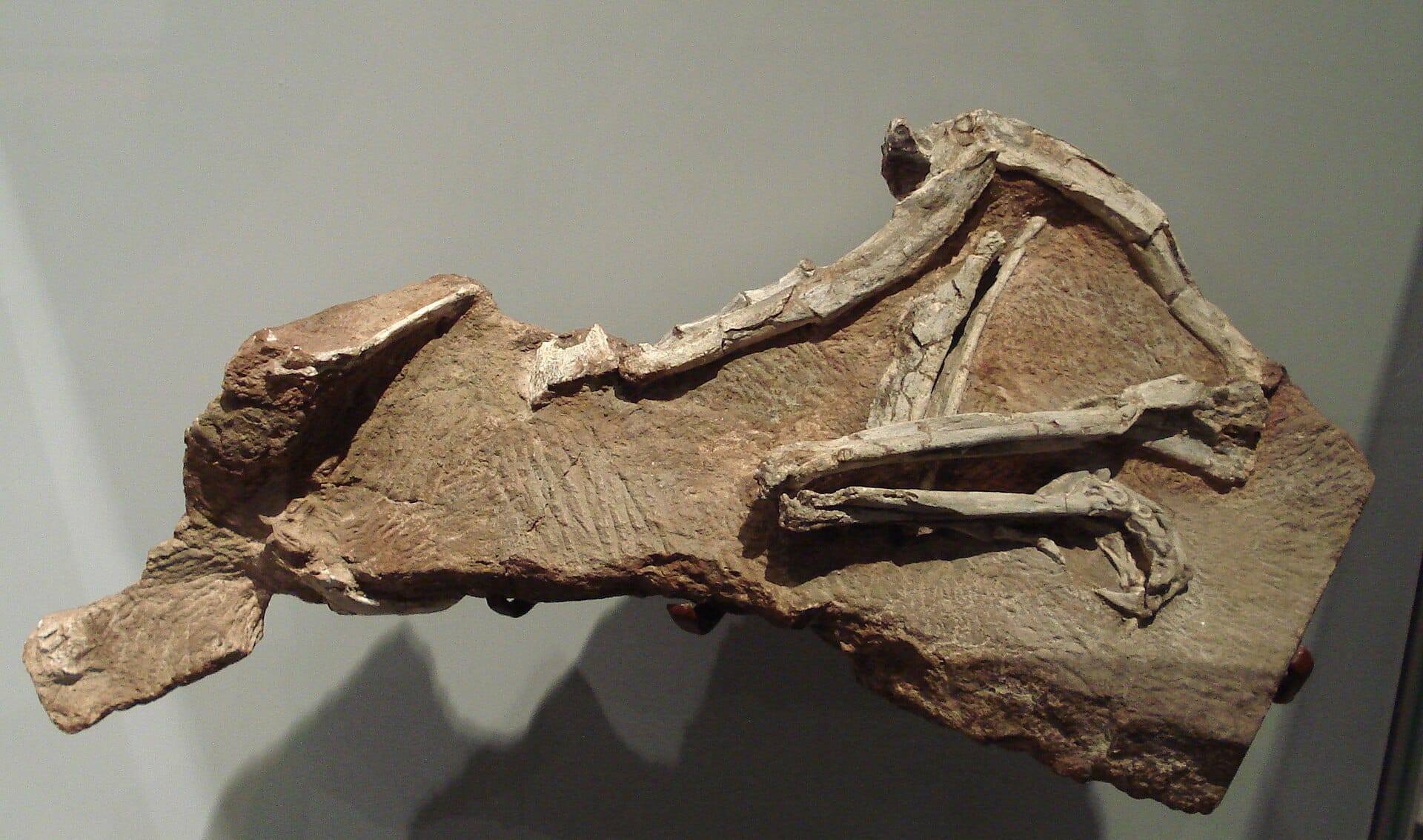

The trouble lay in the skull, since the quarry also yielded other archosaurs and the manager recorded no associations. In 1921, paleontologist Friedrich von Huene found no significant difference between the type skull, SMNS 12591a, and SMNS 12352, a second partial skull found in 1908 with a hand. John Ostrom (1981) disagreed, judging SMNS 12352 not referable to Procompsognathus.
Sereno and Wild then concluded in 1992 that both skulls belonged to Saltoposuchus, a crocodylomorph—a member of the crocodile-line archosaurs. In 2012, Fabien Knoll and Klaus Rohrberg partly dissented after CT scans. They judged SMNS 12352 an indeterminate crocodylomorph, distinct from Saltoposuchus connectens. Their figure even labeled SMNS 12591a an “indeterminate theropod.” However, paleontologist Stephan Spiekman’s 2023 restudy referred both skulls to Saltoposuchus connectens. Comparisons of the maxilla (upper jaw bone) backed Sereno and Wild over Ostrom. Fresh acid preparation of SMNS 12591a also exposed a crocodylomorph-like palate. Knoll had already judged the hand “definitely not theropodan” in 2008.
Procompsognathus Size and Description
Without a skull, any portrait of Procompsognathus begins below the head—and little of the hand is known.
Short description of Procompsognathus
Fraas found all of its bones thin-walled and hollow. Its back was long—its mid-dorsal centra (vertebral bodies) ran roughly 2.7 to 2.9 times as long as their front joint surface was tall. Other coelophysids share this elongation. At the hip, the supra-acetabular crest above the socket ran into the brevis shelf behind it as one continuous ridge. The pubis was flat front-to-back and lacked a distinct “foot,” while its shaft curved slightly forward.
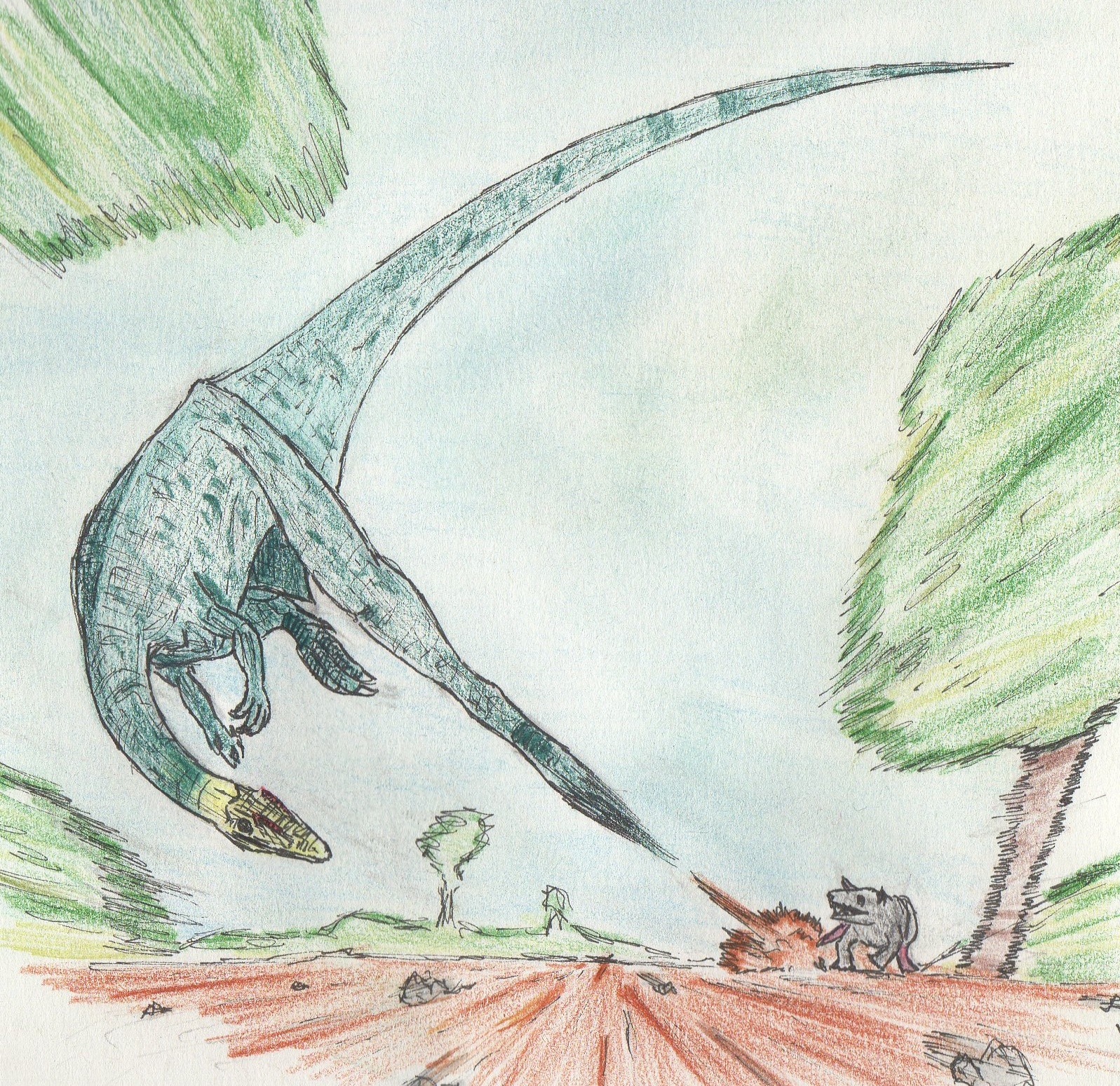
The hindlimb was long and, in Fraas’s words, “thoroughly bird-like.” He added that fusing its three middle metatarsals (foot bones) would yield a bird’s foot, as in a kiwi or a pheasant. In his reconstruction, the animal stood extremely long-legged. Because the holotype preserves bones only, any restoration of its covering—and especially of its head—is speculative.

Size and Weight of Type Species
Fraas’s reconstruction gave a total length of about 2.5 feet (0.75 meters), but that included the crocodylomorph skull. He judged the animal somewhat larger than Compsognathus but more slenderly built in the skull and forelimbs. He also measured the hindlimb at about 12.4 inches (31.5 centimeters).
In 2016, Scott Persons and Philip Currie tabulated direct measurements of a 96-millimeter femur and a 110-millimeter tibia. Its shin was therefore longer than its thigh bone.
In 2014, Roger Benson and colleagues estimated a weight of about 2.5 pounds (1.13 kilograms) from limb-bone shaft circumference. That places it among the smallest non-maniraptoran theropods in their summary table. Paleontologist Oliver Rauhut wrote in 2003 that even if the holotype were a juvenile, adults probably averaged slightly smaller than Coelophysis. He did not, however, claim that it was a juvenile.
The Dinosaur in Detail
What sets Procompsognathus apart is less a single feature than a combination of hip and thigh traits. Following the work of Ostrom and of Sereno and Wild, its diagnosis starts with a sigmoidal trochanteric shelf—an S-shaped ridge on the femur shared with Coelophysis bauri. A deep preacetabular process of the ilium, the front blade of the hip bone, joins it. A prominent supra-acetabular crest and the footless pubis complete the set. Its femur also carries a relatively well-developed fourth trochanter, a flange for thigh muscles.
In 2021, Spiekman and colleagues noted a detail in the middle and rear back vertebrae. There, the neural spine’s rear edge curves back and overhangs the joint behind it, as in C. bauri and Dilophosaurus. Rauhut also noted that the first metatarsal attaches to the shaft of the second and never reaches the ankle.
The foot is harder to read, as its metatarsals are somewhat crushed and only the third’s upper end is known. Ostrom argued they were probably fused. In contrast, Sereno and Wild identified a distal tarsal fused to metatarsal III—a close match with Coelophysis. Fraas, for his part, thought an ossified ankle seemed to be missing entirely.
In 2003, Rauhut treated it as a “metataxon,” hard to separate from Coelophysis because the type is poorly preserved and the two are probably close kin. Still, he found it differed from Liliensternus liliensterni in size and in its longer rear back vertebrae. Knoll reached a similar view in 2008, placing the type material close to Segisaurus and Coelophysis. Spiekman’s team also found that it, Segisaurus, and possibly Podokesaurus each shrank independently from larger ancestors. Taken together, these studies describe a small coelophysid—its bones scant, its head borrowed for decades.
Interesting Points about Procompsognathus
- Fraas called it “the elegant leaper” and pictured an extremely long-legged, jumping dinosaur with a bird-like hindlimb.
- He suggested that such leaping forms could be the stock from which at least some birds, “especially the running birds,” evolved.
- Under Sereno’s 1998 definition, this fragmentary animal is one of the two genera used to define the family Coelophysidae.
- Its lower hindlimb bones are slightly more elongated than in any Coelophysis that Colbert measured, although Rauhut, citing Holtz (1995), noted this “might be size-related.”
- Alongside Pendraig milnerae from Wales and possibly Liliensternus, it is one of only a few Triassic coelophysoids known from Europe.
Contemporary Dinosaurs
Sharing the very same quarry was Efraasia, an early-diverging sauropodomorph—a relative of the later long-necked giants. In 1973, Peter Galton named the genus Efraasia for a prosauropod from the Stubensandstein of northern Württemberg. Its holotype, SMNS 11838, comes from the Weisser Steinbruch, in the same Middle Stubensandstein of the Löwenstein Formation. Although both animals date to the Lacian–Alaunian Norian, no fossil records any interaction between them.
Also present in the Löwenstein Formation was Plateosaurus gracilis, a plateosaurid sauropodomorph once called Sellosaurus gracilis. Huene first gave it its own genus, yet he and Adam Yates later sank Sellosaurus into Plateosaurus, in 1932 and 2003. Its holotype comes from the Lower Stubensandstein at Stuttgart-Heslach—slightly lower, yet overlapping in age. Yates also recognized both Efraasia minor and P. gracilis in this formation. This species is older than the Trossingen Formation’s Plateosaurus trossingensis, and nothing records contact with Procompsognathus.
Procompsognathus in its Natural Habitat
The world Procompsognathus roamed lay along the southern margins of the Central European Basin. There, the Löwenstein and Trossingen formations represent the Norian-age Arnstadt Formation. At Pfaffenhofen, the Stubensandstein reaches about 98 feet (30 meters) thick, with lens-shaped sandstone bodies between red-brown and violet clay layers. Fraas read it as purely terrestrial, with wind-blown dunes and clays laid down in ponds and inland lakes. However, a 1997 conference abstract read the Stubensandstein instead as the deposits of braided and meandering rivers. As a result, Fraas’s dune model is now historical.
Although its diet is not recorded directly, small theropods of this kind are generally regarded as meat-eaters. In 2008, Knoll underlined the remarkable diversity of southern Germany’s carnivorous guild before the end-Triassic events. Fraas noted that the Stubensandstein levels at Pfaffenhofen had so far yielded only small species, some of them very small. The overlying Knollenmergel, by contrast, had so far produced only large animals.
Its neighbors included semionotid fish, temnospondyls (early amphibians), phytosaurs (crocodile-like reptiles), and armored aetosaurs. Shelled stem-turtles such as Proganochelys and the rauisuchid Teratosaurus suevicus also lived in these units. So did the long-snouted, semi-aquatic phytosaur Mystriosuchus planirostris. While there is no direct evidence of whether Procompsognathus lived alone or in groups, its long legs fit Fraas’s old image of an agile leaper. His leaping interpretation, though, remains a historical view. Its role in the ecosystem was likely that of a small predator within that diverse carnivorous guild.
Frequently Asked Questions
Fraas gave no explanation, but he saw the animal as a Triassic forerunner of Compsognathus, and the name reflects that link.
It lived in the Lacian and Alaunian substages of the Late Triassic Norian. A narrower Paleobiology Database estimate gives about 215 to 211 million years ago.
Fraas estimated a length of about 2.5 feet, and a 2014 study estimated a weight of about 2.5 pounds.
It was a small theropod in the family Coelophysidae, closely related to Coelophysis.
Its fossils come from the Weisser Steinbruch near Pfaffenhofen, in the Löwenstein Formation of Baden-Württemberg, Germany.
Its original skull is now assigned to the crocodylomorph Saltoposuchus, so the name covers only a headless partial skeleton.
Sources
The information in this article is based on various sources, drawing on scientific research, fossil evidence, and expert analysis. The aim is to provide a comprehensive and accurate overview of Procompsognathus. However, please be aware that our understanding of dinosaurs and their world is constantly evolving as new discoveries are made.
- https://zenodo.org/record/1536919
- https://doi.org/10.1007/BF01493265
- https://doi.org/10.1080/02724634.1992.10011473
- https://fr.pensoft.net/article/164405/
- https://zenodo.org/records/8432530
- https://doi.org/10.1093/zoolinnean/zlad035
- https://link.springer.com/article/10.1007/s00015-012-0094-4
- https://www.em-consulte.com/article/195106/on-the-procompsognathus-postcranium-late-triassic-
- https://zenodo.org/records/5123143
- https://pmc.ncbi.nlm.nih.gov/articles/PMC8493203/
- https://pmc.ncbi.nlm.nih.gov/articles/PMC4011683/
- https://pmc.ncbi.nlm.nih.gov/articles/PMC6669044/
- https://epub.ub.uni-muenchen.de/12711/1/zitteliana_2003_b24.pdf
- https://palass.org/node/2653
- https://link.springer.com/article/10.1007/BF02985709
- https://pmc.ncbi.nlm.nih.gov/articles/PMC4728391/
- https://pmc.ncbi.nlm.nih.gov/articles/PMC5735062/
- https://epub.ub.uni-muenchen.de/67833/
- https://paleobiodb.org/data1.2/occs/list.json?base_name=Procompsognathus&show=strat,loc,coll&vocab=pbdb
- https://stratigraphy.org/ICSchart/ChronostratChart2024-12.pdf
- https://www.searchanddiscovery.com/abstracts/html/1997/intl/abstracts/1390d.htm
This article was last fact checked: TheDinosaurs Team, 01-11-2026
Featured Image Credit: FunkMonk, CC BY-SA 3.0, via Wikimedia Commons
