
On the northern flank of the Lang Shan—the Wolf Mountains of Inner Mongolia—the red sandstones of the Bayan Mandahu Formation preserve an armored dinosaur with a devilish face. Named Pinacosaurus mephistocephalus in 1999, it is usually placed in the Campanian stage of the Late Cretaceous, though its rocks are undated. For 27 years, scientists classified it as a second species of Pinacosaurus, an ankylosaurid from the Gobi Basin. In 2026, however, a new study moved it into a genus of its own—Eopinacosaurus.
The skeleton came to light in summer 1996, during the second excavation campaign of the Sino-Belgian Dinosaur Expedition. Three years later, paleontologist Pascal Godefroit and three colleagues described it as a new species. Their specimen is a nearly complete, articulated skeleton with its neck armor and tail club still in place. Paul Penkalski gave it a new genus in May 2026. Researchers had called for a review of the genus in 2003 and again in 2011, and Penkalski’s study now provides one.
Eopinacosaurus Key Facts
| Keyword | Fact |
|---|---|
| Pronunciation | Not specified |
| Meaning of name | Not specified for the genus—species name means “Mephistopheles Head” |
| Group | Ankylosauria (Ankylosauridae) |
| Type Species | Eopinacosaurus mephistocephalus |
| Diet | Not specified |
| When it Lived | Not precisely known, usually assigned to the Campanian. Possibly older than Mongolia’s Djadokhta Formation, tentatively dated to about 75 to 71 MYA |
| Period | Cretaceous |
| Epoch | Late Cretaceous (Campanian stage) |
| Length | About 9.8 feet (3 meters), probable subadult |
| Height | Not specified |
| Weight | Not specified |
| Mobility | Not specified |
| First Discovery | 1996 by the Sino-Belgian Dinosaur Expedition |
| Described by | 1999 by P. Godefroit, X. Pereda Suberbiola, Li H., and Dong Z.-M. (as Pinacosaurus mephistocephalus), with the genus named 2026 by P. Penkalski |
| Holotype | IMM 96BM3/1 |
| Location of first find | Quarry SBDE 96BM3, Bayan Mandahu Formation, Urad Houqi Banner, Inner Mongolia, China |
Eopinacosaurus Origins, Taxonomy and Timeline
The species name mephistocephalus joins “Mephisto,” short for Mephistopheles, the devil of the Faust legend, with the Greek kephalê, meaning “head.” Its describers explained that the skull “reminds a devil’s head.”
Eopinacosaurus belongs to Ornithischia, the “bird-hipped” dinosaurs, and within it to Thyreophora, the armored lineage. Within the ankylosaurs, Godefroit and colleagues placed it in Ankylosauridae, the club-tailed family. They named it as a new species of Pinacosaurus, separated from P. grangeri mainly by the nostril region. In 2003, paleontologists Robert Hill, Lawrence Witmer, and Mark Norell still listed it as a species of that genus. In 2026, though, Penkalski’s limited specimen-level analysis found that it “is not referable to Pinacosaurus” and therefore needed a new genus. Eopinacosaurus mephistocephalus is the type species.
Its describers placed the rocks in the Campanian stage of the Late Cretaceous. With no direct date for them, researchers have instead correlated the Bayan Mandahu beds with Mongolia’s Djadokhta Formation. A 1991 study by Jerzykiewicz and Russell centered Djadokhta deposition on about 78 million years ago. Godefroit’s team warned that such conclusions “remain conjectural,” because the Gobi Basin lacked pollen, radioisotopic, or paleomagnetic data. In 2005, however, Demberelyin Dashzeveg and colleagues used paleomagnetic data to tentatively place the Djadokhta Formation at about 75 to 71 million years ago. The Bayan Mandahu beds themselves remain undated. Later authors call them the Wulansuhai Formation, and in 2015, Pittman and colleagues described them as “possibly Campanian.”
Discovery & Fossil Evidence
Members of the Inner Mongolia Museum discovered the Bayan Mandahu site in 1978. From 1987 the Sino-Canadian Dinosaur Project worked these badlands near Urad Houqi, and the Sino-Belgian Dinosaur Expedition followed. The skeleton came from that team’s quarry SBDE 96BM3, which lies at 4,065 feet (1,239 meters) above sea level. Suzanne Clinet, J.-J. Blairvacq, and R. Cremers later prepared the skeleton.
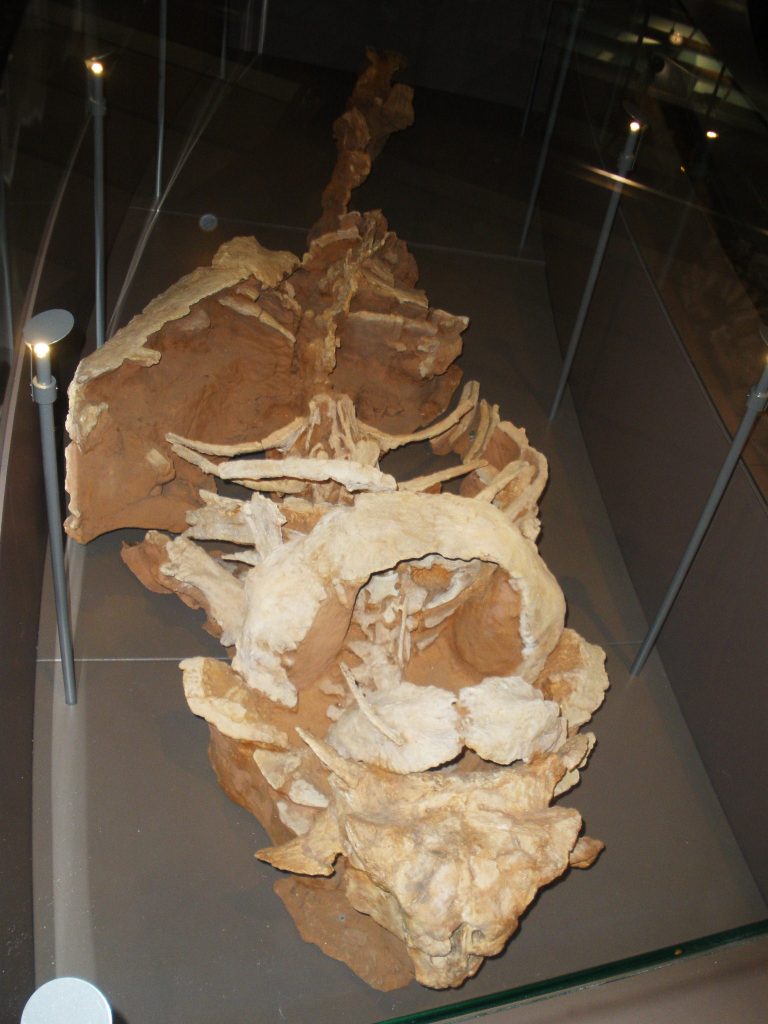

The Inner Mongolia Museum in Hohhot holds the holotype, IMM 96BM3/1. It preserves the skull, mandible (lower jaw), most of the vertebral column, and the right limbs. Part of the dermal armor—bony plates set in the skin—remains in place. The left arm and much of the left pelvis and hind limb are missing. The skeleton lies with its limbs folded under the body, like other Gobi skeletons from sandy beds. It shows no deformation after burial and no sign of transport, though borings, common in Bayan Mandahu dune deposits, mark the bones. Some researchers have proposed carrion insects as the borers, although their identity remains unknown.
In 1988 and 1990, the Sino-Canadian project collected young skeletons at Bayan Mandahu. The 1999 paper reported them as juvenile Pinacosaurus about 4.9 feet (1.5 meters) long. In 2011, however, Michael Burns and colleagues referred four Bayan Mandahu juveniles to Pinacosaurus grangeri rather than to this species, and called for a revision of the genus. The anatomy described below comes from the holotype.
Eopinacosaurus Size and Description
Short description of Eopinacosaurus
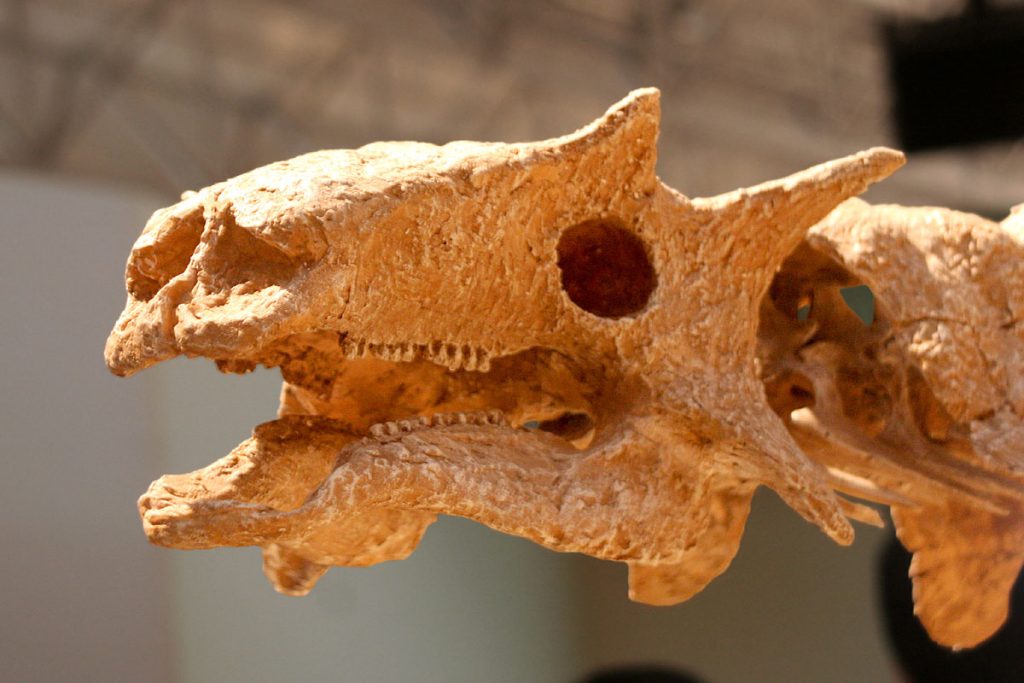
Measured across its cheek horns, the skull was wider than it was long. Prominent bony horns projected from the squamosal, supraorbital, and quadratojugal regions. The cheek horns grew from extra bony plates over the quadratojugals, not from the bones themselves. Its circular orbits (eye sockets) faced sideways, and unlike in adult ankylosaurs, the sutures between the skull-roof bones remain visible. The preserved lower teeth had a weak central cusp, with five denticles (small serrations) on the front edge and four or five on the rear. The snout tip, by contrast, had no teeth at all.
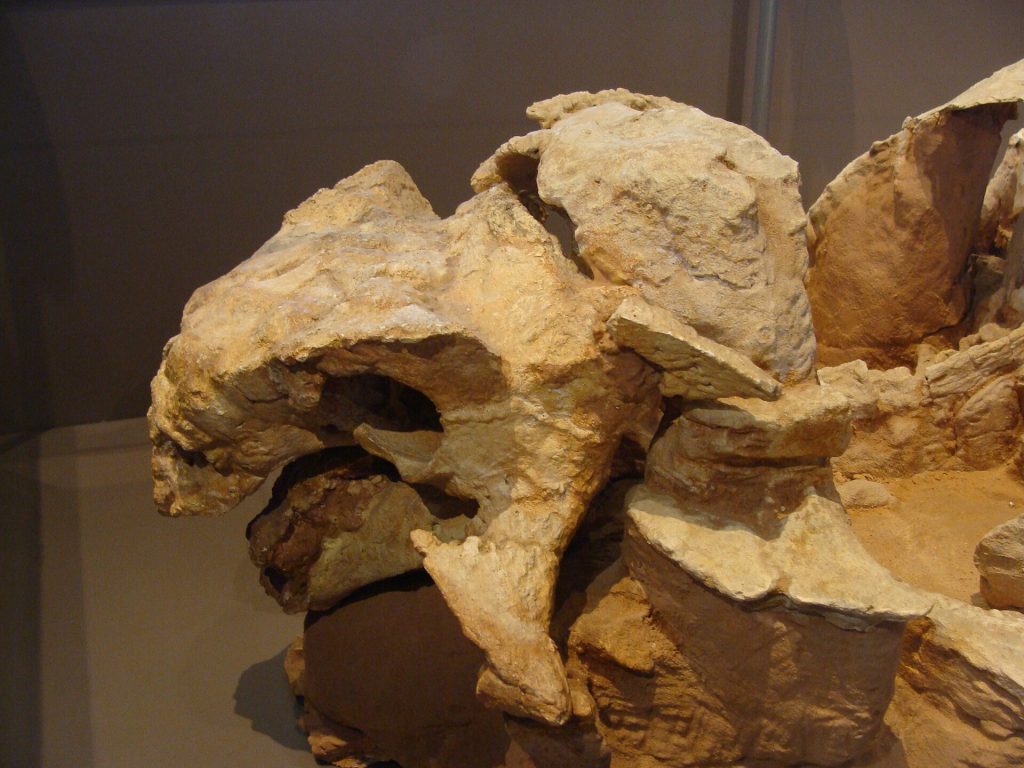

Two cervical half-rings—bony collars—guarded the neck, as usual in ankylosaurids. Along the back, small oval scutes apparently ran in a double row beside the spine. With no evidence of large plates, the back armor appears lighter than in Saichania, Euoplocephalus, or Ankylosaurus. At the end of the tail sat a club, fragmentary but “relatively small and slender.”
Size and Weight of Type Species
Godefroit and colleagues described the holotype as probably a subadult about 9.8 feet (3 meters) long. The paper does not explain how the length was obtained—but the nearly complete tail alone measures about 5.2 feet (160 centimeters). Its skull measures about 9.4 inches (238 millimeters) long and 14.8 inches (375 millimeters) wide across the quadratojugal horns.
Despite its immature skull, the rest of the body looks surprisingly grown-up—a mismatch that led its describers to call it a subadult. The neural arches, dorsal ribs, and sacral ribs have fused to the vertebrae. Ossified tendons also stiffen the back and tail. The adult size of the species remains unknown, and no height or weight appears in the scientific literature.
For scale, its skull is larger than that of the juvenile Pinacosaurus grangeri ZPAL MgD-II/1, about 7.3 inches (18.5 centimeters) long. However, it falls short of the estimated 12 inches (30.5 centimeters) of the crushed P. grangeri holotype.
The Dinosaur in Detail
What sets this dinosaur apart is the region around its nostrils. Its describers counted four pairs of openings there, compared with three in P. grangeri, and called this “one of the most interesting features.” They also listed two pairs of premaxillary foramina (small holes) instead of one, with nares (nostrils) visible only from above. They considered these narial differences “indubitable specific characters.”
The 1999 diagnosis had limits, however, because it rested mainly on comparison with a juvenile P. grangeri—a different growth stage. The authors admitted that some other differences might reflect growth rather than species. In 2003, Hill and colleagues reported Godefroit’s later statement that one key “gland opening” is a closed, cup-shaped depression rather than a true opening. They also found narial anatomy variable in P. grangeri, since one of its skulls shows five pairs of openings. Hill’s team therefore suggested that such differences are more likely individual variation than species-level characters.

In 1999, other traits linked it to Pinacosaurus—paired “gland” openings on the premaxilla, a slender mandible, and lightened back armor. Yet its skeleton differed from P. grangeri in a shorter scapula (shoulder blade), a long deltopectoral crest (a muscle ridge) on the upper arm, and a radius with a strongly expanded upper end. Even so, the describers allowed that these might reflect growth. Hill’s team later concluded that the whole genus needed a reevaluation. Penkalski’s 2026 study took up that task, characterizing true Pinacosaurus by features such as a supranarial embayment and multiple paranasal apertures. For now, only Penkalski’s self-described limited analysis separates it from Pinacosaurus at genus level, and others have yet to test that result.
Interesting Points about Eopinacosaurus
- Its species name refers to Mephistopheles, because its describers thought the holotype’s head resembled a devil’s head.
- The holotype lies with its limbs folded under its body, a pose seen in other Gobi skeletons from sandy beds.
- The species waited 27 years for its own genus, from its naming in 1999 to Penkalski’s 2026 revision.
- Its describers counted four pairs of nostril openings, against three in Pinacosaurus grangeri—though a P. grangeri skull reported in 2003 has five.
- The same 2026 paper that named Eopinacosaurus also named a new species, Pinacosaurus hilwitnorum, and found Minotaurasaurus probably distinct from Pinacosaurus and not the same as Tarchia.
Dinosaurs from the Same Formation
Also known from the Bayan Mandahu (Wulansuhai) Formation (exact level relative to Eopinacosaurus not known): the ankylosaurid Pinacosaurus grangeri (from juveniles referred to it by Burns and colleagues in 2011), the protoceratopsian Protoceratops hellenikorhinus, the dromaeosaurids Linheraptor exquisitus and “Velociraptor” osmolskae, the functionally one-fingered alvarezsauroid Linhenykus monodactylus, and the oviraptorids Wulatelong gobiensis and Machairasaurus leptonychus. In 2025, Bindellini and colleagues supported moving “V.” osmolskae out of Velociraptor, while Moutrille and colleagues preferred to keep it there until more material is found. The beds’ age is debated, too. Earlier workers matched them with the Djadokhta Formation, but in 2010, Longrich and colleagues judged them not coeval with it. In 2013, Xu and colleagues went further—they proposed that these are the oldest Upper Cretaceous red beds in the Gobi area. The formation’s age and time span are not well constrained, so these animals may not all have lived at the same time.
Eopinacosaurus in its Natural Habitat
Imagine a semiarid landscape of alluvial fans and wind-blown sand. The rocks are mainly horizontally bedded red sandstones. In 1993, Eberth identified dune, interdune, lake, soil, and alluvial-fan or braid-plain deposits among them. At one Bayan Mandahu locality, a later study described a braid-plain lying “adjacent to an aeolian dune field.” Today the beds crop out along the Ni Qi Daba Gorge—a cut about 28 miles (45 kilometers) long.
The Bayan Mandahu assemblage includes lizards, amphisbaenians, turtles, crocodilians, dinosaurs, and mammals. Protoceratopsians dominate the dinosaur remains, while Pinacosaurus in the broad sense is the second most common dinosaur. Theropods, in contrast, are very rare, and the turtle Zangerlia neimongolensis and multituberculate mammals also appear. According to Godefroit’s team, the low diversity and modest size of the animals indicate “a stressed palaeoenvironment.”
While there is no direct evidence of its social life, the holotype’s burial has drawn two explanations. One hypothesis holds that such “standing” animals died in place, probably buried alive during violent sandstorms. Another proposes rapid burial on dune-sand alluvial fans during rainstorms. Godefroit and colleagues also suggested that faunal differences from Bayn Dzak, about 220 miles (350 kilometers) away, may reflect local speciation between isolated populations.
Frequently Asked Questions
The species name means “Mephistopheles head,” after the holotype’s devilish skull, and Penkalski coined the genus name in 2026.
It is usually placed in the Campanian stage of the Late Cretaceous. However, its rocks are undated, and some researchers think they predate Mongolia’s Djadokhta Formation.
The holotype, probably a subadult, was about 9.8 feet (3 meters) long, but no height or weight has been published.
It was an armored, club-tailed ankylosaurid, first named as a species of Pinacosaurus in 1999.
The Sino-Belgian Dinosaur Expedition found it in 1996 at Bayan Mandahu, in the Bayan Mandahu Formation of Inner Mongolia, China.
Its describers pointed to its nostril region, including four pairs of openings—a count later shown to vary in Pinacosaurus. In 2026, Penkalski found it distinct enough to need its own genus.
Sources
The information in this article is based on various sources, drawing on scientific research, fossil evidence, and expert analysis. The aim is to provide a comprehensive and accurate overview of Eopinacosaurus. However, please be aware that our understanding of dinosaurs and their world is constantly evolving as new discoveries are made.
- https://biblio.naturalsciences.be/rbins-publications/bulletin-of-the-royal-belgian-institute-of-natural-sciences-earth-sciences/69-sup-b-1999/bulletin69supb-article2.pdf
- https://doi.org/10.1080/08912963.2026.2633178
- https://sites.ohio.edu/witmerl/Downloads/2003%20Hill,%20Witmer,%20&%20Norell%20Pinacosaurus.pdf
- https://biblio.naturalsciences.be/rbins-publications/bulletin-of-the-royal-belgian-institute-of-natural-sciences-earth-sciences/71-sup-2001/irscnb_p4087_01ec08x_71-sup_bulletin-1.pdf
- https://mapress.com/zootaxa/2010/f/zt02403p009.pdf
- https://pubmed.ncbi.nlm.nih.gov/21262806/
- https://peerj.com/articles/986/
- https://ivpp.cas.cn/cbw/gjzdwxb/xbwzxz/201305/t20130507_3833524.html
- https://doi.org/10.1016/j.cretres.2010.11.007
- https://digitalcommons.unl.edu/geosciencefacpub/209
- https://orbi.umons.ac.be/bitstream/20.500.12907/53795/1/Moutrille%20et%20al.%20-%202025%20-%20A%20new%20bird-like%20dinosaur%20from%20the%20Upper%20Cretaceous.pdf
- https://palass.org/publications/palaeontology-journal/archive/53/5/article_pp945-960
- https://www.italianjournalofgeosciences.it/297/article-1232/italic-velociraptor-italic-the-state-of-the-art-100-years-after-the-discovery-of-this-iconic-dinosaur.html
This article was last fact checked: TheDinosaurs Team, 18-11-2026
Featured Image Credit: Connor Ashbridge, CC BY 4.0, via Wikimedia Commons
