
Deep in southwestern Mongolia’s South Gobi Aimak, the red sandstones of the Nemegt Formation at Bugin Tsav yielded a small, bird-like theropod. Today it carries the name Mononykus olecranus—a turkey-sized animal with short, robust arms that each ended in a single stout claw. Its 1993 announcement carried the title “Flightless bird from the Cretaceous of Mongolia,” a label that set off years of argument. A year later, a fuller description, following earlier stratigraphic work, placed its rocks in the mid-Maastrichtian stage of the Late Cretaceous.
The holotype came to light in 1987, when Namsarai B., a preparator at the Mongolian Museum of Natural History, found it on a Soviet-Mongolian expedition. In 1993, paleontologists Altangerel Perle, Mark A. Norell, Luis M. Chiappe, and James M. Clark named the animal from two well-preserved skeletons. Alvarezsaurs, its wider group, are now regarded as non-bird theropods—usually as early maniraptorans, the group that includes birds and their closest theropod relatives. However, a 2025 analysis placed them just outside that group.
Mononykus Key Facts
| Keyword | Fact |
|---|---|
| Pronunciation | mono-NIKE-us |
| Meaning of name | Single Claw |
| Group | Theropoda (Alvarezsauridae) |
| Type Species | Mononykus olecranus |
| Diet | Insectivore (proposed in later studies, not the original description) |
| When it Lived | Not specified (dated mainly by fossil correlation, though one apatite U–Pb date from the formation supports a Maastrichtian age) |
| Period | Cretaceous |
| Epoch | Late Cretaceous (late Campanian to early Maastrichtian stages) |
| Length | About 3.3 to 5.6 feet (1 to 1.7 meters), with 1.7 meters a 2025 estimate |
| Height | Not specified |
| Weight | About 6.5 to 10.3 pounds (2.9 to 4.7 kilograms) in recent estimates |
| Mobility | Moved on two legs (bipedal), inferred from its long, gracile hind limbs |
| First Discovery | 1987 by Namsarai B. (Soviet-Mongolian expedition) |
| Described by | 1993 by A. Perle, M.A. Norell, L.M. Chiappe, and J.M. Clark |
| Holotype | GI N107/6 |
| Location of first find | Bugin Tsav, Nemegt Formation, South Gobi Aimak, Mongolia |
Mononykus Origins, Taxonomy and Timeline
The name Mononykus means “single claw,” fitting for an animal whose short forelimb ended in one stout claw. Yet in April 1993, the team first called it Mononychus olecranus in Nature. Unfortunately, a beetle genus—Mononychus Schueppel, 1824—already held that name. As a result, a correction on 13 May 1993 introduced the replacement Mononykus and credited Ben Creisler with spotting the clash. Together, the name records its most famous feature and a quick repair.
Perle and colleagues originally placed Mononykus in Theropoda and Avialae (the bird lineage), calling it “a basal flightless bird.” They argued it was closer to modern birds than Archaeopteryx is. Their evidence included a keeled sternum (breastbone) and a reduced fibula (outer shin bone). Their 1993 cladogram, or family-tree diagram, reproduced in 1994, set it between Archaeopteryx and Ornithothoraces, the group containing most later birds. Today, by contrast, it sits in Alvarezsauridae, a family defined around Alvarezsaurus calvoi and Mononykus olecranus. Within that family it belongs to Parvicursorinae, and M. olecranus is the type and only known species.
Following earlier stratigraphic work, the 1994 describers assigned the Nemegt Formation to the mid-Maastrichtian. Even so, they called its age “problematic,” because the formation lacked chronostratigraphic data. Instead, their estimate rested on matching its vertebrate fossils, such as Saurolophus, with North American ones. More recent studies give a broader window, from the late Campanian to the early Maastrichtian. With only one imprecise radiometric date—from fossil teeth, supporting a Maastrichtian age for the middle Nemegt—its age is best expressed in stages, not millions of years.
Discovery & Fossil Evidence
At Bugin Tsav, Namsarai B. found the holotype in variegated, mostly red sandstones—an associated skeleton with jointed limbs and vertebrae. Close by lay the remains of turtles and of the tyrannosaurid Tarbosaurus bataar. The 1993 paper rested on two skeletons, which its authors called “among the best preserved fossils known of a primitive bird.” In 1994, however, the team noted that slight differences between the two “may support their allocation to two distinct taxa.” The 1994 study then described only the holotype.
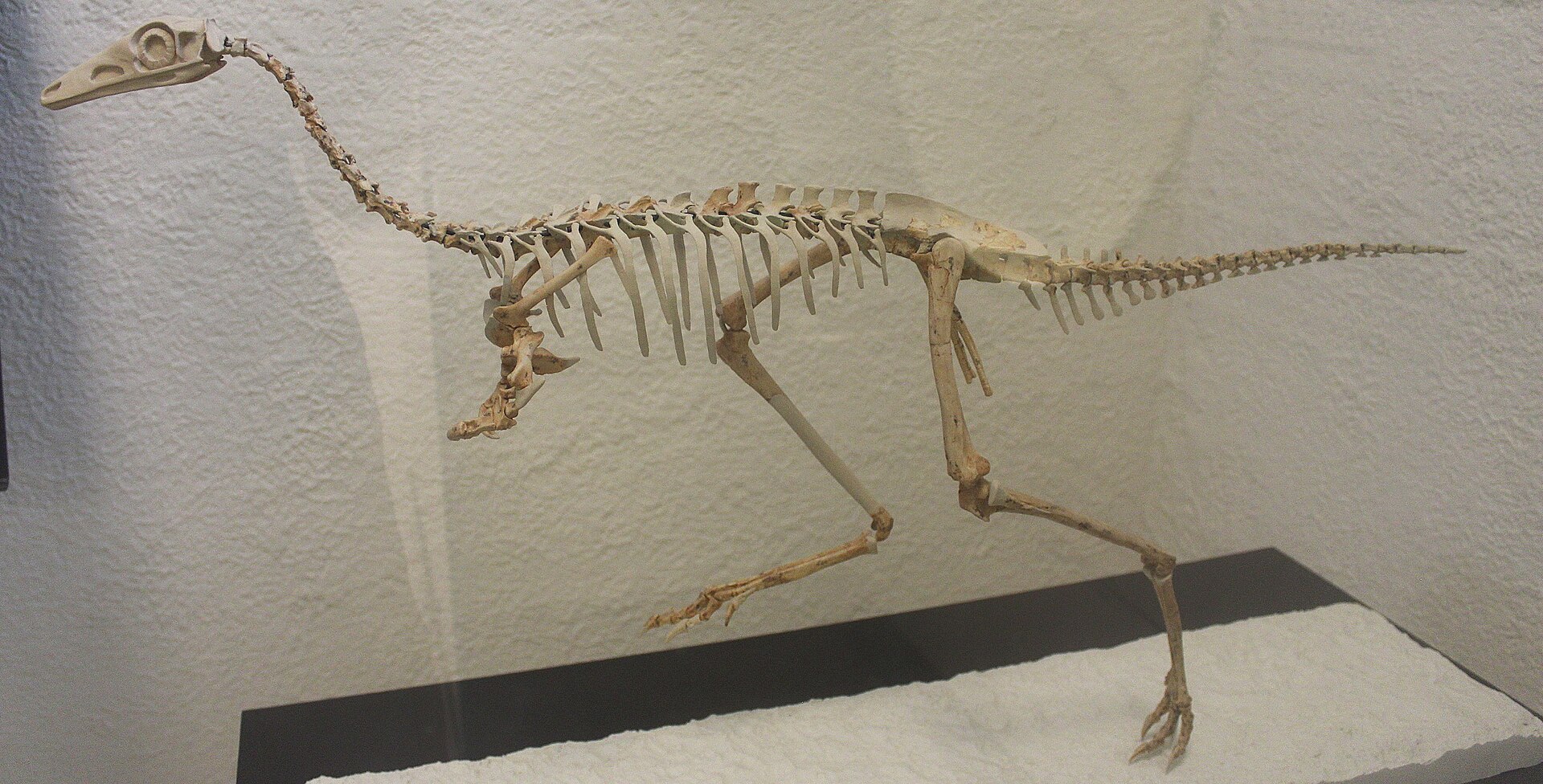
Cataloged as GI N107/6 at the Geological Institute of the Mongolian Academy of Sciences, the holotype is partial. It includes a fragmentary skull with the braincase, part of the right maxilla (upper jawbone), and a single tooth. Behind the head come 16 presacral vertebrae—those in front of the hips—read as eight neck vertebrae, three transitional cervicodorsals, and five back vertebrae. Both forelimbs survive, along with both scapulae (shoulder blades), the left coracoid, and the sternum. The hips and legs add part of the left ilium (main hip bone), both pubes, both femora (thigh bones), the tibiotarsi (fused shin and ankle bones), and foot bones.
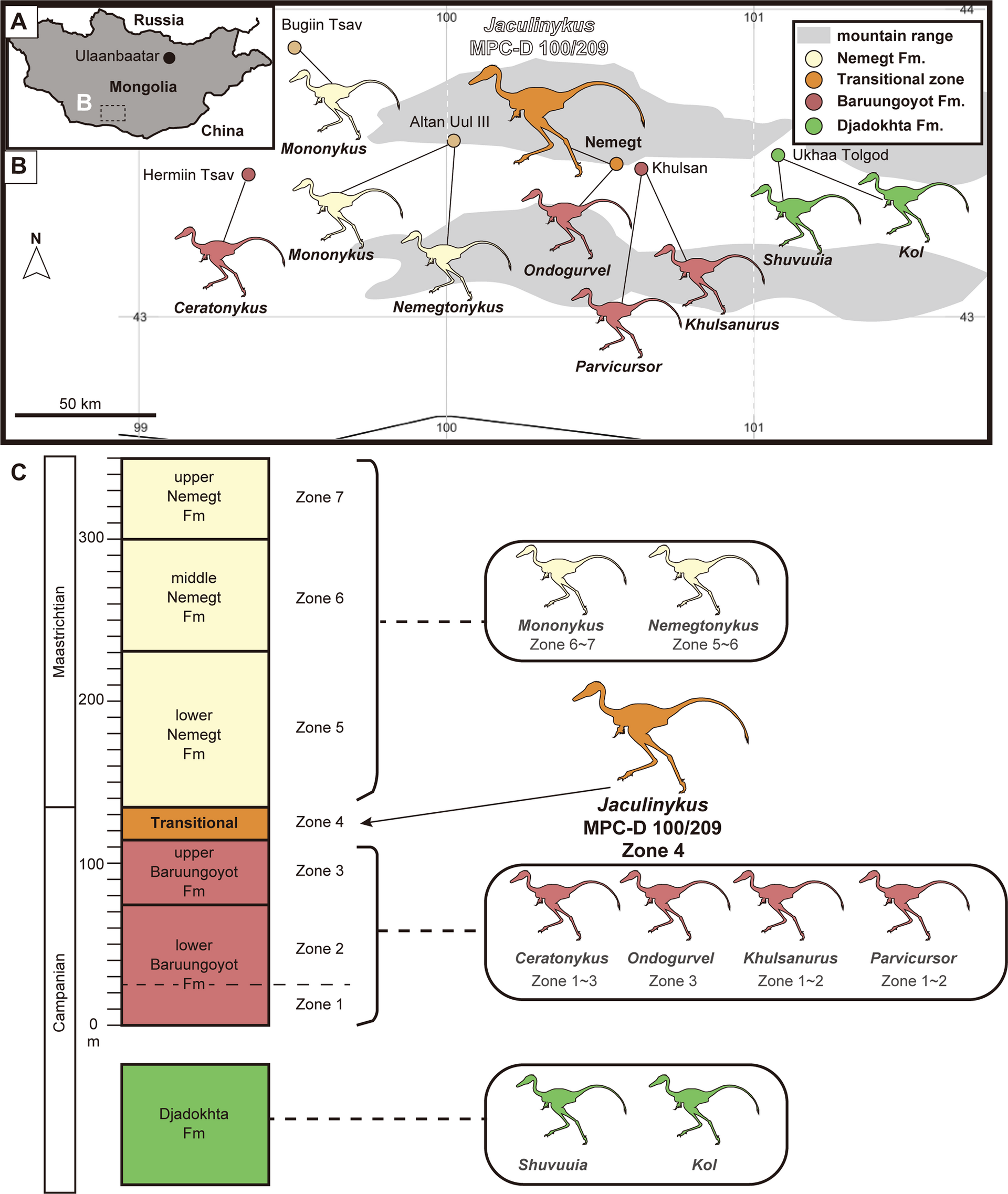

Until 2019, M. olecranus remained the only alvarezsaurid known from the Nemegt Formation. That year, paleontologist Sungjin Lee and colleagues described seven tail vertebrae and a left hind limb from Altan Uul III as cf. Mononykus sp.—a cautious label meaning “comparable to.” Overall, they found it very similar to Mononykus. The main difference, how far the shin had fused with the ankle, “could be related to ontogeny,” or growth stage. Alvarezsaurids are rarer in the Nemegt than in older formations, but Lee’s team suggested this may reflect “preservational biases rather than actual diversity.”
Mononykus Size and Description
Its 1994 describers summed up the animal—odd forelimbs on a body “that of a gracile cursor,” or lightly built runner.
Short description of Mononykus
Little of the skull survives. Its preserved maxilla is toothless, so the describers suggested teeth sat only in the missing front end or the premaxilla (snout-tip bone). The one tiny tooth is leaf-shaped and unserrated, with a constricted base. Large air spaces called tympanic recesses were well developed around the middle ear. The neck and back vertebrae were strongly compressed from side to side and lacked pleurocoels (air-sac openings).
The chest carried a stout sternum, subtriangular in cross-section, with a thick keel that the authors described as unique. No furcula (wishbone) was preserved, and the authors left open whether it was really absent. Farther back, the pelvis was opisthopubic, meaning the pubis pointed backward. Long, gracile hind limbs carried the body, while the fibula apparently stopped short of the ankle.
Skin and feathers are not preserved, so any discussion of its body covering is speculative. The ulna (a forearm bone) also shows no bumps for secondary flight feathers, though that says nothing about other feathers.

Size and Weight of Type Species
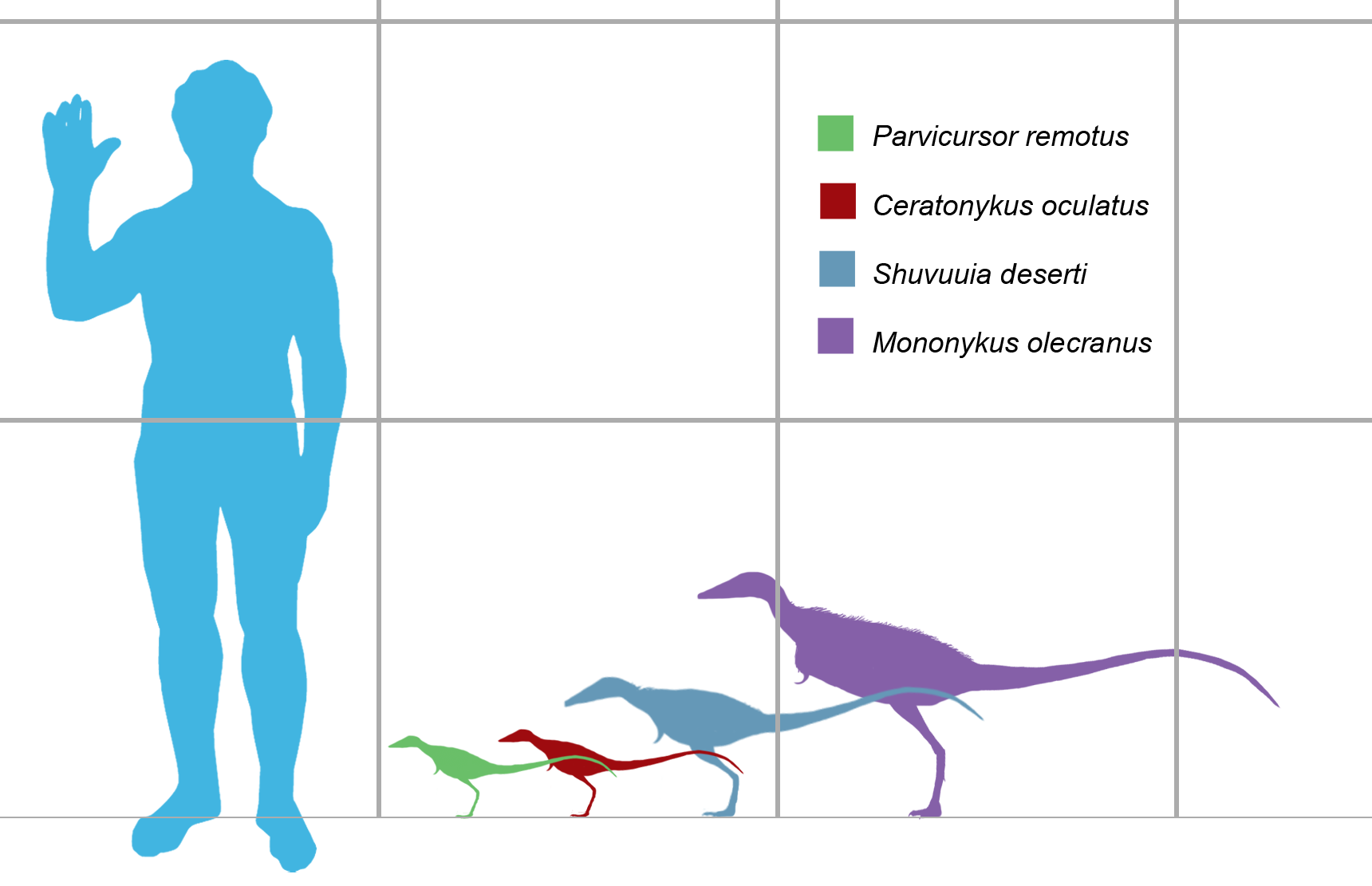
The 1994 describers gave no whole-body measurements and called Mononykus “turkey sized.” Its femur measures 138.6 millimeters (5.5 inches) and its tibiotarsus 175.2 millimeters (6.9 inches).
In 2025, paleontologist Jorge G. Meso and colleagues estimated a length of about 5.6 feet (1.70 meters), using a method from Therrien and Henderson. Using hind-limb regression equations, they reported a mass of about 9.3 pounds (4.23 kilograms). Even so, individual equations gave values from roughly 4 to 28 pounds (1.8 to 12.8 kilograms). A second method, based on limb-bone circumference, gave about 10.3 pounds (4.66 kilograms).
By contrast, London’s Natural History Museum lists about 3.3 feet (1 meter). Taken together, the lengths quoted run from 3.3 to 5.6 feet. Published mass estimates mostly fall between about 6.5 and 10.3 pounds (2.9–4.7 kilograms), for an animal still best pictured as turkey-sized.

The Dinosaur in Detail
What sets this dinosaur apart is its forelimb—short, massively built, and dominated by a single digit. The humerus (upper arm bone) is only about 36.7 millimeters (1.4 inches) long. Its deltopectoral crest, the ridge anchoring the chest and shoulder muscles, is “pillar like.” Its olecranon, the bony point of the elbow, is hypertrophied (enlarged) and forms “nearly half of the ulnar length.” Meanwhile, the carpometacarpus (fused wrist and hand bones) is “massive, short, quadrangular,” and the first digit is “much larger” than the greatly reduced others.
In the foot, metatarsal III is pinched out near the ankle—an arctometatarsalian arrangement the 1994 authors called “unique among Avialae.” In 2023, paleontologist Kohta Kubo and colleagues noted that its pillar-like crest differs from the humerus of Jaculinykus and Shuvuuia. Its carpometacarpus is also fused to metacarpals II and III, whereas Jaculinykus leaves metacarpal II out.
The bird question dominated the 1990s, starting with Zhou’s 1995 paper “Is Mononykus a bird?” Two years later, Chiappe, Norell, and Clark published “Mononykus and birds: methods and evidence.” In 1998, the same team argued that two skulls of its relative Shuvuuia supported a link to birds. However, the 2010 describers of Haplocheirus, which they found to be the earliest-diverging alvarezsauroid, confirmed the group’s place at the base of Maniraptora. They read its bird-like traits as “extreme morphological convergence”—features evolved independently.
Recent analyses still differ. In 2019, Lee and colleagues recovered Mononykus in an unresolved cluster with Shuvuuia, Parvicursor, and others. By contrast, Kubo’s team paired it in 2023 with Jaculinykus plus Shuvuuia. In 2025, Meso and colleagues placed alvarezsaurs just outside Maniraptora, with weak support. They also treated Nemegtonykus, named by Lee’s team, as a synonym of Mononykus. Taken together, these studies keep Mononykus at the center of alvarezsaur research—its identity secure, its exact neighbors still debated.
Interesting Points about Mononykus
- Within about a month of its 1993 naming, it needed a new name—a beetle genus had held Mononychus since 1824.
- The olecranon at its elbow forms nearly half the ulna, which is itself twice as long as the radius.
- In 2023, paleontologist Philip Senter found from shoulder casts that the arm could swing through 98 degrees in one plane, far beyond his 2005 estimate.
- Its 1993 describers presented it as a flightless bird, but alvarezsaurs are now regarded as non-bird theropods, usually placed as early maniraptorans.
Contemporary Dinosaurs
Looming over the Nemegt landscape was Tarbosaurus bataar, a large tyrannosaurid. Its remains lay close to the Mononykus holotype at Bugin Tsav. In 2010, paleontologists David Hone and Mahito Watabe also noted Tarbosaurus teeth and bones at the site, though no study documents an interaction.
Moving through the same river country was Saurolophus, a hadrosaurid—a duck-billed dinosaur. According to Hone and Watabe, one adult skeleton at Bugin Tsav measured approximately 39 feet (12 meters) long. Nothing links it to Mononykus beyond a shared formation and locality.
Stranger still was Deinocheirus mirificus, which paleontologist Yuong-Nam Lee and colleagues in 2014 called “the largest member of the Ornithomimosauria,” the ostrich-mimic dinosaurs. They described it as heavily built and non-cursorial—a “megaomnivore” whose stomach contents included fish remains. A newer specimen came from Bugin Tsav itself, yet the record shows no contact with Mononykus.
Rounding out the group was Nemegtomaia barsboldi, a crested oviraptorid whose holotype comes from the Nemegt locality. In 2012, paleontologist Federico Fanti and colleagues reported it from the upper Baruungoyot Formation as well. Here too, the record shows no interaction.
Mononykus in its Natural Habitat
The world Mononykus roamed was shaped by rivers. Most Nemegt fossils come from channel fills, point bars, and overbank deposits. These formed under more humid conditions than the semi-arid to arid Baruungoyot settings below. At the Nemegt locality, however, the two formations interfinger over about 82 feet (25 meters), suggesting that wind-blown and river environments coexisted early in Nemegt times. Large plant-eaters across the formation included the sauropods Nemegtosaurus and Opisthocoelicaudia, Therizinosaurus, and the armored ankylosaurid Tarchia.
The original authors compared the forelimb with those of fossorial (burrowing) tetrapods and inferred “extremely powerful movements.” Yet they also judged its short arms and long, gracile legs “incongruous with a burrowing habitus.” In 2005, Senter concluded that the arms suited “scratch-digging or hook-and-pull movements,” like those anteaters and pangolins use to open insect nests. In his view, Mononykus likely filled a similar niche. His 2023 restudy found a much wider range of shoulder motion, which, he argued, let it dig at surfaces of many orientations.
While there is no direct evidence of whether Mononykus lived alone or in groups, its long, gracile legs point to a lightly built runner. Meanwhile, Sungjin Lee’s team argued that alvarezsaurids adapted to wet as well as dry environments. If Senter’s reading is right, Mononykus filled an insect-foraging role, apart from the giant plant-eaters and predators around it.
Frequently Asked Questions
It means “single claw,” and it replaced the original spelling Mononychus, which already belonged to a beetle.
It lived in the Late Cretaceous—mid-Maastrichtian by its describers’ estimate, late Campanian to early Maastrichtian in later studies.
Estimates range from about 3.3 to 5.6 feet long and roughly 6.5 to 10 pounds, and its describers called it turkey-sized.
Its original description does not say, but Senter’s later work suggests it dug into insect nests like an anteater.
Its holotype came from Bugin Tsav in the Nemegt Formation of South Gobi Aimak, southwestern Mongolia.
Its short, powerful forelimb ended in one enlarged digit with a robust claw, attached to a massive, quadrangular hand.
Sources
The information in this article is based on various sources, drawing on scientific research, fossil evidence, and expert analysis. The aim is to provide a comprehensive and accurate overview of Mononykus. However, please be aware that our understanding of dinosaurs and their world is constantly evolving as new discoveries are made.
- https://doi.org/10.1038/362623a0
- https://doi.org/10.1038/363188a0
- https://digitallibrary.amnh.org/items/9ba411c8-45b2-4ff6-b27f-2bce20fb7200
- https://pmc.ncbi.nlm.nih.gov/articles/PMC6820876/
- https://pmc.ncbi.nlm.nih.gov/articles/PMC11811816/
- https://pmc.ncbi.nlm.nih.gov/articles/PMC10651048/
- https://www.nature.com/articles/32642
- https://pubmed.ncbi.nlm.nih.gov/20110503/
- https://www.cambridge.org/core/journals/paleobiology/article/abs/function-in-the-stunted-forelimbs-of-mononykus-olecranus-theropoda-a-dinosaurian-anteater/6823FD1CA0FDE6F376621C52A014BF1A
- https://pmc.ncbi.nlm.nih.gov/articles/PMC10704983/
- https://pmc.ncbi.nlm.nih.gov/articles/PMC3275628/
- https://www.app.pan.pl/archive/published/app55/app20090133.pdf
- https://pubmed.ncbi.nlm.nih.gov/25337880/
- https://pmc.ncbi.nlm.nih.gov/articles/PMC8616956/
- https://www.app.pan.pl/archive/published/app64/app005962019.pdf
- https://paleobiodb.org/classic/checkTaxonInfo?taxon_no=53210
- https://www.nhm.ac.uk/discover/dino-directory/mononykus.html
- https://mylog.pub.ous.ac.jp/gyoseki/english/researchersHtml/8337/REP_RONBUN/8337_REP_RONBUN_69.html
This article was last fact checked: TheDinosaurs Team, 03-11-2026
Featured Image Credit: PaleoNeolitic, CC BY 4.0, via Wikimedia Commons
