
In the quarries of Zhucheng, in eastern China’s Shandong Province, the Hongtuya Formation holds vast beds of dinosaur bones. From its Zangjiazhuang quarry comes Zhuchengtyrannus magnus, a giant tyrannosaurid named in 2011. These bone beds formed during the Campanian stage of the Late Cretaceous—roughly 77 to 73.5 million years ago. Only the animal’s jaws are known, yet its describers judged it comparable in size to both Tarbosaurus and Tyrannosaurus.
The jaws came to light during the large-scale excavations that opened up the Zhucheng bone beds. In 2011, paleontologist David Hone and eight colleagues named the animal in the journal Cretaceous Research. They placed it in Tyrannosaurinae—the subfamily that includes Tyrannosaurus itself—and noted that it adds to the known diversity of tyrannosaurids in Asia. Although known from just two bones, it ranks among the close Asian relatives of T. rex.
Zhuchengtyrannus Key Facts
| Keyword | Fact |
|---|---|
| Pronunciation | Zoo-cheng-tie-rannus, or Joo-cheng-tie-rannus |
| Meaning of name | Tyrannosaur From Zhucheng |
| Group | Theropoda |
| Type Species | Zhuchengtyrannus magnus |
| Diet | Carnivore |
| When it Lived | 77.3 to 73.5 MYA |
| Period | Cretaceous |
| Epoch | Late Cretaceous (Campanian stage) |
| Length | 32.8 to 39.4 feet (10 to 12 meters), estimated from the jaws |
| Height | About 13.1 feet (4 meters), press-release figure |
| Weight | About 13,200 pounds (6 metric tons), press-release figure |
| Mobility | Not specified |
| First Discovery | Year not specified |
| Described by | 2011 by D.W.E. Hone, K. Wang, C. Sullivan, X. Zhao, S. Chen, D. Li, S. Ji, Q. Ji, and X. Xu |
| Holotype | ZCDM V0031 |
| Location of first find | Zangjiazhuang quarry, Hongtuya Formation, Wangshi Group, Zhucheng, Shandong Province, China |
Zhuchengtyrannus Origins, Taxonomy and Timeline
As Hone explained, the name Zhuchengtyrannus means “tyrannosaur from Zhucheng,” the city whose quarries produced the bones. A university press release rendered it “tyrant from Zhucheng.” Meanwhile, magnus is Latin for “great,” a nod to its large size. Hone also offered two pronunciations—”Zoo-cheng-tie-rannus,” or a version starting with “Joo” that sits closer to formal Chinese. Together, the name ties a giant predator to the city that unearthed it.
Zhuchengtyrannus belongs to the theropods, the two-legged and mostly meat-eating dinosaurs. Within that group, it sits in the family Tyrannosauridae and, more narrowly, in the subfamily Tyrannosaurinae. On his blog, Hone called it another giant tyrannosaurine in the same mold as Tarbosaurus and Tyrannosaurus. Zhuchengtyrannus magnus is the type and only known species.
Dating the bone beds has proved tricky. In 2017, paleontologist Thomas Carr and colleagues cited the original paper’s age of 73.5 million years or older. However, in 2013, paleontologist Mark Loewen and colleagues had noted that this date came from a study lacking radioisotopic data. They therefore left Zhuchengtyrannus out of their biogeographic analysis. In 2016, An and colleagues dated the Zhucheng bone beds to between 77.3 and 73.5 million years ago, within the Campanian stage. They also assigned the beds to the Hongtuya Formation. Earlier work had put the Zangjiazhuang quarry near its boundary with the older Xingezhuang Formation. The older limit rests on a single zircon (a mineral grain that caps the sediment’s age). Its younger bound comes from a basalt at the top of the formation.
Discovery & Fossil Evidence
The holotype (the name-bearing specimen) comes from the Zangjiazhuang quarry, 5 kilometers (3.1 miles) from Kugou, another rich bone site. According to a university press release, most of the bones in the quarry belong to a gigantic hadrosaur (duck-billed dinosaur). However, no source we consulted records when the jaws left the ground.
Cataloged as ZCDM V0031, the holotype is housed at the Zhucheng Dinosaur Museum. It consists of a maxilla (upper jaw bone) and an associated dentary (lower jaw bone). Hone described the maxilla as nearly complete, with most of the teeth still in both bones. By his measurements, the maxilla is 64 centimeters (25.2 inches) long and the dentary 78 centimeters (30.7 inches). After collection, the maxilla suffered severe damage, so the paper relied on photographs and casts—the bone has since been repaired.
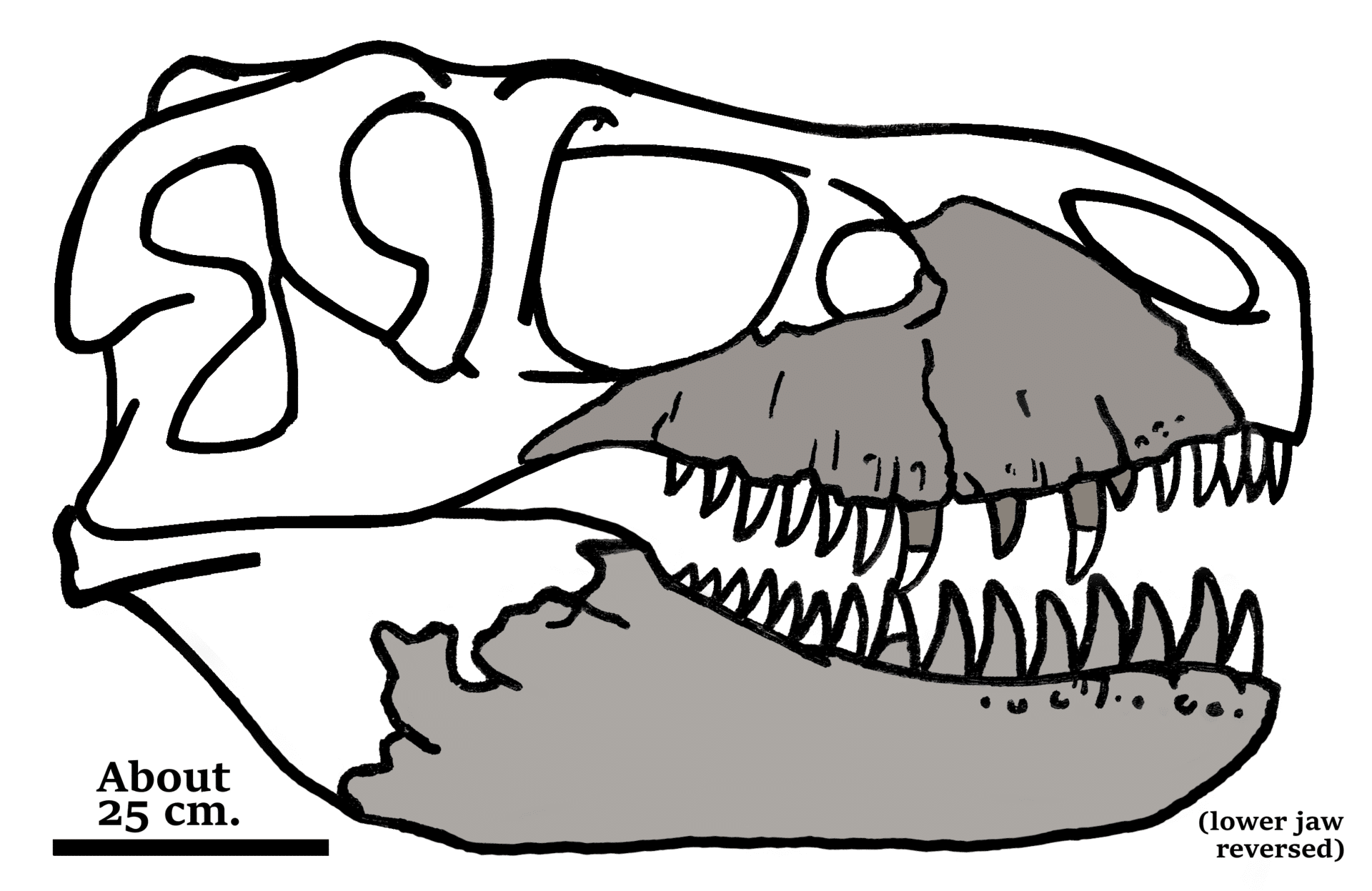

On his blog, Hone also reported a second maxilla and dentary that match neither Zhuchengtyrannus nor other tyrannosaurs—a hint of a second tyrannosaur at the site. Isolated teeth, vertebrae, femora (thigh bones), and metatarsals (foot bones) cannot yet be tied to either. Earlier still, teeth and a metatarsal from Zhucheng had carried the name Tyrannosaurus zhuchengensis. According to Hone, his team called it a nomen dubium—a “doubtful name” resting on undiagnostic fossils—and Yu and colleagues called it invalid in 2018. No additional specimens of Zhuchengtyrannus have been confirmed beyond the holotype jaws.
Zhuchengtyrannus Size and Description
With only two jaw bones to work from, any picture of the whole animal leans heavily on its relatives.
Short description of Zhuchengtyrannus
The holotype preserves parts of the upper and lower jaws of a huge, deep-snouted predator. Its maxilla carries heavy surface sculpting, which Hone noted is normally seen only in adult tyrannosaurs. Later studies, citing the original paper, note textural ridges and shallow hollows that it shares with Tarbosaurus and Tyrannosaurus. In 2024, paleontologist Sebastian Dalman and colleagues listed 15 dentary teeth, against 14 to 15 in Tarbosaurus and typically 13 in T. rex.
Everything behind the jaws is unknown, although Hone suggested that in life it looked very much like Tarbosaurus and Tyrannosaurus. Still, no skin, feathers, or other soft tissue is preserved, so any discussion of its covering is speculative.

Size and Weight of Type Species
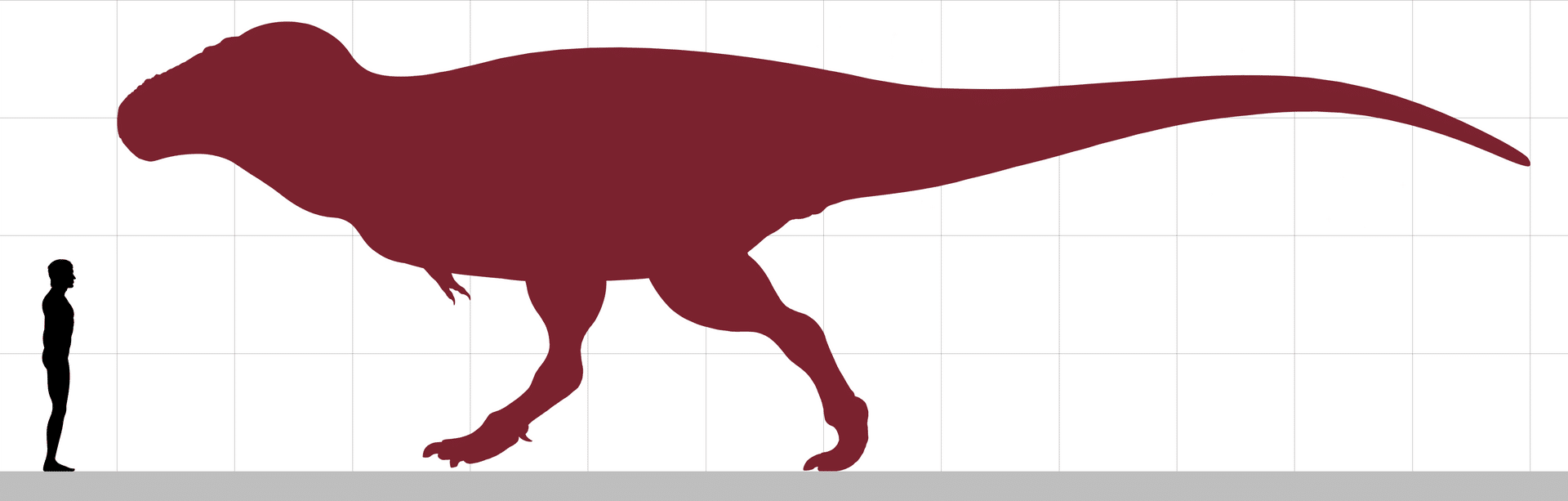
Without a skeleton, estimates of body size must come from comparisons. As Hone later reported, the 2011 paper scaled the jaws against Tyrannosaurus and Tarbosaurus. The result was 32.8 to 39.4 feet (10 to 12 meters)—an indirect estimate, not a measurement. Paleontologist Thomas Holtz’s genus list, updated in 2012, also gave about 32.8 feet.
The accompanying press release offered round numbers—about 36.1 feet (11 meters) long, 13.1 feet (4 meters) tall, and close to 13,200 pounds (6 metric tons). Hone later conceded that the height “might be a bit much,” and the weight, he explained, came by analogy with typical T. rex estimates, not a calculation.
In the press release, Hone said the bones were just a few centimeters smaller than those of the largest T. rex specimen. On his blog, however, he gave the maxilla of “Sue,” a giant T. rex, as about 79 centimeters (31.1 inches) long. As Hone put it, the team was “extrapolating from less than half a skull.”

The Dinosaur in Detail
What sets this dinosaur apart is a pair of small details on the maxilla. Hone and colleagues identified a horizontal shelf at the base of the ascending process, the upward-reaching arm of the bone. They also found a rounded notch at the front of the maxillary fenestra (an opening in the snout’s side). Several additional features complete a unique combination, and Hone later named two—the position of the antorbital fossa (a hollow before the eye socket) and the fenestra’s size.
In 2011, Hone defended the genus, noting that its key traits are not known to change with growth or between individuals. Even so, he acknowledged that some “lumping” taxonomists might not accept it. Later analyses have nonetheless kept Zhuchengtyrannus as a separate genus.
Its exact branch is less settled. In 2013, Loewen and colleagues recovered it as the sister taxon (closest relative) of Tarbosaurus. A year later, Fiorillo and Tykoski placed Nanuqsaurus just outside a group of Tyrannosaurus, Tarbosaurus, and Zhuchengtyrannus. Carr and colleagues then argued that Z. magnus and Tarbosaurus bataar were successive sister species to T. rex. By contrast, McDonald and colleagues left it in an unresolved cluster of large tyrannosaurines in 2018. In 2022, Warshaw and Fowler made it sister to a Tyrannosaurus and Tarbosaurus pairing. Just outside sat the species of Daspletosaurus—a series of separate branches rather than a single group.
Dalman and colleagues later called it a “wildcard taxon”—one that shifts position between analyses. The root problem is missing data—in 2025, Voris and colleagues scored only 10.3 percent of its characters and left it out of their reduced analysis. Taken together, these studies keep Zhuchengtyrannus close to Tarbosaurus and Tyrannosaurus, with its precise position still open.
Interesting Points about Zhuchengtyrannus
- The genus name means “tyrannosaur from Zhucheng,” while the species name magnus refers to the animal’s large size.
- Its dentary, or lower jaw bone, measures about 78 centimeters (30.7 inches), and Hone thought it was probably a little longer in life.
- Severe damage to the holotype maxilla after collection forced its describers to rely on photographs and casts before the bone was repaired.
- Before Anomalipes was named in 2018, Zhuchengtyrannus was the only named, valid theropod from the Zhucheng bone beds.
- In Loewen and colleagues’ 2013 tree, which put Alioramus outside the family, Tarbosaurus and Zhuchengtyrannus were the only tyrannosaurids known beyond western North America.
Contemporary Dinosaurs
Sharing the same quarry was Sinoceratops zhuchengensis, a large centrosaurine ceratopsid, or horned dinosaur. In 2010, its describers called it larger than most centrosaurines and the only known ceratopsid outside North America. No direct evidence links the two, so they are best pictured as neighbors.
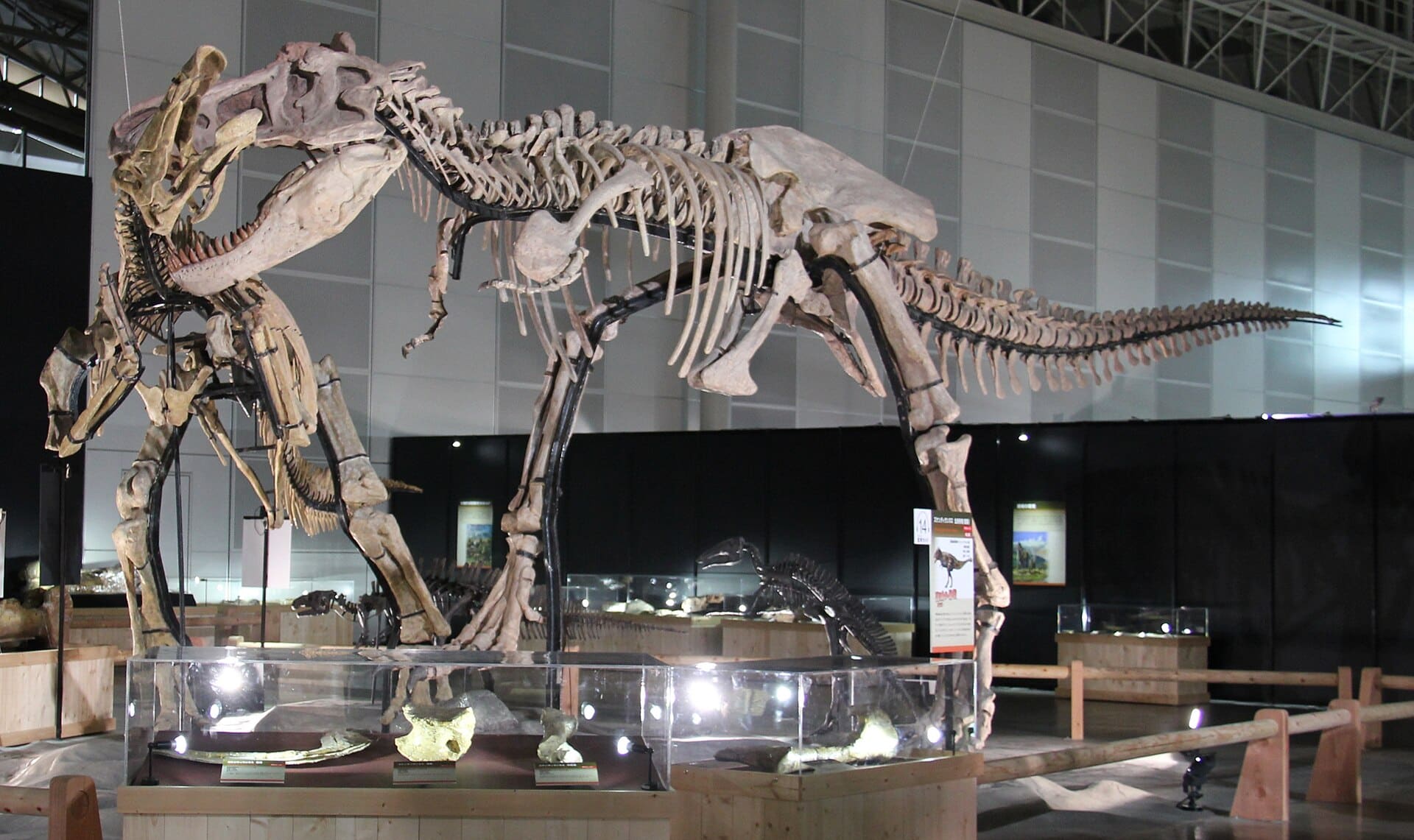
Most abundant of all was Shantungosaurus giganteus, which Xu and colleagues called the largest known hadrosaurid. Its jumbled bones dominate the Zhucheng bone beds. Zhucheng has even displayed a T. rex mount fitted with casts of the Zhuchengtyrannus jaws, posed attacking a young Shantungosaurus. That pairing is a museum scene, however, not fossil evidence.
Adding a long-necked dinosaur to the scene was Zhuchengtitan zangjiazhuangensis, a titanosaurian sauropod known from a nearly complete humerus (upper arm bone). Mo and colleagues described it in 2017 as the first titanosaurian from Shandong’s Upper Cretaceous. The Paleobiology Database places it in the Zangjiazhuang quarry, but nothing else connects it to Zhuchengtyrannus.
From nearby Kugou came Anomalipes zhaoi, a caenagnathid oviraptorosaur known from a partial left hind limb. Yu and colleagues named it in 2018 from bones found within a Shantungosaurus bone bed at Kugou. They also noted that Kugou and Zangjiazhuang lie close together, both geographically and stratigraphically. In 2016, An and colleagues had already placed the Kugou bone beds in the same Hongtuya Formation. It sits on a very different branch of the theropod family tree.
Zhuchengtyrannus in its Natural Habitat
The world Zhuchengtyrannus roamed was a basin fed by alluvial fans—fan-shaped spreads of sediment where streams leave higher ground—and braided rivers. According to An and colleagues, debris flows buried the bones, and the sediment came mainly from the north–northwest, around Laiyang and the Yishu Fault Zone. However, no study we consulted reconstructs its climate or plant life.
Hone inferred that Zhuchengtyrannus filled a niche like other giant tyrannosaurines, combining predation and scavenging. Still, no bite marks or other direct traces tie it to any prey. At Kugou, Hone reported around 3,000 bones, almost all from Shantungosaurus. They showed no sign of scavenging or trampling—which he read as a major, rapid burial event.
While there is no direct evidence of its social life, a second tyrannosaur in the quarry suggests two big predators may have coexisted. In 2011, Hone also thought it quite likely that Zhuchengtyrannus met Tarbosaurus. Later work weakens that idea, however. Loewen and colleagues used an age of about 70.6 million years for Tarbosaurus, and its fossils come mainly from Mongolia’s Nemegt Formation—well over a thousand kilometers from Zhucheng. Taken together, the bone beds paint a picture of a river-fed basin full of giant herbivores—and at least one giant tyrannosaur.
Frequently Asked Questions
It means “tyrannosaur from Zhucheng,” and the species name magnus refers to the animal’s large size.
It lived in the Campanian stage of the Late Cretaceous, between 77.3 and 73.5 million years ago.
Its describers estimated 32.8 to 39.4 feet long. A press release suggested about 13,200 pounds, but that figure was not a calculated estimate.
It was a carnivore, and its lead describer suggested it both hunted and scavenged like other giant tyrannosaurines.
Its jaws come from the Zangjiazhuang quarry in the Hongtuya Formation at Zhucheng, Shandong Province, China.
A horizontal shelf on its upper jaw bone and a rounded notch in a snout opening set it apart from other tyrannosaurs.
Sources
The information in this article is based on various sources, drawing on scientific research, fossil evidence, and expert analysis. The aim is to provide a comprehensive and accurate overview of Zhuchengtyrannus. However, please be aware that our understanding of dinosaurs and their world is constantly evolving as new discoveries are made.
- https://doi.org/10.1016/j.cretres.2011.03.005
- https://research-information.bris.ac.uk/en/publications/ee3d9b9b-8124-4ebb-bbbc-9626cfded7af
- https://archosaurmusings.wordpress.com/2011/03/31/zhuchengtyrannus-is-here/
- https://archosaurmusings.wordpress.com/2011/04/01/notes-on-the-taxonomy-and-identity-of-zhuchengtyrannus/
- https://archosaurmusings.wordpress.com/2011/04/02/the-ecological-implications-of-zhuchengtyrannus/
- https://archosaurmusings.wordpress.com/2011/04/03/so-just-how-big-was-zhuchengtyrannus/
- https://archosaurmusings.wordpress.com/2011/07/08/zhuchengtyrannus-strikes/
- https://archosaurmusings.wordpress.com/2011/07/24/last-zhucheng-roundup/
- https://archosaurmusings.wordpress.com/2014/11/24/a-population-of-shantungosaurus-the-largest-ornithischian/
- https://www.ucd.ie/news/2011/04APR11/010411-Long-lost-cousin-of-T-rex-identified-by-scientists.html
- https://doi.org/10.1016/j.jop.2015.11.002
- https://doi.org/10.1371/journal.pone.0187064
- https://doi.org/10.1371/journal.pone.0079420
- https://doi.org/10.1371/journal.pone.0091287
- https://pmc.ncbi.nlm.nih.gov/articles/PMC4735739/
- https://doi.org/10.1038/srep44942
- https://doi.org/10.7717/peerj.5749
- https://doi.org/10.7717/peerj.14461
- https://doi.org/10.1038/s41598-023-47011-0
- https://doi.org/10.1038/s41598-024-66278-5
- https://www.nature.com/articles/s41586-025-08964-6
- https://doi.org/10.1038/s41598-026-38600-w
- https://doi.org/10.1007/s11434-009-3614-5
- https://doi.org/10.1371/journal.pone.0013835
- https://doi.org/10.1371/journal.pone.0144148
- https://doi.org/10.1038/s41598-018-23252-2
- http://dzhtb.cgs.cn/ch/reader/view_abstract.aspx?file_no=20170901&flag=1
- https://paleobiodb.org/classic/basicCollectionSearch?collection_no=96815
- https://paleobiodb.org/data1.2/occs/list.txt?base_name=Tarbosaurus&show=strat,loc&vocab=pbdb
- http://www.geol.umd.edu/~tholtz/dinoappendix/HoltzappendixWinter2011.pdf
This article was last fact checked: TheDinosaurs Team, 01-11-2026
Featured Image Credit: The Afenogaster, CC BY-SA 4.0, via Wikimedia Commons
