
At Minchinhampton in Gloucestershire, England, the pale limestones of the Great Oolite Group gave up a small skull with a long and contested history. It belongs to Proceratosaurus bradleyi, a meat-eating theropod from the Middle Jurassic—roughly 168 to 165 million years ago. For about a century, scientists moved it between very different branches of the theropod family tree. Since 2010, however, researchers have classed it as a tyrannosauroid—one of the tyrant dinosaurs and their early kin.
The skull came to light during the digging of a reservoir, and its finder, F. Lewis Bradley, prepared it himself. In 1910, paleontologist Arthur Smith Woodward described it as a new species of Megalosaurus, naming it in honor of its discoverer. Sixteen years later, paleontologist Friedrich von Huene gave the species a genus of its own. Still known from this single specimen, Proceratosaurus shows how much one well-prepared skull can reveal—and how long its meaning can stay open.
Proceratosaurus Key Facts
| Keyword | Fact |
|---|---|
| Pronunciation | proh-ker-at-oh-sore-us (Natural History Museum, London) |
| Meaning of name | Before Ceratosaurus |
| Group | Theropoda |
| Type Species | Proceratosaurus bradleyi |
| Diet | Carnivore |
| When it Lived | About 168 to 165 MYA |
| Period | Jurassic |
| Epoch | Middle Jurassic (Bathonian stage) |
| Length | About 9.8 feet (3 meters), estimated from skull length and probably a maximum |
| Height | Not specified |
| Weight | 62 to 79 pounds (28 to 36 kilograms), estimated from skull length and probably a maximum |
| Mobility | Not specified |
| First Discovery | Year not specified (before 1910) by F. Lewis Bradley |
| Described by | 1910 by A.S. Woodward (as Megalosaurus bradleyi), genus named 1926 by F. von Huene |
| Holotype | NHMUK PV R 4860 (also cited as NHM R 4860) |
| Location of first find | Reservoir excavation, Minchinhampton, Gloucestershire, England, Great Oolite Group (exact formation uncertain) |
Proceratosaurus Origins, Taxonomy and Timeline
The name Proceratosaurus means “before Ceratosaurus,” according to the Natural History Museum in London. In 2003, paleontologist O.W.M. Rauhut wrote that Huene saw it as a close relative of Ceratosaurus, a theropod with a bony horn core on its nose.
Today Proceratosaurus sits within Theropoda, Tyrannosauroidea, and the family Proceratosauridae. In 2010, Rauhut, Milner, and Moore-Fay grouped it with Guanlong, a crested species from the Oxfordian stage of China, in a new clade they called Proceratosauridae. Later that year, Averianov and colleagues formally established the family and added Kileskus, a Bathonian theropod from Siberia. Proceratosaurus bradleyi is the type and only known species, and every later study reviewed here treats it as valid.
The skull dates to the Bathonian stage, roughly 168 to 165 million years ago. Rauhut and colleagues placed it in the Late Bathonian, while the Paleobiology Database allows a middle to late Bathonian age. Because the exact bed is unknown, a finer date is not possible. Even so, its age matters. The 2010 authors argued that it pushes the origin of every early coelurosaur lineage—the theropod branch that includes tyrannosauroids—into the Middle Jurassic. They also suggested an early dispersal of tyrannosauroids across Laurasia, the northern supercontinent.
Discovery & Fossil Evidence
Woodward reported that the skull had come “some time ago” from a reservoir dig at Minchinhampton. No source gives an exact year, but the find predates Woodward’s talk to the Geological Society on 26 January 1910. Bradley’s careful work left the specimen “beautifully exposed for study from the left side.” Until then, Woodward wrote, scientists knew the skull of Megalosaurus “only by unsatisfactory fragments of jaws.” His meeting abstract hailed the find as showing “for the first time the skull of Megalosaurus.”
The holotype—the name-bearing specimen—is NHMUK PV R 4860, held by the Natural History Museum in London. Rauhut and colleagues list a partial skull and mandibles (lower jaws), a hyoid (throat bone), and fragments of cervical ribs. The museum’s own catalog lists anterior cervical vertebrae instead. An irregular fissure in the rock had destroyed the top of the skull, and calcite later partly filled the gap.
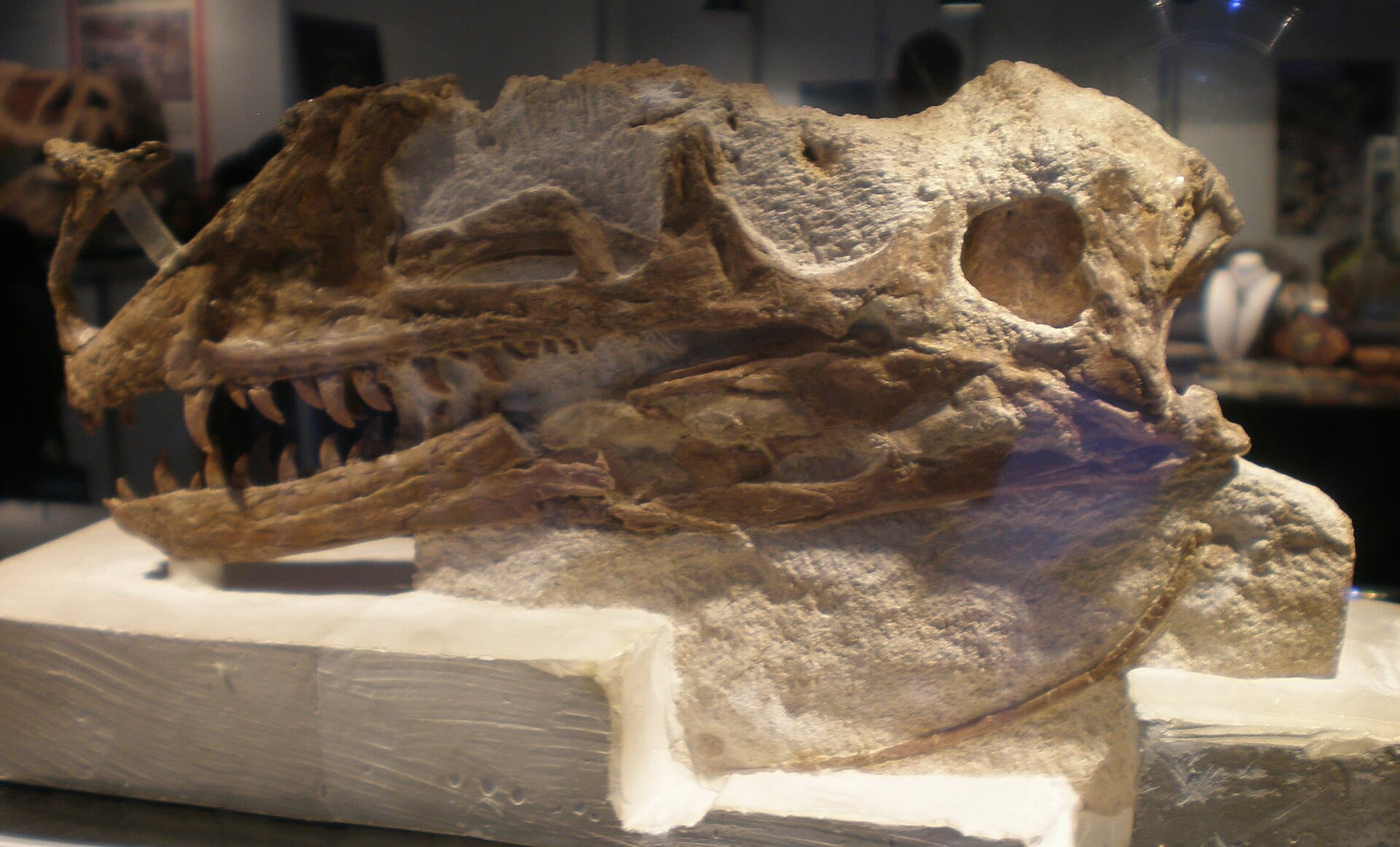

Woodward measured the preserved skull at 10.2 inches (26 centimeters) and called it “rather small.” With the top of the skull gone, Huene later based his restored drawing only on the preserved bones and Ceratosaurus. A 1995 review and the Paleobiology Database both place the horizon in the White Limestone Formation. Other sources disagree, however. The British Geological Survey’s account of Minchinhampton lists different local units, and in 2022, Naish and Cau placed Proceratosaurus in the Taynton Limestone Formation instead. The exact formation remains uncertain. In 2010, Rauhut’s team restudied the fossil using new preparation and CT (computed tomography) scans. No additional specimens of Proceratosaurus have been confirmed—the Minchinhampton skull is still the only one known.
Proceratosaurus Size and Description
With only a skull to go on, Proceratosaurus survives from the neck up—and everything else rests on estimates.
Short description of Proceratosaurus
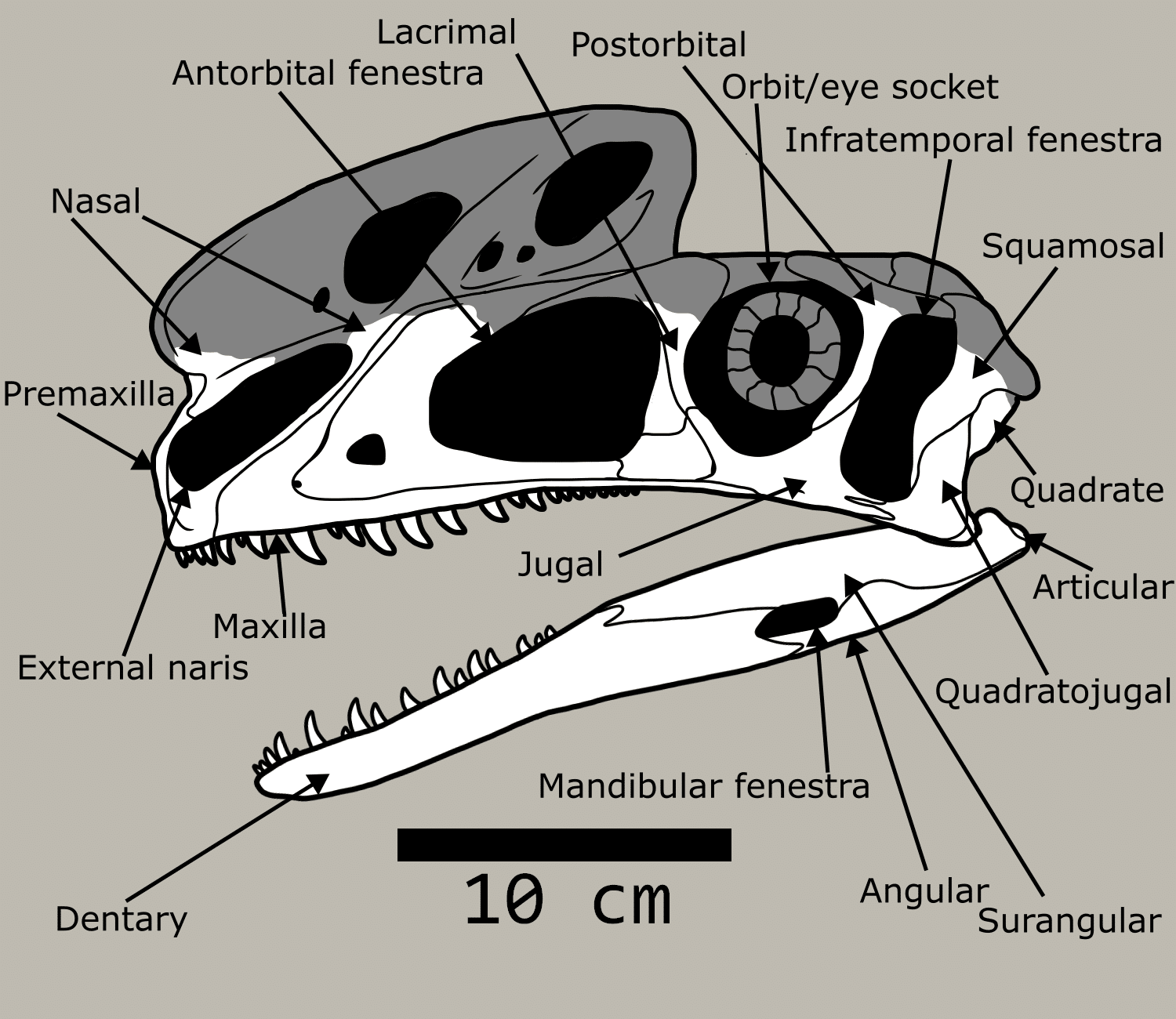
Woodward described an especially large antorbital opening—the window in front of the eye socket. It was “as wide as the other two together,” meaning the orbit and the opening behind it. The nostril opening formed an elongated oval, “three times as wide as deep.” In 2010, Rauhut’s team found the nares (nostrils) “markedly enlarged,” taking up more than 20 percent of the skull’s length. Above them rose a crest, beginning where the premaxilla (front snout bone) meets the nasal bones. Only the front base of this structure survives, and Woodward called it “a horn-core,” as in Ceratosaurus.
The skull was also “highly pneumatic,” hollowed by air spaces in the nasals, jugals (cheekbones), maxillae, and braincase. The premaxilla had sockets for four small teeth, while the maxilla, the main upper tooth-bearing bone, had sockets for eighteen. Huene saw room for a fifth premaxillary tooth behind the first four. Below the lower jaw lay a long, slender curved bone, which Woodward took to be “probably one of the hyoid elements.” Nothing from behind the neck has turned up, so posture, limb proportions, and body covering all remain unknown.

Size and Weight of Type Species
In 2010, Rauhut and colleagues estimated the complete skull at 11.0 to 11.8 inches (280 to 300 millimeters). Using formulas by Therrien and Henderson (2007), they calculated a length of 9.8 to 10.4 feet (2.98 to 3.16 meters).
The same method gave a body mass of 62 to 79 pounds (28 to 36 kilograms). However, the formula seems to overestimate Guanlong, a fully grown relative about 9.8 feet (3 meters) long. If Proceratosaurus followed the same pattern, the authors cautioned, their range would mark a maximum. Even so, it points to “a rather small and gracile animal.”
Growth stage adds another layer of doubt. In 1910, Woodward suggested that the skull’s small size “may perhaps be due to immaturity.” A century later, Rauhut’s team found its sutures “generally firmly closed,” with no juvenile bone texture. They judged it at least a subadult, although they could not completely rule out a late juvenile.
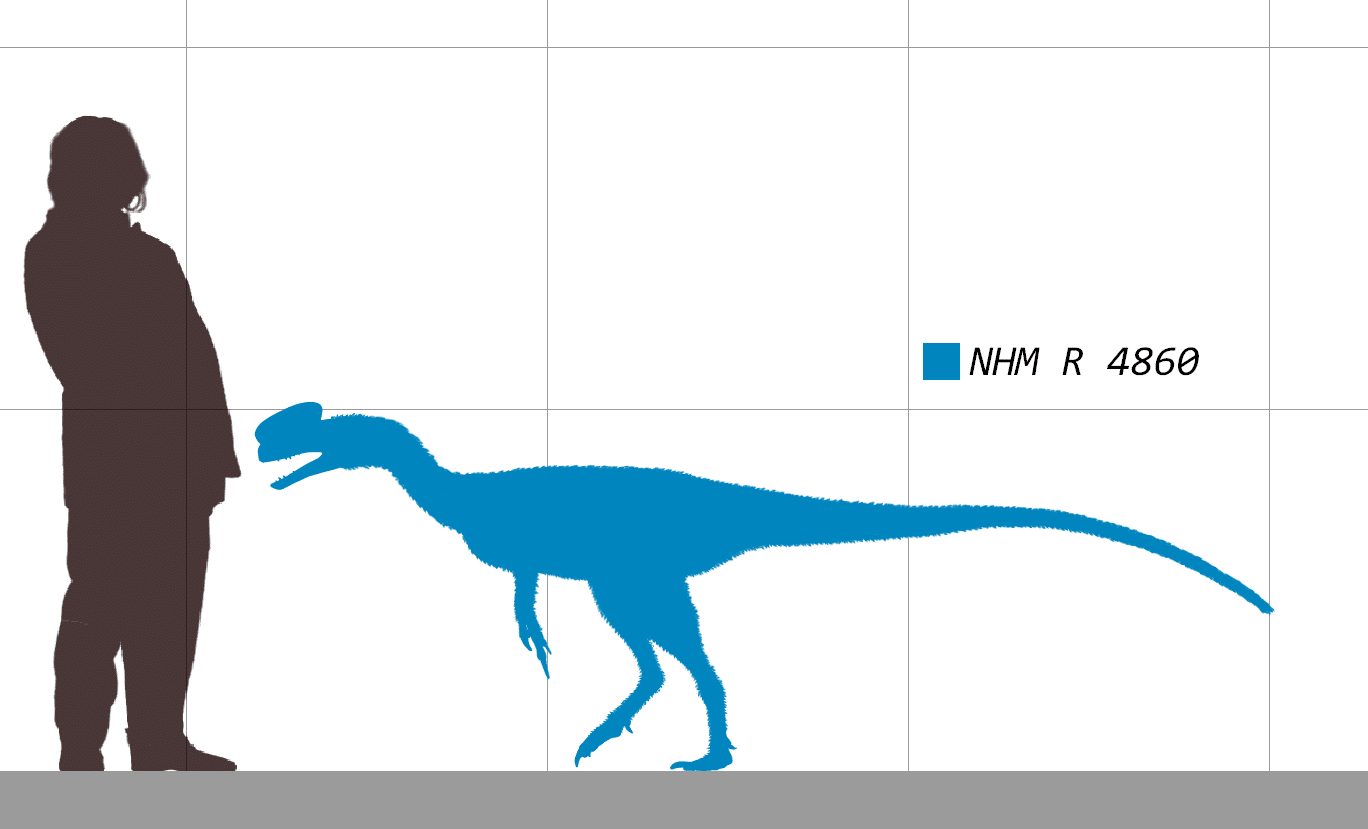

Museum figures vary. The Natural History Museum’s Dino Directory lists 13.5 feet (4.1 meters) without a method, while the Australian Museum suggests 6.6 to 9.8 feet (2 to 3 meters). The peer-reviewed figure of about 9.8 feet works best as an upper limit.
The Dinosaur in Detail
What sets this dinosaur apart is the front of its snout. In 2010, Rauhut’s team listed its unique traits, led by a nasal horn core overhanging the bony bar between the nostrils. That bar forks toward the back, and the antorbital fossa—a sunken area around the opening—reaches far forward. The first dentary (lower jaw) tooth is odd too, curving forward out of the jaw.
The teeth show a sharp contrast. Woodward found the premaxillary teeth “remarkable for their very small size,” with a few slight vertical flutings. Huene added that they bore “peculiar lateral flat longitudinal folds,” unknown to him elsewhere. By contrast, the maxillary teeth had flat sides and a backward curve, with a sharp serrated rear edge. Woodward even saw a tendency for alternate tooth replacement, “as in crocodiles.”
The crest is harder to read. Woodward and Huene both saw a horn core like that of Ceratosaurus, and Huene stressed a “near relationship.” In 2003, however, Rauhut noted that its position differs from that horn. Because the skull roof is incomplete, he could not tell whether it was a nasal horn or a midline crest. None of the studies reviewed here proposes a use for it.
Its family tree has wandered just as much. Huene treated it as a coelurosaur in 1932, and Paul linked it to Ornitholestes in 1988. Madsen and Welles placed it in Ceratosauridae in 2000, while Holtz and Rauhut each recovered it as a basal coelurosaur, with weak support. The 2010 analysis then placed it within Tyrannosauroidea. In 2016, Brusatte and Carr described Proceratosauridae as an early clade “of mostly small-bodied species with elaborate cranial crests.” Larger forms such as Yutyrannus group alongside them. Taken together, current analyses put Proceratosaurus near the root of the tyrannosauroid line.
Interesting Points about Proceratosaurus
- Woodward assigned the skull to Megalosaurus partly for its four premaxillary teeth, and he ruled out Ceratosaurus because that genus had “not more than three.”
- In 2010, Rauhut and colleagues noted that Huene credited Woodward with the Ceratosaurus link, although Woodward had used that tooth count against it.
- At the 1910 meeting, Geological Society president W.J. Sollas regretted only that the skull was “not to rest side by side with the original specimen” in Oxford.
- The name Proceratosaurus first appeared in a 1923 figure by Huene without any text, making that early use a nomen nudum—a “naked name” with no formal standing.
- In 1988, Paul referred the much larger French Piveteausaurus divesensis to Proceratosaurus, although the only overlapping bones were then still hidden in rock.
Contemporary Dinosaurs
From a neighboring region comes Cetiosaurus, a large sauropod from the Late Bathonian White Limestone and Forest Marble formations of Oxfordshire, roughly 40 miles (65 kilometers) east of Minchinhampton. A 1995 review by Benton and Spencer gives its species C. oxoniensis a length of about 49 feet (15 meters) and a femur (thigh bone) of 5.4 feet (1.65 meters). The same review records Cetiosaurus in the upper White Limestone at quarries such as Bletchington and Kirtlington, calling its bones “relatively abundant” in the Late Bathonian. In 2009, Upchurch and colleagues noted that the remains first used to name C. oxoniensis came from the Forest Marble—another Bathonian unit of the Great Oolite Group. The British Geological Survey traces the uppermost Great Oolite beds near Minchinhampton eastward into the White Limestone, part of the same carbonate shelf. Still, no fossil links the two animals directly.
Proceratosaurus in its Natural Habitat
The world Proceratosaurus knew was a patchwork of sea and land. In the Bathonian, shallow seas surrounded areas of low-lying land on structural highs. Southern England sat on a carbonate ramp called the Cotswold Shelf, where an oolite barrier divided open sea to the south from lagoons and coastal plains to the north. Meanwhile, karst surfaces, ancient soils, and drifted wood show that patches of land occasionally emerged.
Summarizing Palmer (1979), Benton and Spencer compared the setting at Kirtlington in Oxfordshire to a low coastal landscape “rather like the Florida Everglades.” In Bathonian times, the site lay near a small island barrier about 19 miles (30 kilometers) off the Anglo-Belgian landmass, at roughly 30°N. Palmer also supposed a quiet-water lagoon in the upper White Limestone there, stirred from time to time by currents, perhaps during storms. Back at Minchinhampton, the skull’s own block is a white limestone made of ooids—tiny rounded grains.
While there is no direct evidence of its meals, scientists have treated Proceratosaurus as a carnivore since 1910, when Woodward placed it in “the carnivorous Dinosaur Megalosaurus.” That view rests on its place among theropods, not on stomach contents or bite marks. Its social life and hunting style are equally unknown. Even so, this small Middle Jurassic predator offers a rare glimpse of the tyrannosauroid lineage near its roots.
Frequently Asked Questions
It means “before Ceratosaurus,” reflecting Huene’s view that it was an early relative of that horned theropod.
It lived in the Bathonian stage of the Middle Jurassic, about 168 to 165 million years ago.
A 2010 estimate from skull length gives about 9.8 feet (3 meters) and 62 to 79 pounds, probably a maximum.
Scientists class it as a carnivore, based on its place among theropods rather than on direct evidence.
Its only skull came from a reservoir excavation at Minchinhampton, Gloucestershire, England, in the Great Oolite Group.
A nasal horn core overhangs its forked nostril bar, and its Middle Jurassic age makes it an early member of the tyrannosauroid line.
Sources
The information in this article is based on various sources, drawing on scientific research, fossil evidence, and expert analysis. The aim is to provide a comprehensive and accurate overview of Proceratosaurus. However, please be aware that our understanding of dinosaurs and their world is constantly evolving as new discoveries are made.
- https://archive.org/details/quarterlyjourna661910geol
- https://archive.org/download/biostor-86534/biostor-86534.pdf
- https://doi.org/10.1080/00222932608633437
- https://publicaciones.fcnym.unlp.edu.ar/rmlp/article/view/1393
- https://doi.org/10.1111/j.1096-3642.2009.00591.x
- https://tb.plazi.org/GgServer/html/0073C5185766F9524679FBF2FDDFFB1C
- https://tb.plazi.org/GgServer/html/0073C5185765F953442BFC38FDA5FEF7
- https://tb.plazi.org/GgServer/html/0073C518577AF94F4417FA65FB51F99D
- https://tb.plazi.org/GgServer/html/77323C29FFD2B424FF179A43F920F8DA
- https://www.zin.ru/journals/trudyzin/doc/vol_314_1/TZ_314_1_Averianov.pdf
- https://www.ncbi.nlm.nih.gov/pmc/articles/PMC4735739/
- https://data.jncc.gov.uk/data/574eac76-683c-47c6-a1de-b22439031f4c/gcr-v10-fossil-reptiles-of-great-britain-c6.pdf
- https://archive.org/download/biostor-284266/biostor-284266.pdf
- https://doi.org/10.1016/j.pgeola.2019.02.003
- https://earthwise.bgs.ac.uk/index.php/Great_Oolite_Group,_Middle_Jurassic,_Minchinhampton,_Bath%E2%80%94Cotswolds_Province
- https://doi.org/10.7717/peerj.12727
- https://paleobiodb.org/data1.2/occs/list.json?base_name=Proceratosaurus&show=strat,loc,coll,ref,stratext,lithext,paleoloc&vocab=pbdb
- https://data.nhm.ac.uk/dataset/collection-specimens/resource/05ff2255-c38a-40c9-b657-4ccb55ab2feb/record/2140243
- https://www.nhm.ac.uk/discover/dino-directory/proceratosaurus.html
- https://australian.museum/learn/dinosaurs/fact-sheets/proceratosaurus-bradleyi/
- https://stratigraphy.org/ICSchart/ChronostratChart2024-12.pdf
This article was last fact checked: TheDinosaurs Team, 03-11-2026
Featured Image Credit: ABelov2014, CC BY-SA 3.0, via Wikimedia Commons
