In central Patagonia, east of the Chubut River, the upper layers of the Cañadón Calcáreo Formation yielded a sauropod skeleton with a complete run of back vertebrae. The site lies about 15 miles (24 kilometers) north of Cerro Cóndor in Chubut Province, Argentina. Its owner, Bicharracosaurus dionidei, received its name in 2026 and lived in the Oxfordian to Kimmeridgian stages of the Late Jurassic. Like other sauropods, it was probably a plant-eater. Its describers call it an unequivocal macronarian—a member of one major branch of the advanced sauropods. They also see it as a putative brachiosaurid, the family of Brachiosaurus and Giraffatitan.
The story began in March 2001, when farmer Dionide Mesa showed the bones to paleontologist Oliver Rauhut. Digging started in 2002, but the formal description came more than two decades later. In 2026, paleontologist Alexandra Reutter and four colleagues finally named the animal in the journal PeerJ. Their study adds a new sauropod to one of only two formations in Late Jurassic Gondwana, the southern supercontinent, with several articulated or closely associated sauropod skeletons.
Bicharracosaurus Key Facts
| Keyword | Fact |
|---|---|
| Pronunciation | Not specified |
| Meaning of name | Big Animal Lizard |
| Group | Sauropoda (Macronaria, possibly Brachiosauridae) |
| Type Species | Bicharracosaurus dionidei |
| Diet | Herbivore |
| When it Lived | Younger than about 157.4 MYA (U–Pb dates from lower in the formation), around 155 MYA per the LMU press release |
| Period | Jurassic |
| Epoch | Late Jurassic (Oxfordian to Kimmeridgian stages) |
| Length | About 66 feet (20 meters), a press-release estimate not given in the scientific paper |
| Height | Not specified |
| Weight | Not specified |
| Mobility | Not specified |
| First Discovery | Reported in March 2001 by farmer Dionide Mesa to O.W.M. Rauhut, excavated 2002 to 2018 |
| Described by | 2026 by A. Reutter, J.L. Carballido, G.J. Windholz, D. Pol, and O.W.M. Rauhut |
| Holotype | MPEF-PV 1730 |
| Location of first find | Dionide 3 locality, higher parts of the Cañadón Calcáreo Formation, Chubut Province, Argentina |
Bicharracosaurus Origins, Taxonomy and Timeline
The name Bicharracosaurus has a homespun origin. “Bicharraco” is informal Spanish for “big animal,” the word Dionide Mesa used for the bones’ great size. The Greek “sauros” adds “lizard.” The species name dionidei honors Mesa himself, who also found other dinosaur bones on his farm. Together, the name preserves both the farmer’s own word for the fossils and the man who found them.
Within Sauropoda, Bicharracosaurus sits among the eusauropods and neosauropods, inside Macronaria. Reutter and colleagues tested its position with two large datasets of 403 and 556 characters, each under several weighting schemes. Every analysis recovered it as a macronarian. Beyond that, however, the results split—some trees placed it near the base of Macronaria, while others nested it inside Brachiosauridae. The authors therefore “consider it possible” that it was a brachiosaurid. Bicharracosaurus dionidei is the type and only known species.
The original description places its level, high in the formation, in the Oxfordian and Kimmeridgian stages. Uranium–lead dates of about 157.4 million years come from the top of the lower lake beds—a maximum age for the layers above. Meanwhile, the LMU press release gives its age as about 155 million years. In 2009, Volkheimer and colleagues considered the formation’s pollen and spores Early Cretaceous. In 2013, however, Cúneo and colleagues found that deposition began before about 158 million years ago, probably in the Oxfordian. Citing new pollen work by Zavattieri and colleagues, backed by their own dates, they also placed the pollen-bearing beds in the Late Jurassic. Later, in 2017, Rauhut and fellow paleontologist Diego Pol gave the whole formation an Oxfordian to Tithonian range.
Discovery & Fossil Evidence
The bones lay at the Dionide 3 locality, high in the Cañadón Calcáreo sequence. After Mesa alerted Rauhut, crews began digging in 2002. They took most of the skeleton out in 2011 and returned in 2018 for additional neck vertebrae. The Museo Paleontológico Egidio Feruglio (MPEF) in Trelew prepared the material, and the museum now stores it permanently.
The holotype, MPEF-PV 1730, preserves seven cervical (neck) vertebrae and four broken cervical ribs. It also includes all 10 dorsal (back) vertebrae, 10 dorsal ribs, and a sacrum of five fused hip vertebrae. That sacrum is fused to the front blade of the right ilium, the upper hip bone. Nine caudal (tail) vertebrae and one fragmentary chevron—a small bone beneath the tail—complete the list. Much of the neck, back, and hip lay articulated or closely associated, with the sacrum exposed at the surface. Three more neck vertebrae turned up 6.6 to 9.8 feet (2 to 3 meters) to the northwest. No skull survives—the authors suggest that light elements may have washed away before burial.
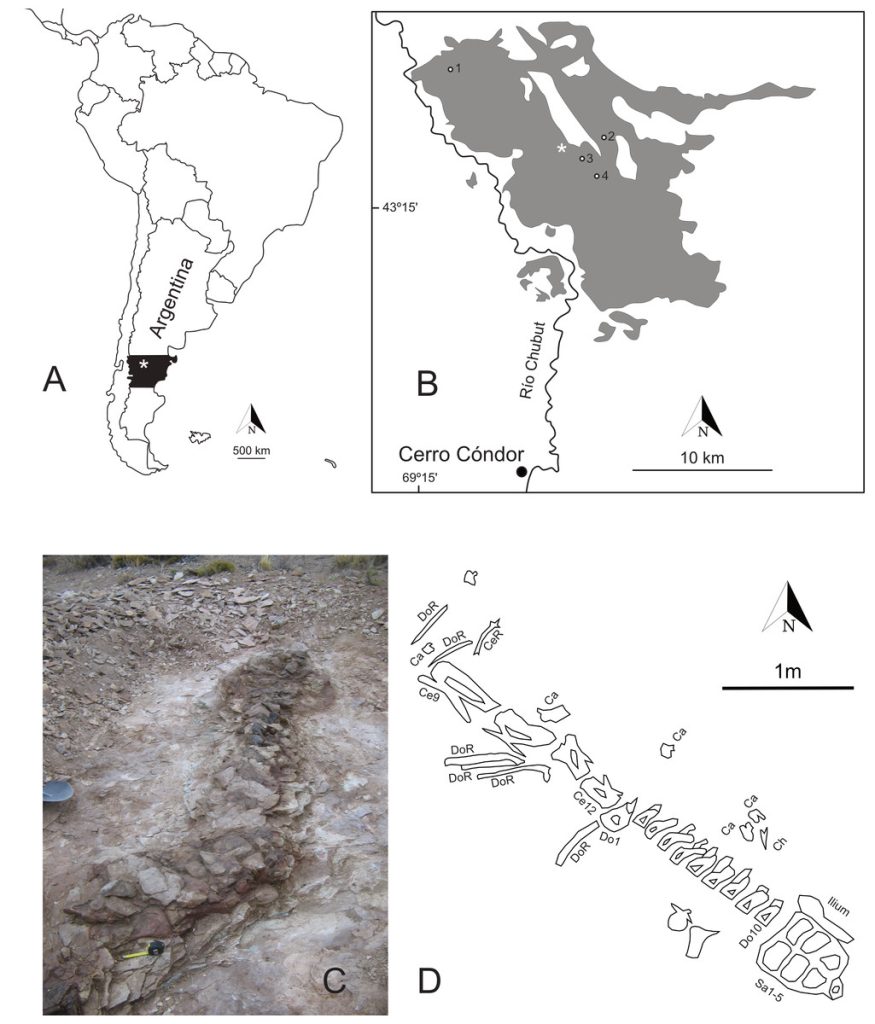

The team also referred a second specimen, MPEF-PV 1324, though only tentatively. These back vertebrae come from about 1.2 miles (2 kilometers) to the southeast, also high in the sequence. In 2015, Rauhut, Carballido, and Pol had reported them as a diplodocid. Although their centra are much larger than the holotype’s, the 2026 study now links them to Bicharracosaurus. Partial tail vertebrae from a few hundred meters south, MPEF-PV 3099, could also belong to it—an idea that cannot yet be tested. Meanwhile, anyone can examine the holotype through 26 surface scans on MorphoSource.
Bicharracosaurus Size and Description
With no skull or limbs preserved, the portrait of Bicharracosaurus comes almost entirely from its spine.
Short description of Bicharracosaurus
Among the seven surviving neck vertebrae, the longest centrum—the spool-shaped body of a vertebra—measures 17.3 inches (440 millimeters) without its front ball joint. The authors assumed 12 neck vertebrae, as in Camarasaurus, so they numbered the survivors six to 12. Their neural spines, the upright blades above the spinal cord, are undivided, and pillar-like knobs rise above the rear joints.
Farther back, the 10 back vertebrae become slightly opisthocoelous toward the hips—convex in front and concave behind. The widest centrum spans 10.6 inches (270 millimeters). At the hip, the surviving front blade of the ilium is rounded and almost horizontal, and it shows no air-sac hollows.
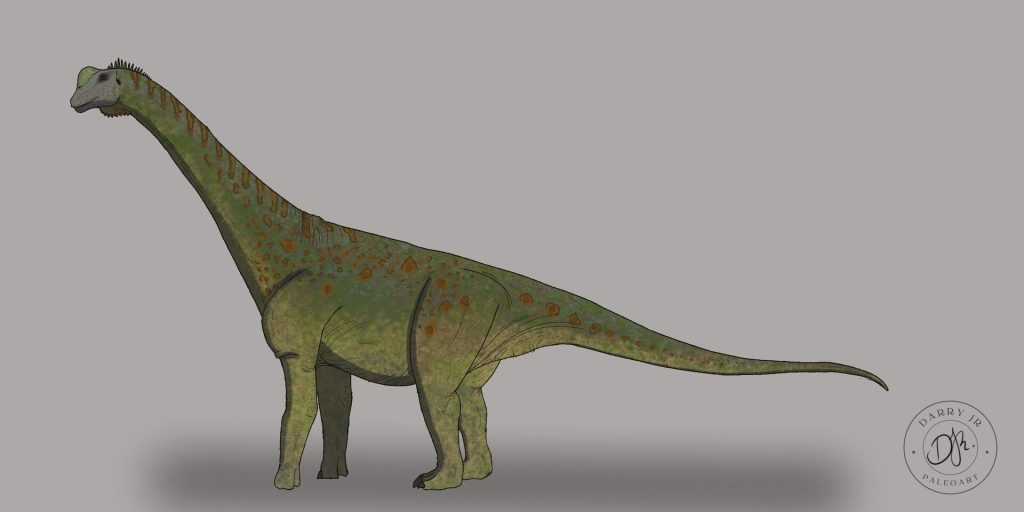
The first preserved tail vertebra is concave in front and flat behind, while the rest are concave at both ends. Skin impressions or soft tissue are not preserved, so any discussion of its outer appearance is speculative.

Size and Weight of Type Species
The 2026 paper gives no body length or weight. Instead, the LMU press release cites an estimated length of around 66 feet (20 meters), a little longer than a bowling lane. The release does not explain that figure, and neither source offers a height or body mass.
Even so, the bones suggest that this was a grown animal. Its neurocentral sutures, the seams between spool and arch in each vertebra, had closed, and its hip vertebrae had fused. A thin section of a rib revealed at least seven growth marks—a minimum age of seven years, if each mark is annual. Moreover, an external fundamental system, a distinct outer bone layer, shows that growth had stopped—a typical sign of determinate growth.
According to the LMU press release, some parts of the skeleton resemble the African Giraffatitan. Its back vertebrae, however, look more like those of Diplodocus and its North American relatives.
The Dinosaur in Detail
What sets this dinosaur apart are three features found in no other sauropod. On the middle and rear neck vertebrae, a triangular opening pierces a pit on the side of each bone. The rearmost neck vertebrae also carry a small upward bump on one of their bony struts, or laminae. Finally, the joint surfaces between the sacral vertebrae are shaped like little boats.
Several traits point toward the brachiosaurids. The middle neck vertebrae have a pit on the side of their front joints, as in Brachiosaurus, Giraffatitan, and Europasaurus. Another hollow on the neck holds several openings, much as in Vouivria and Giraffatitan. In addition, the first sacral vertebra helps support the second sacral rib—a trait otherwise known only in Vouivria, Brachiosaurus, and Giraffatitan. Yet other features argue against the link—its back spines lack wing-like flanges, and its front tail vertebrae lack air-sac openings.
Some traits even echo the diplodocids. In the middle and rear back vertebrae, a small triangular pit below and ahead of the air-sac opening is otherwise known only in MPEF-PV 1324 and Diplodocus. Statistical tests could not rule out even a diplodocid position, although forcing it into Diplodocidae cost 10 to 20 extra evolutionary steps, against three or four for Brachiosauridae.
Bicharracosaurus shares about 72 to 75 percent of comparable character states with Tehuelchesaurus, another sauropod from the same formation. Even so, only two of eight main analyses grouped the pair closely, and the authors list clear differences, such as 10 back vertebrae against at least 11. In every analysis of one dataset, Tehuelchesaurus comes out as the closest relative of the African Janenschia, a group that only sometimes includes Bicharracosaurus. Taken together, these results paint a picture of an animal that blurs early macronarian evolution—a “problematic early evolution,” as the paper’s title puts it.
Interesting Points about Bicharracosaurus
- Its name comes from “bicharraco,” informal Spanish for “big animal,” which farmer Dionide Mesa used for the bones’ size.
- Removing the skeleton from the field took from 2002 until 2018, with most of it lifted out in 2011.
- Bones once reported as a diplodocid have now been tentatively referred to Bicharracosaurus, leaving the diplodocid record of its formation ambiguous.
- The LMU press release calls it South America’s first Jurassic brachiosaurid, but the paper says only possibly—and fragmentary remains from its formation were tentatively called brachiosaurid in 2006.
Dinosaurs from the Same Formation
Also known from the Cañadón Calcáreo Formation (exact level relative to Bicharracosaurus not known): Brachytrachelopan. Brachytrachelopan was a dicraeosaurid sauropod from the formation’s upper river deposits. Its neck was about 40 percent shorter than in other known dicraeosaurids. In 2013, Cúneo and colleagues found that deposition began before about 158 million years ago. They judged the upper fossil-bearing part probably Kimmeridgian. The formation therefore spans at least a few million years, so the two sauropods may not have been contemporaries.
Bicharracosaurus in its Natural Habitat
The world Bicharracosaurus roamed was a basin of rivers, lakes, and floodplains in central Patagonia. Geologically, the Cañadón Calcáreo Formation is the post-rift fill of the Cañadón Asfalto Basin, a large, fault-bounded trough known as a half-graben. The skeleton lay in sandstone sheets and mudstones of a quiet floodplain. Preliminary reports of araucarian seed cones and conifer wood in the upper river deposits suggest conifer forests persisted across the basin. Lower down, older lake beds hold more than 130 species of gymnosperm pollen and spores of bryophytes (mosses and their relatives), lycophytes (clubmosses), and ferns. Freshwater fish such as Luisiella swam in those Oxfordian lakes.
While there is no direct evidence of what Bicharracosaurus ate, it was probably a plant-eater like other sauropods. Yet no skull or teeth are known, and the paper does not discuss its diet. Although conifers grew nearby, no published study links them to its feeding.
Other nearby dinosaur fossils remain unnamed. Putative brachiosaurid remains lie in the formation’s upper interval a few hundred meters south of the quarry, and some could belong to Bicharracosaurus. A theropod tooth cast from the dig hints that theropods were present. The skeleton probably belonged to one individual buried at or near where it died, with no confident scavenger marks. However, the authors suggest that scavengers may have scattered some heavier bones.
Older dinosaurs come from lower down. The putative macronarian Tehuelchesaurus lay in the formation’s middle lake deposits. In 2013, Cúneo and colleagues dated that interval to the Oxfordian, below tuffs of about 157.4 million years. Pandoravenator, a theropod near the base of Tetanurae, comes from the basal part, at the shift from lake to river deposits. In 2017, Rauhut and Pol judged it very close in age to a tuff dated to roughly 157 million years.
Frequently Asked Questions
It means roughly “big animal lizard,” from informal Spanish “bicharraco” and Greek “sauros.”
It lived in the Oxfordian to Kimmeridgian stages of the Late Jurassic, around 155 million years ago according to the LMU press release.
The scientific paper gives no size, but the LMU press release estimates a length of around 66 feet (20 meters).
It was a macronarian sauropod, and its describers consider it possibly a brachiosaurid.
Its fossils come from the Cañadón Calcáreo Formation, about 15 miles north of Cerro Cóndor in Chubut Province, Argentina.
Its backbone combines brachiosaurid-like and Diplodocus-like features, and three traits on its vertebrae are known in no other sauropod.
Sources
The information in this article is based on various sources, drawing on scientific research, fossil evidence, and expert analysis. The aim is to provide a comprehensive and accurate overview of Bicharracosaurus. However, please be aware that our understanding of dinosaurs and their world is constantly evolving as new discoveries are made.
- https://doi.org/10.7717/peerj.20945
- https://doi.org/10.1016/j.gr.2013.01.010
- https://staff.mef.org.ar/images/investigadores/diego_pol/papers/63.pdf
- https://doi.org/10.5710/AMGH.12.10.2017.3105
- https://doi.org/10.1038/nature03623
- https://www.lmu.de/en/newsroom/news-overview/news/palaeontologists-discover-new-long-necked-dinosaur-in-patagonia-dd830393.html
- https://www.eurekalert.org/news-releases/1124450
- https://www.morphosource.org/concern/media/000774949?locale=en
This article was last fact checked: TheDinosaurs Team, 16-11-2026
Featured Image Credit: Connor Ashbridge, CC BY 4.0, via Wikimedia Commons
