
On the southeastern coast of Aphae Island, off South Korea’s southwestern shore, reddish mudstones of the Ilseongsan Formation have yielded a rare prize. Named Doolysaurus huhmini in 2026, it was a small neornithischian (a member of a major branch of the “bird-hipped” ornithischian dinosaurs) from the mid-Cretaceous. It lived roughly 113 to 97 million years ago, during the Albian to early Cenomanian stages. Korea is rich in dinosaur footprints and eggs, but its skeletons are exceedingly rare. This one also holds the first diagnostic dinosaur skull material from the peninsula.
According to the University of Texas at Austin, co-author Hyemin Jo discovered the skeleton in 2023. In March 2026, Jongyun Jung, Minguk Kim, Jo, and paleontologist Julia Clarke described it in the journal Fossil Record. Micro-CT scanning—X-ray imaging at very fine resolution—revealed skull bones still hidden inside the rock. The animal was a youngster, probably no older than two, and a cluster of stomach stones lay among its bones. Small as it is, this single skeleton widens a remarkably thin Korean bone record.
Doolysaurus Key Facts
| Keyword | Fact |
|---|---|
| Pronunciation | Not specified |
| Meaning of name | Dooly’s Lizard |
| Group | Ornithischia |
| Type Species | Doolysaurus huhmini |
| Diet | Possibly omnivore, based on stomach stones |
| When it Lived | 113 to 97 MYA |
| Period | Cretaceous |
| Epoch | Early to Late Cretaceous (Albian to early Cenomanian stages) |
| Length | Not specified |
| Height | Not specified |
| Weight | About 18 pounds (8.3 kilograms), authors’ estimate for the juvenile holotype |
| Mobility | Not specified |
| First Discovery | 2023 by Hyemin Jo (year per University of Texas news release) |
| Described by | 2026 by J. Jung, M. Kim, H. Jo, and J.A. Clarke |
| Holotype | KDRC-SA-V001 |
| Location of first find | Ilseongsan Formation, southeastern coast of Aphae Island (Aphaedo), Shinan, Republic of Korea |
Doolysaurus Origins, Taxonomy and Timeline
The genus name honors Dooly the Little Dinosaur, a baby dinosaur from a 1983 Korean cartoon by Soo-Jung Kim. Meanwhile, the ending -saurus comes from the Greek sauros, meaning “lizard.” The species name huhmini recognizes Professor Min Huh for 30 years of outstanding Korean dinosaur research. Huh also studied the giant theropod egg nest found at Aphaedo. Together, the name pairs a beloved cartoon with a researcher tied to the same island’s fossil eggs.
Within Ornithischia, Doolysaurus belongs to Neornithischia and the family Thescelosauridae. In their main analysis, using the Fonseca et al. (2024) dataset, Jung and colleagues placed it in the subfamily Thescelosaurinae. One version was Bayesian and tip-dated—a method that uses fossil ages to help build the family tree. In that tree, Doolysaurus is the sister of a group containing Parksosaurus, Fona, and Thescelosaurus. It therefore sits closer to these North American animals than to East Asian forms such as Haya, Changchunsaurus, and Jeholosaurus. Doolysaurus huhmini is the type and only known species.
The authors prefer an Albian to early Cenomanian age for the fossil-bearing beds. That works out to roughly 113 to 97 million years ago, a span straddling the Early and Late Cretaceous—hence “mid-Cretaceous.” However, the dating has shifted—in 2012, Rhee and colleagues first proposed 77 to 83 million years. Later, a 2014 study of the giant egg clutch also placed its beds in the Campanian. That same year, however, Kim and colleagues re-dated the overlying Maewolli Tuff, a volcanic layer, to about 97.55 million years. In 2023, Choi and colleagues proposed an Albian–Cenomanian window from ostracods (tiny shelled crustaceans) and the range of Macroelongatoolithus eggs.
Discovery & Fossil Evidence
The site lies on the southeastern coast of Aphaedo, in Shinan. Its rocks sit beneath the Aphaedaegyo Bridge section, where a giant theropod egg nest had earlier come to light. According to the University of Texas release, the team first noticed leg bones and vertebrae. The skull bones turned up only in a micro-CT scan. By hand, the release adds, freeing bones from such rock “can take close to a decade.”
The holotype—the name-bearing specimen—is KDRC-SA-V001, housed at the Korea Dinosaur Research Center of Chonnam National University in Gwangju. It is an associated partial skeleton, preserved in three dimensions across two adjoining blocks of reddish sandy mudstone. From the skull come the dentary (lower jaw bone), the maxilla (main upper tooth-bearing bone), and teeth. Alongside them lie the quadrate (the bone that hinges the jaw) and several braincase bones. The rest includes back vertebrae, ribs, part of a femur (thigh bone), the upper halves of the shin bones, and much of the foot. Only scraps of the arm and shoulder survive, and while the skull and spine bones lay scattered, the hind limb bones remained well articulated.
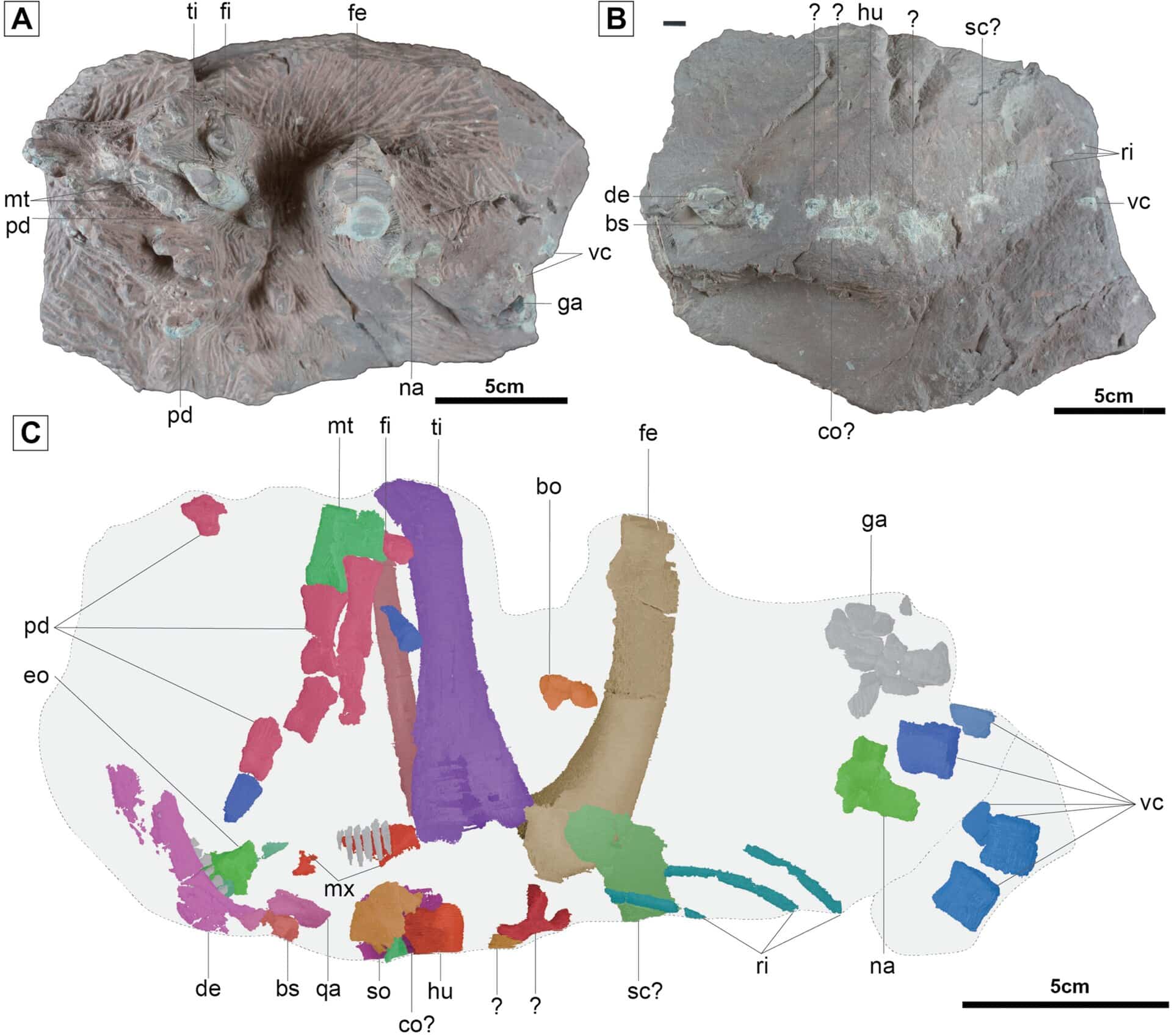

Its small size, unfused skull bones and vertebrae, and femur microstructure all mark the animal as a juvenile. No other specimens have been referred to Doolysaurus, and it is the only named dinosaur known from skeletal remains on Aphaedo. According to Jung and colleagues, bones like these are scarce in Korea for several reasons. For one thing, many fossil beds lie on tide-swept coasts and islands with poor access. In addition, heat from Late Cretaceous to early Paleogene magmatism turned many rocks into hornfels—a hard, baked rock.
Doolysaurus Size and Description
Short description of Doolysaurus
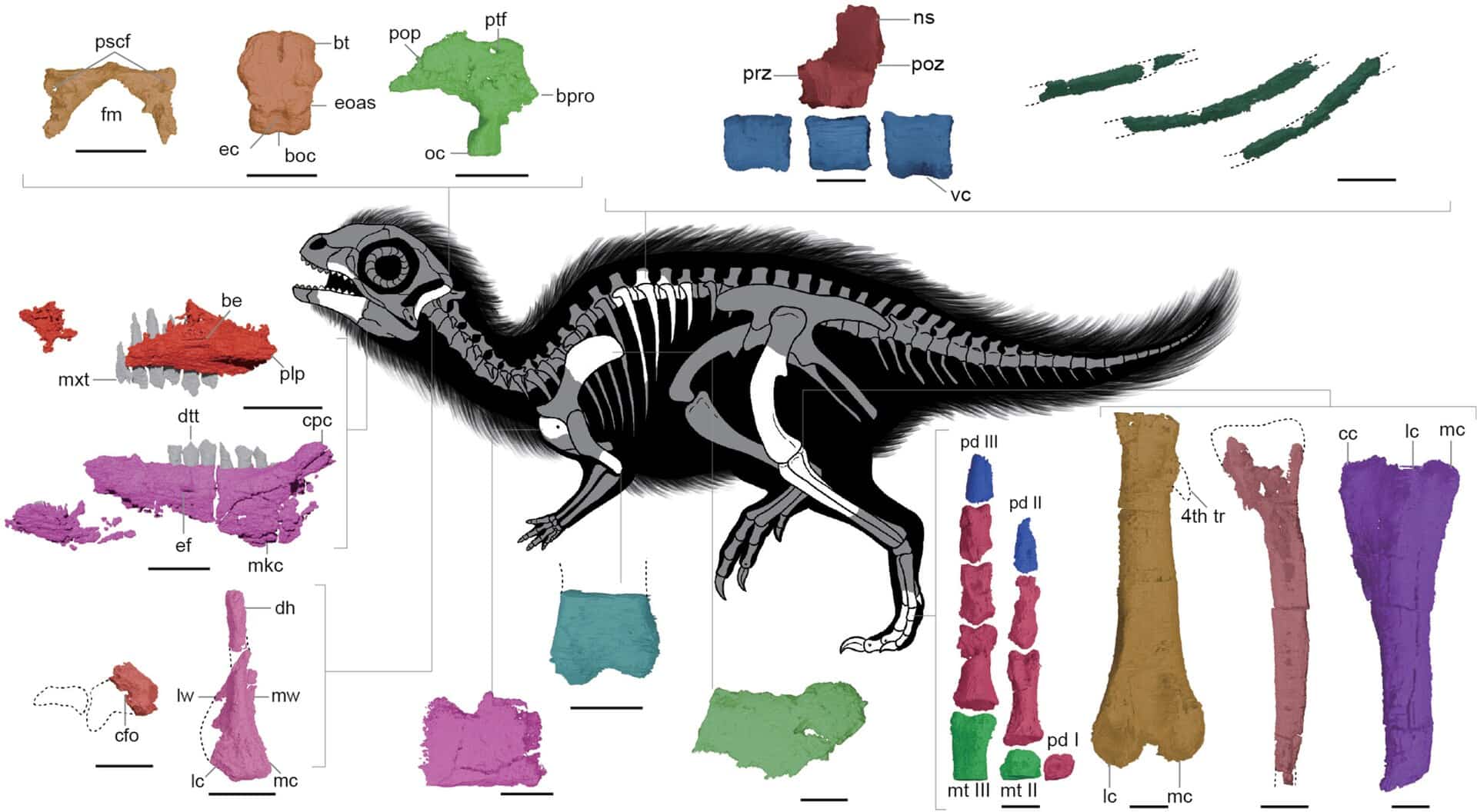
The larger of two maxilla pieces holds six teeth and nine tooth sockets, and the full count likely exceeded nine. Its crowns were triangular, slightly asymmetrical, and flattened side to side, with tiny denticles (serrations) on both edges. Each also had a well-developed cingulum—a raised collar near the base. Similarly, the dentary preserves 15 teeth plus two replacement teeth, and the authors estimate at least 17 in all. Wear facets appear to run along the entire tooth row.
At the back of the skull, the supraoccipital shows a subtle midline rise rather than a prominent nuchal (neck-muscle) crest. Its back vertebrae were all unfused, and their centra, or vertebral bodies, were amphicoelous—concave at both ends. Farther down, the femur bore a prominent fourth trochanter, a flange where a large tail muscle attached. The foot ended in claw-like unguals (toe tips), with three phalanges (toe bones) in the second digit and four in the third. Its posture is not stated in the description, but many small-bodied neornithischians were likely bipedal (two-legged). Skin is not preserved, so any picture of its outer covering is speculative.

Size and Weight of Type Species
No total length or height for Doolysaurus has been published. Instead, Jung and colleagues estimated that the incomplete femur measured about 4.7 to 5.1 inches (12 to 13 centimeters) in full. They based this indirect figure on Australian ornithopod thigh bones.
That is close to the femora of Fona, at 4.8 inches (12.25 centimeters), and Haya, at 5.1 inches (12.9 centimeters). By comparison, a Dryosaurus specimen has an estimated femur of 5.5 inches (14 centimeters).
From the thigh bone’s girth, the authors estimated a body mass of about 18 pounds (8.3 kilograms) for this juvenile. No peer-reviewed study gives an adult mass, but the University of Texas release put the youngster at about turkey size. It added that an adult “may have grown to twice that size.”
The Dinosaur in Detail
What sets this dinosaur apart is a combination of ten features, one unique to it. That autapomorphy—a trait found in no other species—lies at the knee end of the femur. There, two bony projections, the crista tibiofibularis and the medial condyle (inner joint knob), are about equally wide near their base. Meanwhile, the femur’s blood-vessel canals grow no sparser toward its surface, suggesting relatively rapid growth at death.
The blade-like quadrate probably had a larger outer condyle than inner one, as in Orodromeus and Haya. Its hypoglossal (tongue) nerve left the skull through a single exit, as in Jeholosaurus. The braincase floor, however, carries a marked midline groove rather than the ridge or flat floor of other early neornithischians. Its estimate of at least 17 dentary teeth is similar to that of Hypsilophodon and Fona. However, it is lower than the roughly 20 in Thescelosaurus neglectus.
Unlike that of Koreanosaurus boseongensis, Korea’s only other named neornithischian, its tibia lacks an accessory condyle near the knee, among other differences. Koreanosaurus also comes from the “significantly younger,” 81-million-year-old Seonso Conglomerate. Two hallmarks support placing Doolysaurus in Thescelosaurinae—a pit at the base of the quadrate’s inner (pterygoid) wing and an overhanging outer tibial condyle.
Parsimony, which favors the simplest tree, left Doolysaurus in an unresolved cluster within Thescelosauridae in its strict consensus. However, its majority-rule tree again placed it in Thescelosaurinae. With Avrahami and colleagues’ 2024 dataset, it could instead pair with Diluvicursor near the base of Orodrominae, the family’s other branch. The authors call Doolysaurus and Koreanosaurus “floating taxa” with unstable positions. Even so, whenever the family is recovered, they report, Asian species sit at or near the base of it or of its two branches. They therefore propose that the two branches split in Asia before spreading into North America.
Interesting Points about Doolysaurus
- Its genus name honors Dooly the Little Dinosaur, a baby dinosaur character from a 1983 Korean cartoon created by Soo-Jung Kim.
- Doolysaurus preserves the first diagnostic dinosaur skull material from the Korean Peninsula and is only the second early-diverging neornithischian described from Korea.
- Micro-CT scanning exposed its hidden skull bones, and the resulting 3D models of the skeleton are publicly available on MorphoSource.
- According to the University of Texas, it was the first new dinosaur species from Korea in 15 years.
- Between its vertebrae and femur lay 40 to 50 small stomach stones weighing at least 1.08 ounces (30.7 grams) together.
Doolysaurus in its Natural Habitat
The world Doolysaurus roamed was a distal floodplain—the outer reaches of a river plain—where sediment built up steadily and fairly rapidly. Its soils survive as paleosols (fossil soils) dotted with calcareous (lime-rich) nodules, and gray volcanic layers interleave with the mudstones. In addition, the authors interpret stratified beds holding bone and eggshell fragments as crevasse splays, fans of sediment spread when floodwater breaches a riverbank.
Its gastroliths—stones swallowed to help grind food—offer the best clue to its diet. They were well-sorted pebbles and discs of quartzite and volcanic rock, 2 to 10 millimeters (0.08 to 0.4 inches) across. Together, they made up about 0.37 percent of the juvenile’s estimated body mass. Their shapes and relative mass, the authors propose, fit a more omnivorous diet. Their subrounded edges also suggest a less powerful gastric mill, or grinding stomach, than in modern seed-eating birds. Even so, the authors urge caution, noting that living birds vary widely in stomach anatomy and gastrolith use.
Similar clusters occur in Haya and Changmiania, yet none has been reported from a North American thescelosaurid. To the authors, this adds to evidence that gastrolith use was more common among small neornithischians. So far, the Ilseongsan Formation has produced no other named non-avian dinosaur. Instead, the Paleobiology Database lists only eggs beside it—Macroelongatoolithus plus dendroolithid and laevisoolithid eggs, types named from their shells.
Higher in the sequence lies Huh and colleagues’ ring-shaped clutch of 19 eggs, 7.5 feet (2.3 meters) across. Jung and colleagues call it “an exceptionally large oviraptorosaurian egg nest.” Although Korea has no known footprints of early neornithischians, the authors offer two explanations. Floodplain soils preserve tracks poorly, they note, or such footprints might have been mistaken for theropod tracks. Whether the two Korean species reveal habitat preferences within their family, the authors add, remains unclear.
Frequently Asked Questions
It means “Dooly’s lizard,” after the Korean cartoon character Dooly the Little Dinosaur, and huhmini honors Professor Min Huh.
It lived in the Albian to early Cenomanian stages of the mid-Cretaceous, roughly 113 to 97 million years ago.
The only known juvenile weighed an estimated 18 pounds, according to its describers. No adult size has been published in a scientific study.
Its describers suggest its stomach stones are consistent with a more omnivorous diet, though they urge caution.
It was found in the Ilseongsan Formation on the southeastern coast of Aphae Island, in Shinan, South Korea.
It preserves the first diagnostic dinosaur skull material from Korea, plus a unique feature at the knee end of its femur.
Sources
The information in this article is based on various sources, drawing on scientific research, fossil evidence, and expert analysis. The aim is to provide a comprehensive and accurate overview of Doolysaurus. However, please be aware that our understanding of dinosaurs and their world is constantly evolving as new discoveries are made.
- https://doi.org/10.3897/fr.29.178152
- https://binary.pensoft.net/file/1562789
- https://binary.pensoft.net/file/1562791
- https://doi.org/10.1080/08912963.2014.894998
- https://paleobiodb.org/classic/checkTaxonInfo?taxon_no=519157
- https://www.jsg.utexas.edu/news/?p=29667
This article was last fact checked: TheDinosaurs Team, 13-11-2026
Featured Image Credit: Connor Ashbridge, CC BY 4.0, via Wikimedia Commons
