
In the Painten basin of Lower Bavaria, the laminated limestones of the Torleite Formation preserved a tiny theropod with traces of skin and fuzz. Under ultraviolet light, those soft tissues still glow on the stone. Named Sciurumimus albersdoerferi in 2012, it lived during the latest Kimmeridgian stage of the Late Jurassic—around 150 million years ago. Its describers called it the most complete megalosauroid yet discovered and the most basal theropod with direct evidence for feathers.
The skeleton reached science through private collector Raimund Albersdörfer, and it now rests on permanent loan at the Bürgermeister-Müller-Museum in Solnhofen. In 2012, paleontologist Oliver Rauhut and three colleagues described it in PNAS as a probably early-posthatchling individual. Since then, its place on the theropod family tree has been argued over again and again. Whatever the outcome, this fossil shows a predatory dinosaur at the very start of its life.
Sciurumimus Key Facts
| Keyword | Fact |
|---|---|
| Pronunciation | Not specified |
| Meaning of name | Squirrel-Mimic |
| Group | Theropoda |
| Type Species | Sciurumimus albersdoerferi |
| Diet | Carnivore |
| When it Lived | Around 150 MYA |
| Period | Jurassic |
| Epoch | Late Jurassic (Kimmeridgian stage) |
| Length | About 2.3 feet (70 centimeters), juvenile holotype |
| Height | Not specified |
| Weight | Not specified |
| Mobility | Not specified |
| First Discovery | 2012 (year of description) |
| Described by | 2012 by O.W.M. Rauhut, C. Foth, H. Tischlinger, and M.A. Norell |
| Holotype | BMMS-BK 11 (also written BMMS BK 11) |
| Location of first find | Rygol Quarry, Arnstorf Member of the Torleite Formation, near Painten, Lower Bavaria, Germany |
Sciurumimus Origins, Taxonomy and Timeline
The name Sciurumimus draws on Sciurus, the genus of tree squirrels, and translates as “squirrel-mimic.” It refers to the especially bushy tail preserved on the fossil. The species name albersdoerferi honors Raimund Albersdörfer, the private collector who made the specimen available for study. Together, the name captures both the animal’s most eye-catching feature and the person who brought it to science.
Sciurumimus belongs to Theropoda, the lineage of predatory dinosaurs. Rauhut and colleagues originally described it as a juvenile megalosauroid—a relative of the big Jurassic hunters known as megalosaurs. Their keywords also list the family Megalosauridae, and in 2018 Rauhut and co-authors still called it “the early juvenile megalosaurid Sciurumimus.” However, its baby teeth look strikingly like those of basal coelurosaurs, the theropod branch that includes birds. Such juvenile features lie at the heart of an unresolved debate. Sciurumimus albersdoerferi is the type and only known species.
The Painten beds date to the latest Kimmeridgian, within the Hybonoticeras beckeri ammonite zone and its Lithacoceras ulmense subzone. Each zone is a slice of rock time defined by its ammonite species. On the international time scale, the Kimmeridgian ran from roughly 154.8 to 149.2 million years ago. This level therefore lies shortly before the Kimmeridgian–Tithonian boundary, dated to about 149.2 ± 0.7 million years ago, while the describing team’s press release gives about 150 million. At that time, southern Germany lay beneath a shallow, tropical sea dotted with small and larger islands.
Discovery & Fossil Evidence
The Rygol Quarry near Painten has been worked since the 1950s, yet its fossils only came to light after 2001. That was when systematic excavations began—first by Wolfgang Häckel and later by the private Albersdörfer institute. Painten lies within the “Paintener Wanne,” one of the basins of the Solnhofen Archipelago. Its fossil beds belong to the Arnstorf Member.
The rock unit itself has worn three names. The 2012 paper referred these layers to the Rögling Formation, while a 2016 table by Rauhut and colleagues listed “Painten Fm.” In 2018, however, Rauhut and colleagues followed a revision by Niebuhr and Pürner (2014), which places them in the Torleite Formation.
The holotype, BMMS-BK 11, is a juvenile skeleton housed at the Bürgermeister-Müller-Museum Solnhofen. Its describers call it exceptionally preserved, and the press release called it the most complete predatory dinosaur ever found in Europe. Beyond that, the describers single out its manus (hand), while later studies discuss its skull, teeth, and cervical (neck) vertebrae. Under ultraviolet light, remains of the skin and feathers show up as luminous patches in photographs by co-author Helmut Tischlinger.
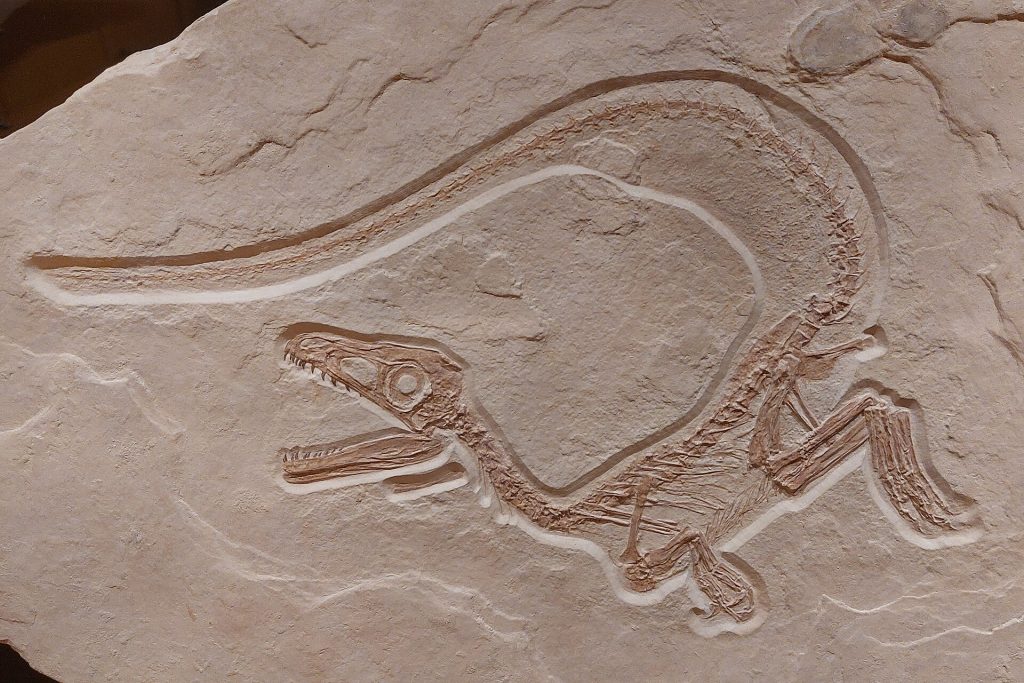

Its custody is also unusual, since the specimen is on permanent loan from Albersdörfer. A 2021 study even cited it as a precedent for publicly guaranteed private specimens. No further specimens of Sciurumimus have been described.
Sciurumimus Size and Description
Small as it is, the skeleton shows how a young theropod of this lineage may have looked.
Short description of Sciurumimus
In 2014, Hendrickx and Mateus put its maxilla (main upper tooth-bearing bone) at about 53 percent of skull length. They gave the same proportion for Monolophosaurus. Its slender, pointed front teeth closely resembled those of basal coelurosaurs. They also show strong recurvature—a backward curve seen in other small or juvenile theropods too. Behind the head, ten cervical vertebrae preceded the back, according to a 2015 study by Evers and colleagues. Its hand, meanwhile, lacked any trace of a fourth finger.
Filaments covered the tail base and parts of the body. In 2020, Foth and colleagues concluded that the animal was probably entirely plumaged, with scaleless skin. They also traced a filamentous crest along the top of the front part of the tail. The team studied these structures with autofluorescence (the faint glow some materials give off) under UVA and cyan light. A 2018 study of fossil skin likewise cited Sciurumimus as an example of preserved skin without scales.
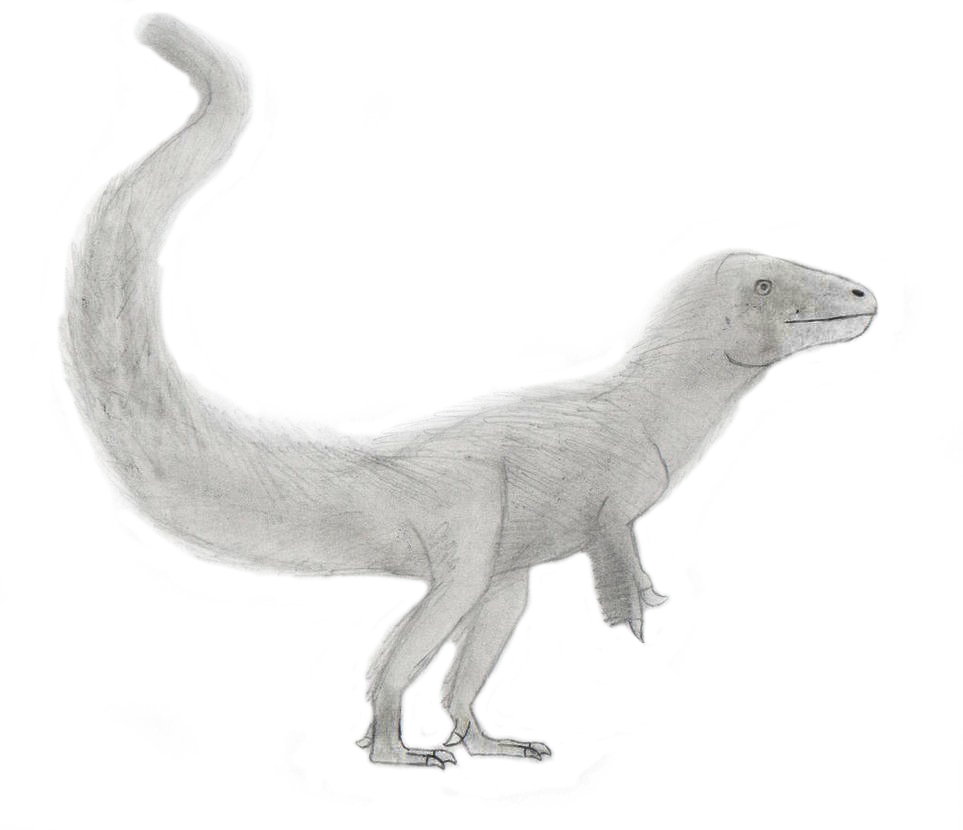

Size and Weight of Type Species
The press release from the describing team’s institution gives the juvenile holotype a length of only about 2.3 feet (70 centimeters). Height and weight estimates, however, are not available.
According to the same release, that small size does not necessarily mean the adult was small too. The release adds that adult megalosaurs reached more than 6 meters (about 20 feet) and often weighed more than a ton. Rauhut even speculated that a grown Sciurumimus might have reached 6 meters (about 20 feet) or more. That remains a press-release guess rather than a published estimate.
Because only one young individual is known, the true adult size remains open. Even its exact age is hedged—the describers called it a probably early-posthatchling individual, and the press release probably a recently hatched baby. Any comparison with grown relatives therefore depends on where it sits on the theropod tree—a question that remains unsettled.
The Dinosaur in Detail
What sets this dinosaur apart is its integument (body covering). The describers report filaments “identical to the type 1 feathers”—simple, unbranched strands—reported in some ornithischians, Dilong, Beipiaosaurus, and probably Sinosauropteryx. According to the describers, the find helps close the gap between coelurosaur feathers and ornithischian filaments, supporting a shared origin. In the press release, Rauhut went further, saying it indicated all predatory dinosaurs had feathers.
Its teeth caused a second stir. Because they so closely resemble basal coelurosaur teeth, the describers warned that coelurosaur records based on isolated teeth “should be used with caution.” In 2016, Gerke and Wings noted that its teeth, like those of Compsognathus, lack a mesial carina—a cutting ridge along the front edge. That same year, Foth and colleagues found that early coelurosaur skulls trend toward a shape resembling the juvenile Sciurumimus. They linked this to paedomorphosis—adults keeping youthful traits.
Where Sciurumimus belongs is still debated. Foth and colleagues used it in 2016 as the juvenile stand-in for the megalosaurid Dubreuillosaurus. Yet later analyses, among them Andrea Cau’s 2018 study, recovered it among the earliest diverging coelurosaurs, as Cau’s 2024 paper recounts. In 2019, Hartman and colleagues placed it within Compsognathidae, blaming its earlier position away from Compsognathus “almost entirely” on misscorings. By their count, moving it back to Megalosauroidea cost seven extra steps.
Cau’s 2024 study then swung the pendulum back. By coding juvenile and adult character states separately, his analysis recovered Sciurumimus—along with both Compsognathus specimens and Scipionyx—inside Megalosauroidea. In his view, it shows the immature condition of non-spinosaurid megalosauroids. Even so, a 2025 review by Xu and Barrett calls it both “the megalosauroid Sciurumimus” and “the early diverging tetanuran Sciurumimus.” In the end, the dispute turns on one stubborn problem—reading a baby’s anatomy when no adult of its kind is known.
Interesting Points about Sciurumimus
- The name Sciurumimus means “squirrel-mimic,” chosen for the especially bushy tail preserved on the fossil.
- Its describers called it the most complete megalosauroid yet discovered, while the press release hailed it as Europe’s most complete predatory dinosaur.
- Under ultraviolet light, remains of its skin and feathers show up as luminous patches on the stone.
- The original study was funded by the Volkswagen Foundation and the American Museum of Natural History.
- Between 2012 and 2024, analyses placed it among megalosauroids, early coelurosaurs, compsognathids, and then megalosauroids again.
Dinosaurs from the Same Formation
Also known from the Torleite Formation (exact level relative to Sciurumimus not known): Juravenator, another small juvenile theropod, from the Stark Quarry at Schamhaupten. Its beds fall in the same beckeri zone and ulmense subzone, although some workers assign them to the Painten Formation instead. Like Sciurumimus, its classification is disputed, and Cau’s 2024 analysis recovered it among several alternative positions within Allosauroidea. In 2020, Foth and colleagues compared the preserved integument of the two juveniles. In Juravenator, they could trace short feathers only in the tail region. The formation spans from the upper pseudomutabilis to the upper beckeri ammonite zone, so the two may not have lived at the same time.
Sciurumimus in its Natural Habitat
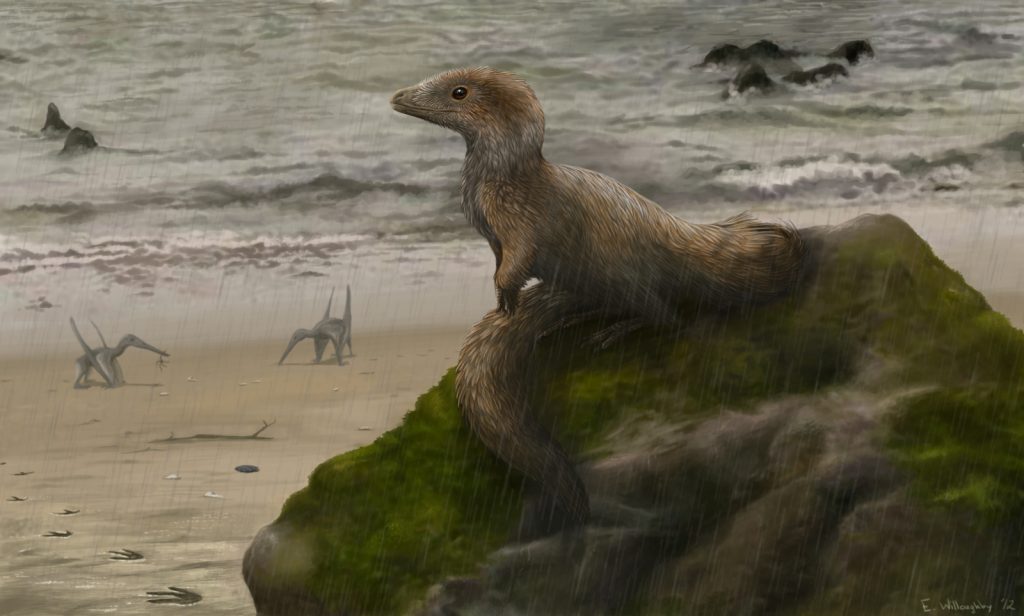
The world of Sciurumimus centered on a shallow, tropical sea scattered with small and larger islands. Its skeleton came to rest in the Painten basin, a “Wanne,” or locally restricted basin, about 15 by 12 kilometers (9 by 7.5 miles) across. Sponge reefs typically bordered such basins. Stagnant, oxygen-poor, salty bottom waters, along with rapid storm deposits, probably explain the exceptional preservation. Meanwhile, abundant land plants point to a near-shore lagoon, and coleoids (squid relatives) show that it was mostly open to the sea. The eastern basins, such as Painten and Schamhaupten, also appear to have had a stronger influence from land than the western ones.
The lagoon held sponges, corals, ammonites, crustaceans, fishes, and rays such as Apolithabatis seioma. Reptiles included rhynchocephalians, ichthyosaurs, the turtle Solnhofia parsonsi, and the marine crocodile relatives Cricosaurus albersdoerferi and Dakosaurus. Pterosaurs such as Pterodactylus antiquus are also known from the quarry. According to the press release, the slender-toothed youngster probably hunted insects and other small, elusive prey. Rauhut added that its teeth differed so markedly from those of adult megalosaurs that it had a different diet.
While there is no direct evidence of how young Sciurumimus behaved, Xu and Barrett proposed in 2025 that its tail crest hints at an early signaling role. Plants and land animals in the quarry show that islands must have lain nearby. So far, Sciurumimus is the only dinosaur in the quarry’s published faunal list—a lone voice from that vanished land.

Frequently Asked Questions
It means “squirrel-mimic,” for its bushy tail, and the species name honors collector Raimund Albersdörfer.
It lived in the latest Kimmeridgian stage of the Late Jurassic, around 150 million years ago.
The only known specimen, a juvenile, was about 2.3 feet (70 centimeters) long. Its adult size is unknown.
It was a carnivore, and the describing team’s press release suggested the youngster hunted insects and other small, elusive prey.
It was a theropod first described as a juvenile megalosauroid. Some later analyses placed it among early coelurosaurs or compsognathids, but a 2024 analysis returned it to Megalosauroidea, and the question is still debated.
It was found in the Rygol Quarry near Painten, Lower Bavaria, Germany, in rocks of the Torleite Formation.
Sources
The information in this article is based on various sources, drawing on scientific research, fossil evidence, and expert analysis. The aim is to provide a comprehensive and accurate overview of Sciurumimus. However, please be aware that our understanding of dinosaurs and their world is constantly evolving as new discoveries are made.
- https://doi.org/10.1073/pnas.1203238109
- https://snsb.de/en/neuer-jungraubsaurier/
- https://doi.org/10.7717/peerj.4963
- https://doi.org/10.1371/journal.pone.0287936
- https://doi.org/10.26879/928
- https://doi.org/10.1007/978-3-030-27223-4_6
- https://doi.org/10.7717/peerj.7247
- https://doi.org/10.4435/BSPI.2024.08
- https://palaeo-electronica.org/content/pdfs/654.pdf
- https://doi.org/10.7717/peerj.4191
- https://doi.org/10.1002/mmng.201200001
- https://doi.org/10.1186/s12862-017-1076-y
- https://pmc.ncbi.nlm.nih.gov/articles/PMC11756912/
- https://doi.org/10.7717/peerj.1323
- https://doi.org/10.7717/peerj.1589
- https://doi.org/10.1098/rsbl.2024.0517
- https://doi.org/10.1371/journal.pone.0088905
- https://doi.org/10.1371/journal.pone.0158334
- https://doi.org/10.1038/s41467-018-04443-x
- https://stratigraphy.org/ICSchart/ChronostratChart2024-12.pdf
This article was last fact checked: TheDinosaurs Team, 18-11-2026
Featured Image Credit: Olmagon, CC BY-SA 4.0, via Wikimedia Commons
