
Near the Lima Peaks of southwestern Montana, the volcanic-rich mudstones and sandstones of the upper Blackleaf Formation hold a dinosaur found in an unlikely place—inside a burrow. Named Oryctodromeus cubicularis in 2007, this small, two-legged ornithischian lived during the Cenomanian stage of the Cretaceous. Its describers presented it as the first trace and body fossil evidence of a burrowing, denning dinosaur. The den held an adult and two juveniles together—a sign, they argued, of extensive parental care.
A 2007 Montana State University news release credits the find to Yoshihiro Katsura, a former graduate student there. He spotted the bones in 2004 while prospecting on public land, and a university crew removed them the following year. In 2007, paleontologists David J. Varricchio, Anthony J. Martin, and Katsura named the animal in Proceedings of the Royal Society B. Since then, new burrows and more specimens from Montana and Idaho have reshaped its portrait.
Oryctodromeus Key Facts
| Keyword | Fact |
|---|---|
| Pronunciation | Not specified |
| Meaning of name | Digging Runner |
| Group | Ornithischia (Neornithischia, Thescelosauridae) |
| Type Species | Oryctodromeus cubicularis |
| Diet | Herbivore (presumed) |
| When it Lived | About 97 to 93 MYA (dates from upper Vaughn Member ash beds elsewhere in Montana. The holotype bed is undated, and Idaho finds may be slightly older) |
| Period | Cretaceous |
| Epoch | Late Cretaceous (Cenomanian stage) |
| Length | About 6.9 feet (2.1 meters) in 2007, revised to roughly 9.8 feet (3 meters) in 2024 |
| Height | Not specified |
| Weight | About 49 to 71 pounds (22 to 32 kilograms), estimated from burrow size |
| Mobility | Moved on two legs (bipedal) |
| First Discovery | 2004 by Yoshihiro Katsura |
| Described by | 2007 by D.J. Varricchio, A.J. Martin, and Y. Katsura |
| Holotype | MOR 1636a |
| Location of first find | Upper Blackleaf Formation (Vaughn Member), near the Lima Peaks, Beaverhead County, Montana, USA |
Oryctodromeus Origins, Taxonomy and Timeline
The name Oryctodromeus joins the Greek roots orycto and dromeus to mean “digging runner.” Its species name, cubicularis, means “of the lair”—a nod to the denning habit inferred from the burrow. The name captures both sides of the animal, built for running yet equipped to dig.
Varricchio and colleagues placed Oryctodromeus within Ornithischia, the “bird-hipped” dinosaurs, as an early member of Ornithopoda. They called it “hypsilophodont-grade”—a loose grade of small, basal ornithopods rather than a true family. Their analysis grouped it with two other Montana dinosaurs, Zephyrosaurus schaffi and Orodromeus makelai. According to the same paper, the whole clade may have been specialized for digging, judging from features all three share. Later studies moved it to Neornithischia and the family Thescelosauridae, although its exact branch is still disputed. Oryctodromeus cubicularis is the type and only known species.
Citing earlier pollen and radiometric studies, the original paper assigned the bone-bearing rocks to the Cenomanian. In 1995, however, Zartman and colleagues noted that pollen from near Lima cannot pin down a stage. Their zircon crystals from upper Vaughn Member ash beds gave ages of about 97 to 93 million years—the early to middle Cenomanian. Yet those samples came from the eastern Pioneer Mountains and near Drummond, leaving the Lima Peaks holotype bed undated. Referred material also comes from Idaho’s Wayan Formation, which later studies place in the late Albian to Cenomanian. In 2022, Krumenacker and colleagues called it slightly older than the Vaughn Member, so the species may reach back into the Albian, the preceding stage.
Discovery & Fossil Evidence
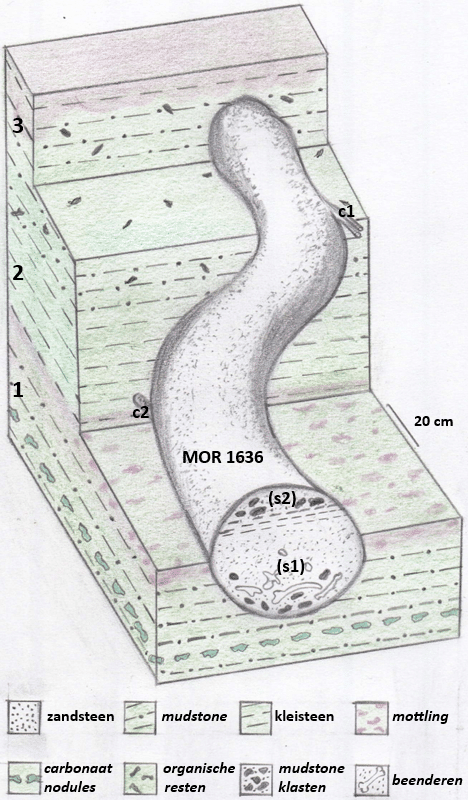
According to the 2007 release, the site lay about 15 miles (24 kilometers) from the town of Lima. The fossils sat within 2 to 3 feet (0.6 to 0.9 meters) of the surface. Erosion had already exposed the far end of the burrow and some bones. Excavating the fossils then destroyed parts of the structure before the team recognized and photographed it.
The adult holotype, MOR 1636a, belongs to the Museum of the Rockies. It includes fused premaxillae (the front bones of the upper jaw) and the rear of the braincase. Behind them come three neck, six back, and 23 tail vertebrae, the sacrum, three ribs, the shoulder bones, and one arm. Both tibiae (shin bones), part of a fibula, and one metatarsal complete the list. A second number, MOR 1636b, covers two juveniles—most of their measurements run about 55 to 65 percent of the adult’s.
The bones lay inside a sinuous body of sandstone that cuts across three layers of mudrock. It runs for more than 210 centimeters, or about 6.9 feet, with an oval cross-section about 30 to 38 centimeters high. The tunnel slopes gently, turns sharply right, steepens, turns left, and then widens into a chamber, dropping nearly 50 centimeters overall. A dense jumble of adult and juvenile bones lay in the lowest 7 centimeters of fill, mostly within that chamber.

In 2019, paleontologist L.J. Krumenacker and colleagues reported that Oryctodromeus dominates the fossil assemblages of Idaho’s Wayan Formation and Montana’s Vaughn Member. They also described new burrows that match the original in shape and size. Specimens cited in more recent studies include a second braincase, MOR 1642, and a tooth, IMNH 44946. In 2023, Idaho named Oryctodromeus its official state dinosaur.
Oryctodromeus Size and Description
Its skeleton pairs a runner’s legs with a snout, shoulder, and hips that its describers linked to digging.
Short description of Oryctodromeus
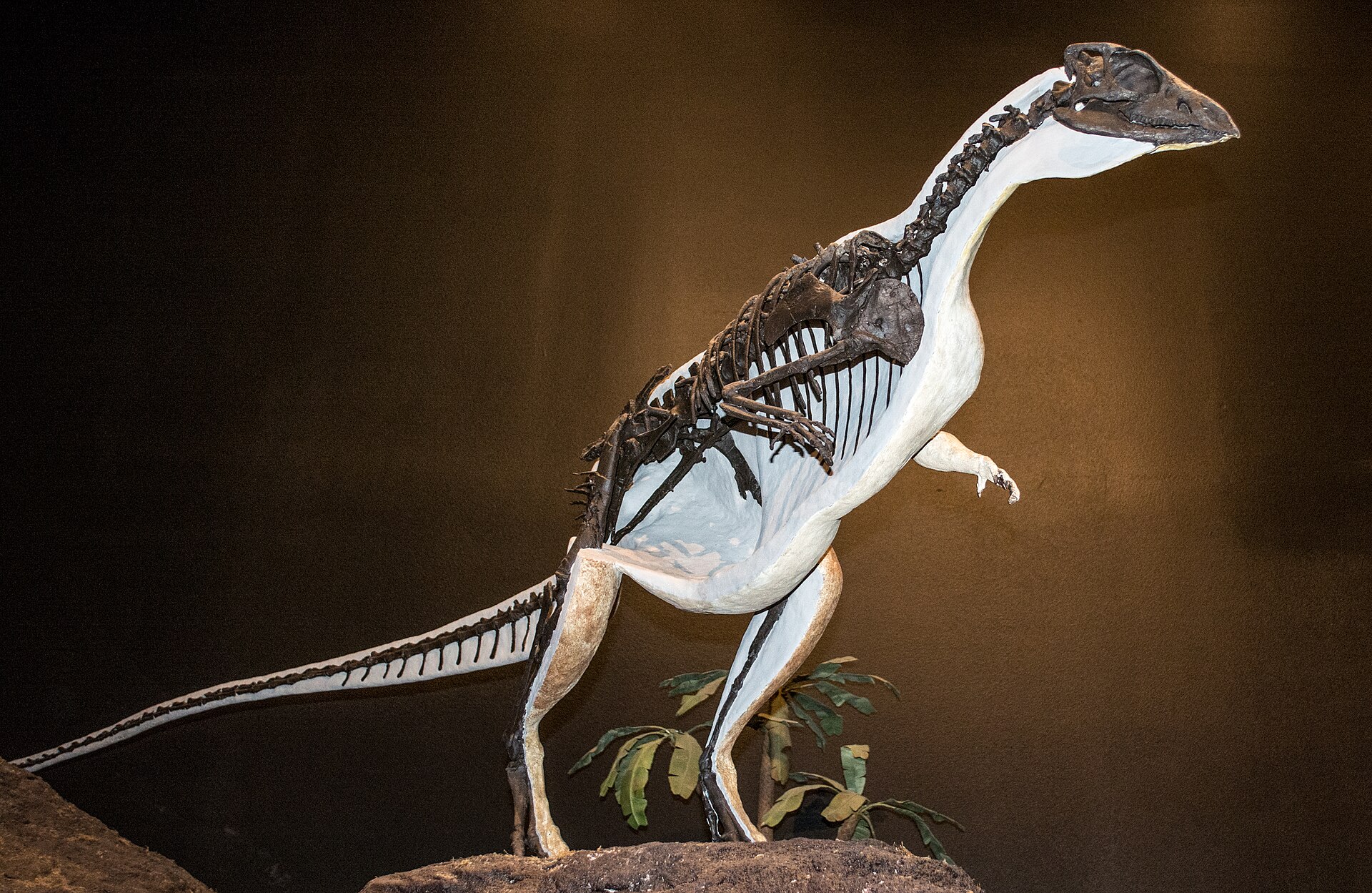
At the tip of the snout, the fused premaxillae carried five teeth behind a small beak, and their front face was broad and roughened. The paroccipital processes—bony struts at the back of the skull—were long, which suggests a relatively broad skull. According to its abstract, Krumenacker and colleagues’ 2024 osteology reports neck vertebrae about 1.6 times longer than tall, against 1.4 times in the back. Seven vertebrae formed the sacrum, a count the 2007 describers called more typical of much larger iguanodontians. In the adult, fusion was extensive, joining the premaxillae, the rear braincase, the sacrum, and every neurocentral suture—the seams between each vertebral body and its arch.
The hind limbs kept cursorial, or running-adapted, proportions. In the juveniles, for instance, the tibia was 1.19 times the length of the femur, or thigh bone. The tail, however, drew the biggest revision. In 2007, the describers reported few ossified tendons and no tendon lattice in a tail represented by 23 vertebrae. By contrast, the 2024 osteology, according to its abstract, describes more than 55 elongate tail vertebrae wrapped in ossified tendons. They suggested that such tendons were more flexible than supposed, or that its burrows had separate entrances and exits. None of the studies consulted describes skin or feathers, so any restoration of its outer covering is speculative.

Size and Weight of Type Species
Varricchio and colleagues estimated an adult length of about 6.9 feet (2.1 meters), with roughly 4.1 feet (1.25 meters) of that in the tail. Because they worked from 39 preserved vertebrae, the figure is an estimate rather than a measurement. In 2024, Krumenacker and colleagues raised it to roughly 9.8 feet (3 meters), two-thirds of it tail. However, the paper’s abstract does not say how they reached that number.
Weight came from the burrow rather than the bones. The 2007 team used an equation linking burrow cross-section to body mass, which predicted a burrow maker of 49 to 71 pounds (22 to 32 kilograms). That range, they noted, matches mass estimates for medium-sized hypsilophodonts. Judging from the shoulder girdle and rib placement, the trunk was also 10 to 12 inches (26 to 30 centimeters) across.
By comparison, the two juveniles would have measured about 4.3 feet (1.3 meters) long. Still, none of the studies consulted gives a hip height.
The Dinosaur in Detail
What sets this dinosaur apart is a snout, shoulder girdle, and pelvis its describers judged “consistent with digging.” The scapula (shoulder blade), at 176 millimeters, was longer than the 157-millimeter humerus. It bore a narrow acromion—the projection near the shoulder joint—with a thin, outward-facing spine, and its blade bent backward. Moreover, scapula and coracoid were fused into one scapulocoracoid—among ornithopods, the 2007 team knew this only in Ouranosaurus.
Yet Oryctodromeus was no mole, lacking the elongate humeral head, expanded lower humerus, and prominent elbow process of specialized underground diggers. Instead, Varricchio and colleagues likened it to running mammals that dig when needed, such as aardwolves and rabbits, though more specialized. In 2016, Fearon and Varricchio’s muscle reconstruction suggested broad shoulder-muscle attachments on the expanded blade—modest changes, they concluded, that sufficed for burrowing. Later, Krumenacker’s team added that a femoral head angled at about 35 degrees likely aided digging from a braced, splayed stance.
The 2007 diagnosis, based on a juvenile ilium (upper hip bone), gave it a very short front blade. The 2024 diagnosis, drawing on new specimens, lists an elongate one. Similarly, MOR 1642 lacks the steep-sided “box” the original paper described under the basioccipital, a braincase bone. Avrahami and Zanno (2026) read this as variation within the species.
Its family tree also remains contested. In 2024, Krumenacker and colleagues recovered it within Orodrominae, which they called a clade of burrowing neornithischians from Asia and western North America. A 2021 review by Madzia and colleagues places Albertadromeus there too. Also in 2024, however, Avrahami and colleagues placed it in Thescelosaurinae alongside Thescelosaurus. Then, in 2026, Avrahami and Zanno confined Orodrominae to North America. One of their analyses found the Utah dinosaur Fona herzogae to be its closest relative. Both camps keep it within Thescelosauridae—the question is which branch.
Interesting Points about Oryctodromeus
- The tunnel, about 12 inches wide, matched the adult’s estimated trunk breadth—a tight fit, its describers noted, like those seen in modern burrowing animals.
- Small side tunnels off the burrow were too small for Oryctodromeus to have dug, and the describers suggested smaller cohabitants may have made them.
- In 2011, Woodruff and Varricchio ran 13 trials with rabbit skeletons in a half-scale burrow model, and several produced bone and sediment patterns like the fossil’s.
- Since collecting the burrow destroyed it, Wilson and Varricchio later built 3D models from photos taken at three stages of excavation.
- The 2007 team argued that burrowing could have let small dinosaurs exploit polar latitudes, deserts, and high mountains.
Oryctodromeus in its Natural Habitat
The world Oryctodromeus knew was a broad floodplain cut by small rivers. It lay at the western edge of a foreland basin—a lowland that sank in front of rising mountains. Nearby volcanism linked to the Idaho batholith fed volcanic debris into its sediments. The lowest layer the burrow cut through was an ancient soil, which the describers read as a calcisol—alkaline, well drained, and semi-arid to subhumid. Blackleaf plant fossils include the tree fern Tempskya, while Idaho’s Wayan Formation has yielded the ferns Gleichenia and Anemia.
None of the papers consulted discusses its diet. However, the 2007 university release, paraphrasing Varricchio, described it as a small plant-eating dinosaur. Except for one nodosaur skeleton, it is the only animal in these Idaho and Montana rocks known from substantial associated skeletons. In the Wayan Formation, though, other bones and teeth point to tyrannosauroids, dromaeosaurids, a possible neovenatorid, ankylosaurs, iguanodontians, mammals, crocodyliforms, turtles, and fishes. Eggs assigned to Macroelongatoolithus indicate large oviraptorosaurs. A tyrannosauroid femur resembles that of Moros, a small tyrannosauroid from Utah, but Krumenacker and colleagues judged it a previously unrecognized taxon. They also noted general similarities with Utah’s Mussentuchit Member fauna, though only two mammal species are shared, and considered the Wayan slightly older.

While there is no direct evidence of herds, the burrow points to family life. Varricchio’s team argued that an adult sharing a chamber with two juveniles indicates parental care lasting at least several months. Burrowing, they proposed, may have been an important adaptation for rearing young. They even took the den as support for parental care being ancestral to dinosaurs. According to Krumenacker and colleagues, later finds of presumed juveniles alongside adults reinforce that idea. They also described its community as one dominated by a small runner and digger—Oryctodromeus itself.
Frequently Asked Questions
It means “digging runner,” and the species name cubicularis means “of the lair.”
It lived in the Cenomanian stage of the Late Cretaceous. Ash beds elsewhere in Montana date to about 97 to 93 million years ago, but the original skeleton’s bed is undated.
It was about 6.9 feet long by a 2007 estimate, revised to roughly 9.8 feet in 2024, and weighed about 49 to 71 pounds.
It was a small, two-legged neornithischian in Thescelosauridae, placed in Orodrominae or Thescelosaurinae depending on the study.
It was found in the upper Blackleaf Formation near the Lima Peaks, Beaverhead County, Montana.
Its describers presented it as the first trace and body fossil evidence of a burrowing dinosaur, with an adult and two juveniles in one den.
Sources
The information in this article is based on various sources, drawing on scientific research, fossil evidence, and expert analysis. The aim is to provide a comprehensive and accurate overview of Oryctodromeus. However, please be aware that our understanding of dinosaurs and their world is constantly evolving as new discoveries are made.
- https://pmc.ncbi.nlm.nih.gov/articles/PMC2176205/
- https://doi.org/10.1080/02724634.2024.2330581
- https://doi.org/10.1016/j.palaeo.2019.05.047
- https://doi.org/10.1017/jpa.2022.42
- https://doi.org/10.1080/08912963.2015.1137913
- https://doi.org/10.1080/02724634.2016.1078341
- https://doi.org/10.2110/palo.2010.p10-001r
- https://doi.org/10.1080/08912963.2018.1563783
- https://doi.org/10.1002/ar.25505
- https://doi.org/10.1371/journal.pone.0353169
- https://doi.org/10.7717/peerj.12362
- https://pubs.usgs.gov/bul/2113/report.pdf
- https://phys.org/news/2007-03-burrowing-dinosaurs-southwest-montana.html
- https://legislature.idaho.gov/sessioninfo/2023/legislation/S1127/
- https://legislature.idaho.gov/statutesrules/idstat/title67/t67ch45/sect67-4516/
This article was last fact checked: TheDinosaurs Team, 14-11-2026
Featured Image Credit: TotalDino, CC BY 4.0, via Wikimedia Commons
