
Within Grand Staircase-Escalante National Monument in southern Utah, the floodplain mudstones of the Wahweap Formation hold one of the oldest known members of the tyrannosaurid family. Named Lythronax argestes in 2013, this carnivore lived during the Campanian stage of the Late Cretaceous, about 81.5 million years ago by a 2022 estimate. Its describers called it the geologically oldest member of Tyrannosauridae, the family of Tyrannosaurus itself. Even so, its broad skull already showed features otherwise known only in much later giants.
In 2009, Bureau of Land Management archaeologist technician Scott Richardson came across the bones near Nipple Butte. A joint team from the Natural History Museum of Utah and the monument then excavated the skeleton. Four years later, paleontologist Mark Loewen and four colleagues named the animal in PLOS ONE. Their study linked the family’s rise to rising and falling sea levels—a new proposal for when and where tyrannosaurids began.
Lythronax Key Facts
| Keyword | Fact |
|---|---|
| Pronunciation | LYE-thro-nax |
| Meaning of name | Gore King |
| Group | Theropoda |
| Type Species | Lythronax argestes |
| Diet | Carnivore |
| When it Lived | Around 81.5 MYA |
| Period | Cretaceous |
| Epoch | Late Cretaceous (Campanian stage) |
| Length | About 24 feet (2013 university news release, no peer-reviewed estimate) |
| Height | Not specified |
| Weight | Around 2.5 tons (2013 university news release, no peer-reviewed estimate) |
| Mobility | Moved on two legs (bipedal) |
| First Discovery | 2009 by Scott Richardson |
| Described by | 2013 by M.A. Loewen, R.B. Irmis, J.J.W. Sertich, P.J. Currie, and S.D. Sampson |
| Holotype | UMNH VP 20200 |
| Location of first find | UMNH VP Locality 1501, near Nipple Butte, Wahweap Formation (Reynolds Point Member), Grand Staircase-Escalante National Monument, Kane County, Utah, USA |
Lythronax Origins, Taxonomy and Timeline
The name Lythronax joins two Greek words, lythron (“gore”) and anax (“king”). The species name argestes is Greek for the Homeric wind from the southwest—a nod to the fossil’s place in North America. Together, the name reads roughly as “gore king from the southwest,” as the University of Utah release put it.
In classification, Lythronax belongs to the theropods and, within them, to Coelurosauria and Tyrannosauroidea—the broad tyrant-dinosaur lineage. Narrowing further, Loewen and colleagues placed it in Tyrannosauridae and its subfamily Tyrannosaurinae, the branch that later produced Tyrannosaurus. In their analysis, it sat closer to Tyrannosaurus than Teratophoneus and Bistahieversor did. Lythronax argestes is the type and only known species.
Loewen’s team first placed the quarry between two bentonites (volcanic ash beds) dated to 79.9 and 80.6 million years ago. They called that “middle Campanian.” However, Beveridge and colleagues (2022) later estimated an age of about 81.5 million years—up to 1.6 million years older. On that study’s timescale, the animal falls in the early Campanian. The Wahweap Formation itself spans roughly 82.2 to 77.3 million years ago, the first half of that stage. At the time, Laramidia—the western North American landmass—lay cut off from the east by the Western Interior Seaway. The original study suggested that tyrannosaurids first arose on this island continent.
Discovery & Fossil Evidence
The bones came from UMNH VP Locality 1501, near Nipple Butte in Kane County. Richardson made the find in 2009. Alan Titus of the national monument directed the fieldwork that led to it. Afterward, Marilyn Harris, Jerry Golden, and Randy Johnson prepared the bones. According to Loewen’s team, the quarry lies about 5 meters (16 feet) above the base of the formation’s middle member. In 2022, Beveridge’s team named that unit the Reynolds Point Member.
The Natural History Museum of Utah in Salt Lake City permanently houses the holotype, UMNH VP 20200. It is an associated partial skeleton—bones from one individual, found together but not joined. From the skull, it preserves the right maxilla (main upper tooth-bearing bone), both nasals, the right frontal, and the left jugal, or cheekbone. In addition, it includes the left quadrate, the right palatine and laterosphenoid, and four bones of the left lower jaw. Beyond the head, the team recovered a dorsal rib, a tail chevron, and both pubes. From the hind limb come the left tibia and fibula and two metatarsals—the long bones of the foot.
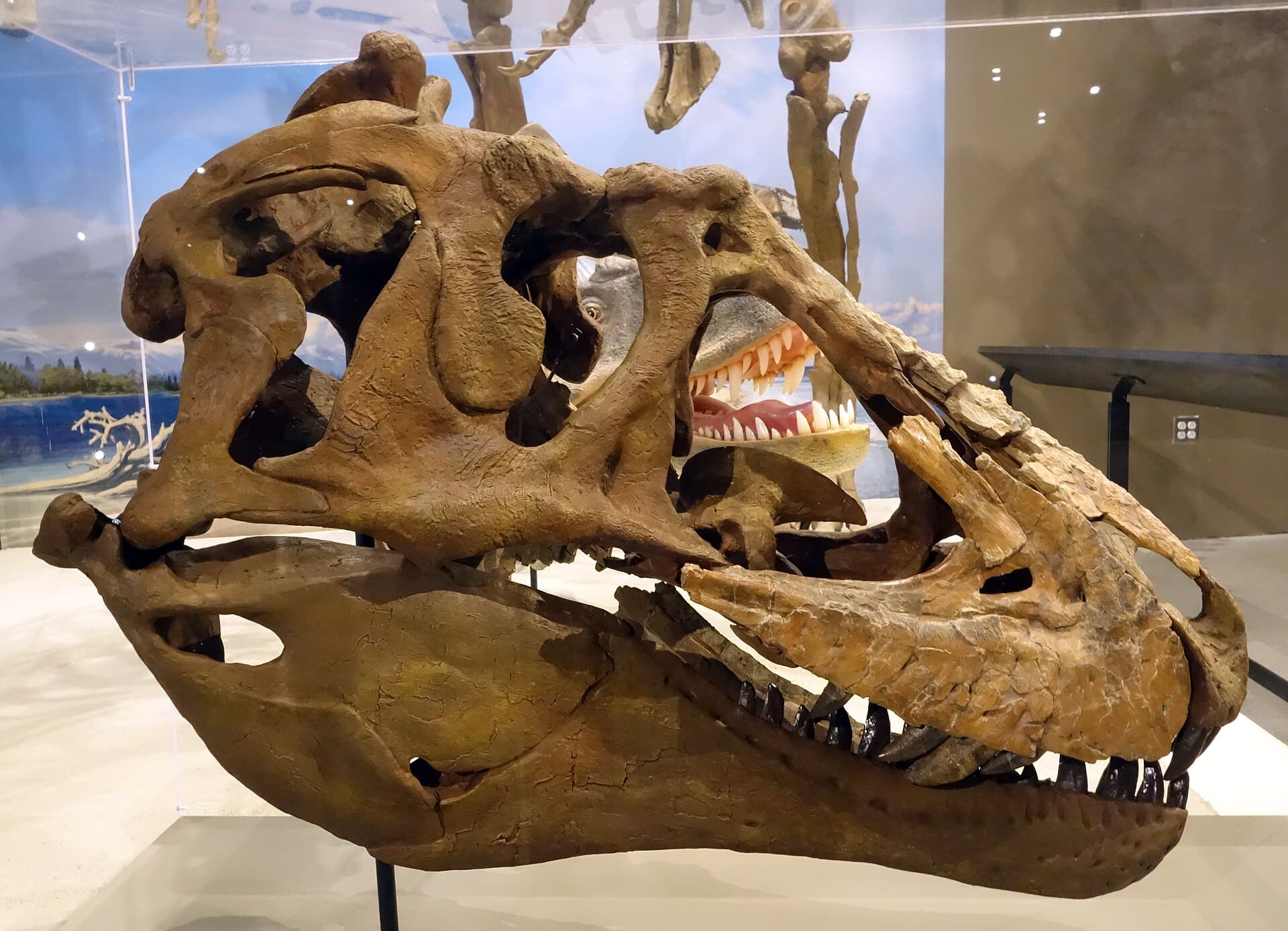

According to Beveridge and colleagues, the skeleton lay disarticulated and scattered within mudstone horizons of the lower Reynolds Point Member. To rebuild the skull, Loewen’s team digitally mirrored surface scans of the bones. They also scaled a quadratojugal from Teratophoneus to fit, which let them position the quadrate. No one has confirmed a second specimen—the supplementary data list only the holotype.
Lythronax Size and Description
Although only one partial skeleton exists, its bones reveal a great deal about the animal’s head.
Short description of Lythronax
Its skull had a short snout and a broad build. As in other tyrannosaurids, the snout made up less than 0.65 of skull length and the width more than 0.4 of it. Toward the back, however, the skull flared sideways, so the eye sockets faced forward and upward. Among tyrannosaurids, that arrangement was otherwise known only in Tyrannosaurus and Tarbosaurus. Along the upper jaw, the maxilla held 11 teeth. The first five were much larger than the six behind them—a form of heterodonty, or teeth of differing sizes within one jaw.
The dentary, the main tooth-bearing bone of the lower jaw, was strongly concave on its outer face. Its rear end flared top to bottom, which the describers read as a sign of a deep rear jaw. Below the head, the preserved bones resembled those of other tyrannosaurids in overall form. A university news release describes the animal as two-legged.
Since the holotype consists of bones alone, any discussion of skin or feathers is speculative. Likewise, the paper’s skeletal outline is a reconstruction by artist Scott Hartman, not a complete fossil.
Size and Weight of Type Species
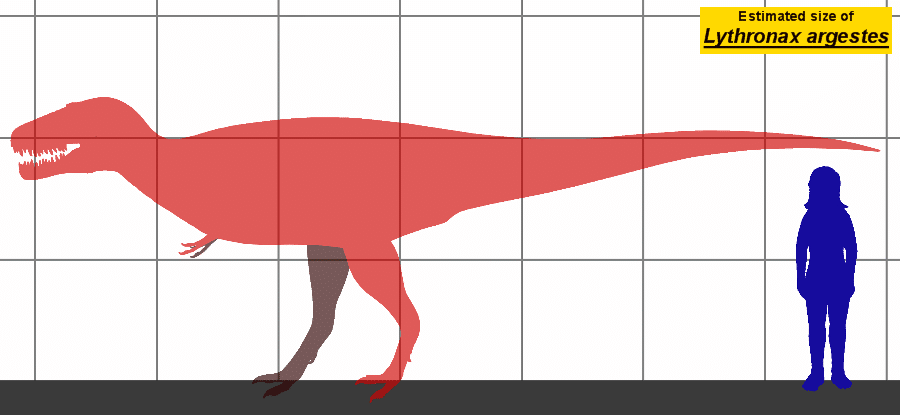
Loewen and colleagues gave no length or weight for Lythronax. Their skeletal drawing carries only a 1-meter (3.3-foot) scale bar. As a result, no peer-reviewed size estimate has yet appeared in the sources reviewed here.
The most repeated figures come from a 2013 University of Utah news release. It described the animal as “approximately 24 feet (8 meters) long” and said it “weighed around 2.5 tons.” However, the release names no estimator or method, so these are rough popular figures. Its own conversion is also loose—24 feet is about 7.3 meters, while 8 meters is closer to 26 feet.
Science News for Students reported in 2013 that the holotype was a juvenile. It also quoted Loewen as saying adults may have reached “maybe 35 feet” (about 10.7 meters) long. The 2013 paper itself does not discuss the animal’s age, so peer review has tested neither claim. No published source gives a hip height either. Until a formal estimate appears, its size remains an open question—one that a single partial skeleton cannot easily settle.

The Dinosaur in Detail
Four features set Lythronax apart from every other tyrannosaurid. Its maxilla had a sigmoidal, or S-curved, outer margin. Its nasals were also more than 2.5 times wider at the front than in the middle. On the frontal, the contacts for two neighboring skull bones nearly touched, and the jugal bore a distinct flange below the eye socket.
The 11 maxillary tooth sockets of Lythronax match Teratophoneus and Bistahieversor. In comparison, Tyrannosaurus had 12 to 13, while Albertosaurus had 14 to 16. Its pubis (a hip bone) ended in a large boot—at least 60 percent of the bone’s length—proportioned most like those of Tarbosaurus and Tyrannosaurus. The diagnosis also credits it with a tall ascending process on the astragalus (an ankle bone). However, no astragalus appears in the published holotype list.
In the news release, Loewen said the broad rear skull let the animal see with an overlapping field of view. The paper, however, describes only the eye sockets, not vision.
Its exact placement has proved less settled. Loewen’s original analysis of 54 taxa and 501 characters recovered Lythronax as sister to a group containing Tyrannosaurus, Tarbosaurus, and Zhuchengtyrannus. In 2016, Brusatte and Carr’s parsimony tree resolved the subfamily fully, but their Bayesian tree left Lythronax and Teratophoneus unresolved. Even so, they used its age of about 80 million years as a minimum date for an Asia–North America dispersal. Their placement of the alioramins, the group that includes Alioramus, implied that crossing. A year later, Carr and colleagues found Lythronax, Teratophoneus, and Nanuqsaurus in an unresolved three-way split. In 2025, however, Voris and colleagues recovered the alioramins as a late lineage that reached Asia only in the latest Cretaceous. Every later study reviewed here treats it as a valid genus, although its exact branch remains debated.
Interesting Points about Lythronax
- Its name means “gore king,” and argestes refers to a Homeric southwest wind.
- Its 2013 describers called it the geologically oldest tyrannosaurid, pushing the family’s origin back by at least two million years.
- A 2022 dating study placed the holotype at about 81.5 million years old, up to 1.6 million years older than earlier estimates.
- Scott Richardson, a Bureau of Land Management archaeologist technician, first spotted the skeleton in southern Utah in 2009.
- In 2013, Loewen told Science News for Students it was “the first tyrannosaur that could look you in the eye—with both eyes!”
Contemporary Dinosaurs
Also found in the Reynolds Point Member was Diabloceratops, a centrosaurine ceratopsid, or horned dinosaur. Beveridge and colleagues call it the oldest known centrosaurine. Its fossils come from UMNH VP Locality 1092. Their 2022 age model dates that site to about 81.27 million years ago, roughly 200,000 years after the Lythronax holotype. By geological standards the gap is small, yet no fossil evidence shows that the two ever met.
Lythronax in its Natural Habitat
Lythronax lived among rivers and floodplains in southern Laramidia. The Wahweap Formation is a 360- to 460-meter (1,180- to 1,510-foot) succession of floodplain mudstones and channel sandstones laid down by rivers. Within the Reynolds Point Member, floodplain deposits become more common, and sandstones appear as isolated, single-story channels. According to the university release, the quarry also yielded turtle shell, crab claws, leaf impressions, and a few mollusks.
Lythronax was a carnivore, and the same release called it the largest carnivore in its ecosystem. Science News for Students added a caveat to that claim—it holds only if one ignores a 12-meter (40-foot) crocodylian in coastal waters. Nothing shows directly what Lythronax ate, but its rock unit records centrosaurines, hadrosaurids, ankylosaurians, and pachycephalosaurids.
With only one skeleton known, nothing yet shows whether Lythronax lived alone or in groups. Even so, Beveridge and colleagues note that the formation preserves early members of iconic latest Cretaceous dinosaur lineages. Loewen’s team went further, proposing that rising and falling seas split tyrannosaurid populations into northern and southern forms. Brusatte and Carr (2016), however, found no clear north–south division among tyrannosaurids, so the idea remains contested. If Loewen’s team is right, Lythronax may have been an early product of that southern branch—its broad skull a preview of the giants to come.
Frequently Asked Questions
It means “gore king,” from the Greek words lythron, meaning “gore,” and anax, meaning “king.”
It lived in the Campanian stage of the Late Cretaceous, around 81.5 million years ago by a 2022 estimate.
No peer-reviewed size estimate has turned up. A 2013 university news release gave about 24 feet and around 2.5 tons. Loewen also told Science News for Students that the specimen was a juvenile.
It was a carnivore, and a 2013 university news release called it the largest carnivore in its ecosystem.
Its bones came from near Nipple Butte in Grand Staircase-Escalante National Monument, southern Utah, in the Wahweap Formation.
Four skull features occur in no other tyrannosaurid. They are an S-curved upper-jaw margin, nasals over 2.5 times wider at the front than the middle, nearly touching bone contacts on the frontal, and a flange below the eye on the jugal. Among tyrannosaurids, only Tyrannosaurus and Tarbosaurus otherwise share its broad rear skull and forward- and upward-facing eye sockets.
Sources
The information in this article is based on various sources, drawing on scientific research, fossil evidence, and expert analysis. The aim is to provide a comprehensive and accurate overview of Lythronax. However, please be aware that our understanding of dinosaurs and their world is constantly evolving as new discoveries are made.
- https://doi.org/10.1371/journal.pone.0079420
- https://journals.plos.org/plosone/article/file?type=supplementary&id=10.1371/journal.pone.0079420.s001
- https://doi.org/10.1016/j.palaeo.2022.110876
- https://par.nsf.gov/servlets/purl/10395959
- https://doi.org/10.1038/srep20252
- https://doi.org/10.1038/srep44942
- https://doi.org/10.1038/s41586-025-08964-6
- https://cmes.utah.edu/news/U%20scientists%20unearth%20the%20oldest%20Tyrannosaur%20to%20Date.php
- https://www.snexplores.org/article/king-gore
- https://www.doi.gov/employees/news/blm-archaeologist-technician-discovers-king-of-gore-in-grand-staircase-escalante-national-monument
This article was last fact checked: TheDinosaurs Team, 02-11-2026
Featured Image Credit: Tomopteryx, CC BY-SA 3.0, via Wikimedia Commons
