
Along the south coast of the Isle of Wight, west of Grange Chine, lie the mudstones of the Wessex Formation. From one of its plant debris beds, known simply as L9, came Brighstoneus simmondsi. This herbivorous iguanodontian lived in the early Barremian of the Early Cretaceous. Its describers called it a non-hadrosaurid hadrosauriform—an early relative of the later duck-billed dinosaurs. The find also suggests that Wealden iguanodontians were more diverse than the two traditional names implied.
Keith Simmonds discovered the skeleton, and in 1978 a team including the Museum of Isle of Wight Geology dug it out. The bones then waited more than four decades for a full study. In 2021, paleontologist Jeremy Lockwood and colleagues David Martill and Susannah Maidment finally named it. They found a modest bump on the nose and an unusually crowded lower jaw. It was, they noted, the island’s first well-characterized new hadrosauriform in a hundred years.
Brighstoneus Key Facts
| Keyword | Fact |
|---|---|
| Pronunciation | Not specified |
| Meaning of name | Of Brighstone (after the Isle of Wight village) |
| Group | Ornithopoda (Iguanodontia) |
| Type Species | Brighstoneus simmondsi |
| Diet | Herbivore |
| When it Lived | Within 126.5 to 121.4 MYA (early Barremian) |
| Period | Cretaceous |
| Epoch | Early Cretaceous (Barremian stage) |
| Length | Not specified |
| Height | Not specified |
| Weight | Not specified |
| Mobility | Not specified |
| First Discovery | 1978 by Keith Simmonds |
| Described by | 2021 by J.A.F. Lockwood, D.M. Martill, and S.C.R. Maidment |
| Holotype | MIWG 6344 |
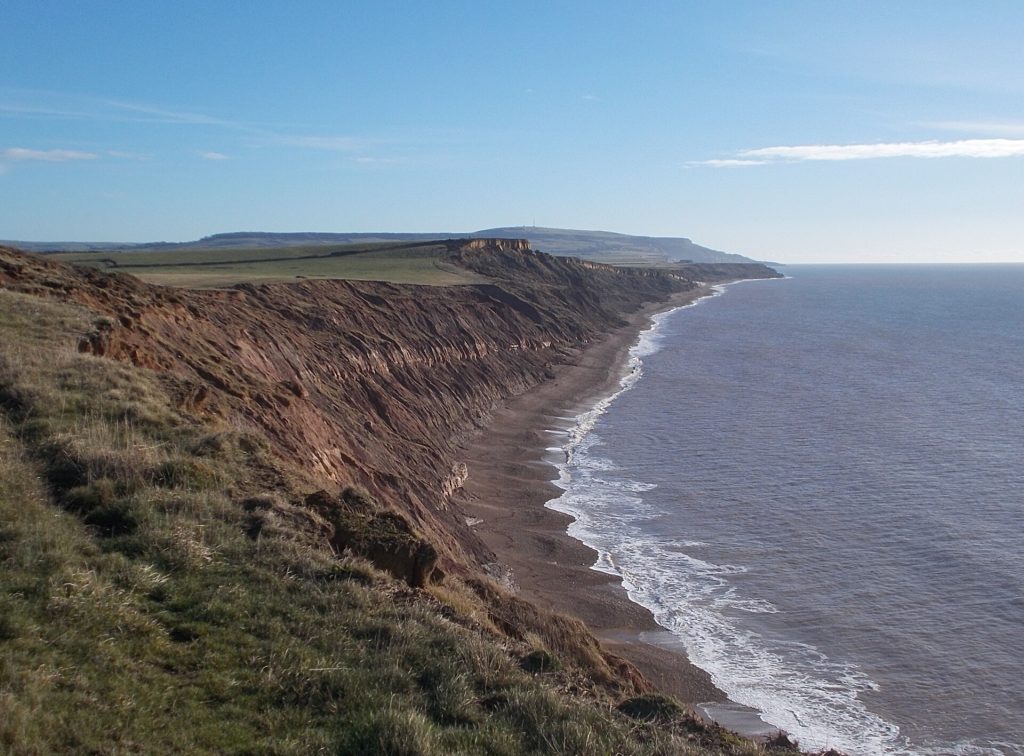
| Location of first find | Plant debris bed L9, west of Grange Chine, Wessex Formation, Isle of Wight, England, UK |
Brighstoneus Origins, Taxonomy and Timeline
The name Brighstoneus honors the village of Brighstone—close to the excavation site and once home to the Reverend William Fox. The species name simmondsi honors Keith Simmonds, who made the discovery. Together, the name ties the animal to its village and to the man who first found its bones.
In the original description, Brighstoneus sits within Ornithopoda, Iguanodontia, and Ankylopollexia, then the narrower Styracosterna and Hadrosauriformes. Lockwood and colleagues’ strict consensus—the most cautious of their family trees—made it an early-diverging hadrosauriform outside the duck-billed Hadrosauridae. However, their other trees disagreed. A majority-rule tree made it the sister of Ouranosaurus, outside Hadrosauriformes. Meanwhile, without their two new characters, it became the earliest-branching hadrosauroid, prompting the authors to note “the volatility of these topologies.” Brighstoneus simmondsi is the type and only known species.
The fossil dates to the early Barremian. Following a 2020 timescale, the original paper placed the Barremian roughly 126.5 to 121.4 million years ago—a span of about 5.1 million years. The current international chart puts the stage’s base slightly younger, at 125.77 million years ago. Assuming steady rates of deposition, Lockwood and colleagues place the specimen about 4 million years before the Mantellisaurus holotype.
Discovery & Fossil Evidence
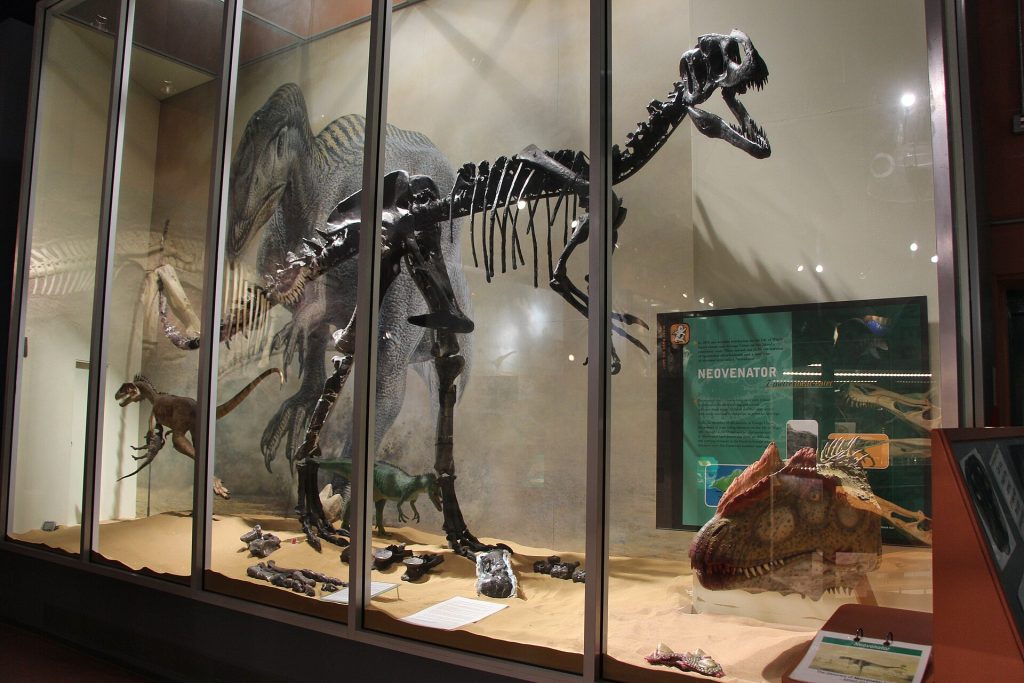
The dig took place in 1978 in plant debris bed L9, west of Grange Chine. A site photograph places it at Brighstone Bay, beneath considerable overburden. Simmonds himself drew the first-phase site plan on a 3.3-foot (1-meter) grid. The same 10 × 20 foot (3 × 6 meter) patch also held the predator Neovenator, and the two skeletons even overlapped.
No bones lay articulated, yet preservation was consistent and no element appeared twice. Accordingly, the authors treat the bones as one associated individual, a view the then curator shares. The holotype, MIWG 6344, is a partial skeleton now in the Dinosaur Isle Museum collection. It preserves part of the right premaxilla (the front upper jaw bone), both maxillae (upper tooth-bearing bones), and both dentaries (lower jaws). The predentary—a toothless bone at the tip of the lower jaw—also survives. A left nasal, a left palpebral (a small bone over the eye), and both jugals (cheek bones) complete the skull material.
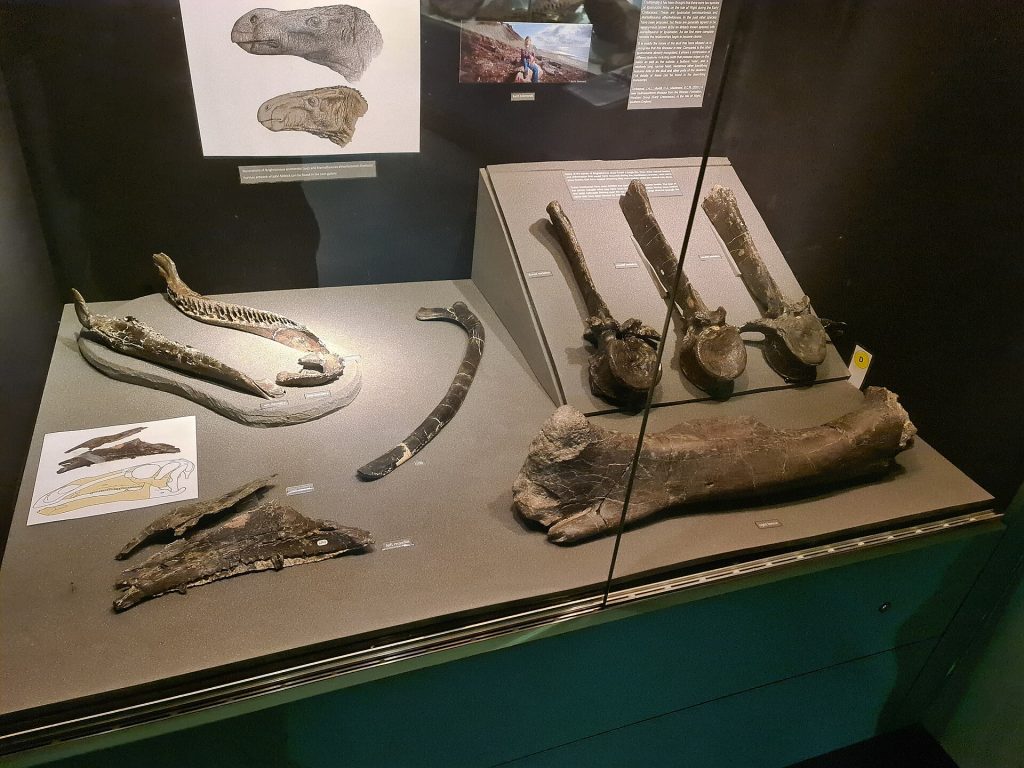

Behind the head, the skeleton includes eight back vertebrae, a sacrum (the fused hip vertebrae), six tail vertebrae, and 14 ribs. Both ilia (upper hip bones), a right ischium, and a right femur add to the list. A few other parts, including two back vertebrae, remain undescribed in private hands. Overall, preservation is excellent, with little distortion or crushing. Beyond the holotype, an unprepared partial skeleton from the Wessex Formation, IWCMS 2001.445, has an upper tooth with a similar inner ridge. It is possibly referable to Brighstoneus, but no additional specimens have been formally referred to it.
Brighstoneus Size and Description
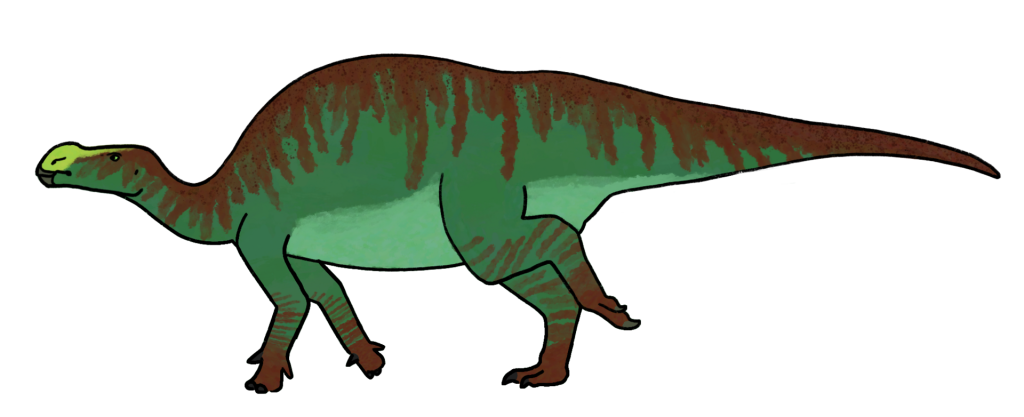
Brighstoneus looked broadly like its Wealden relatives, but its snout and back held several surprises.
Short description of Brighstoneus
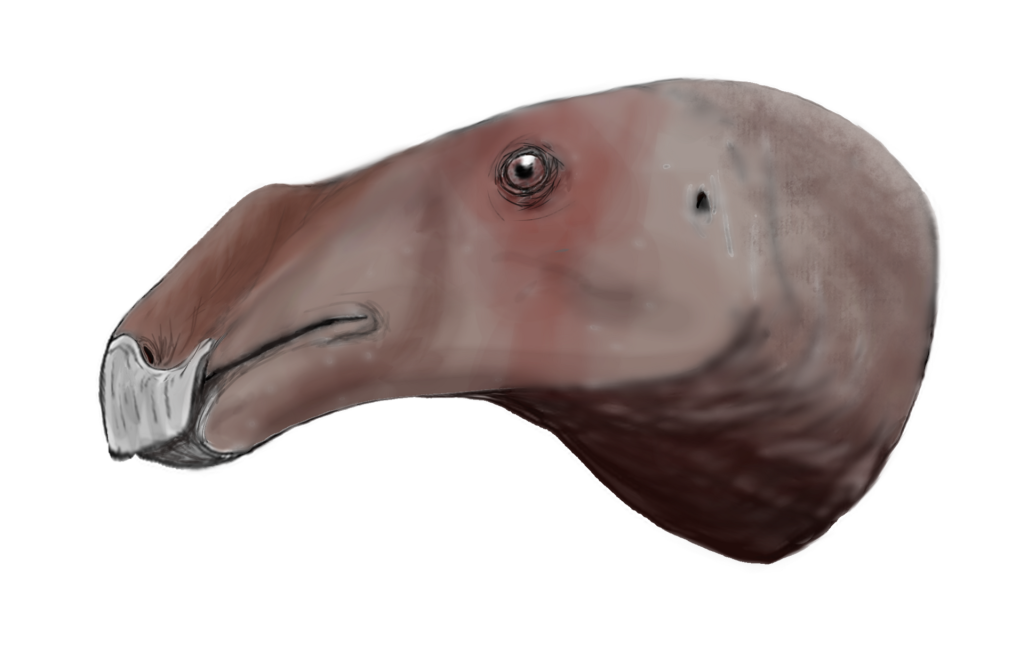
The skull carried a maxilla whose ascending process (its upward prong) sat far back, leaving the front section about twice the length of the rear. On top of the snout, the nasal bone rose into a rounded bulge, or nasal bulla, with convex side walls. At the tip of the lower jaw, a horseshoe-shaped predentary bore five pointed denticles (small tooth-like points) along its front edge. The fossils are bone alone, so any skin or beak covering in a restoration is speculative.
Farther back, the middle back vertebrae carried tall neural spines—the bony blades above each vertebra. The describers judged them at least three times as tall as the centrum (vertebral body), and possibly much taller. A partial meshwork of ossified tendons, bony rods that braced the spine, survives on one of them. The hips probably held seven fused sacral vertebrae, and the femur is slender and essentially straight except near its lower end. The original description does not specify its posture. In contrast, a 2026 study linked tall spines in its proposed group to larger bodies and a four-legged stance. However, its authors call this a hypothesis still to be tested.

Size and Weight of Type Species
The original description gives no body length or mass. Its best size clue is the right femur, which measures 28.0 inches (710 millimeters) as preserved, with its lower joint surfaces missing. Modeled on Mantellisaurus, the complete bone would have reached about 29.7 inches (754 millimeters).
Around its midpoint, the femur has a circumference of 14.9 inches (378 millimeters), including the fourth trochanter—a ridge where muscles attached. According to Lockwood and colleagues, the estimated femur length is 10% greater than that of the Mantellisaurus holotype. Fused neurocentral sutures, the joints between each vertebral body and its arch, also suggest a reasonably mature animal.
In 2021, the Natural History Museum quoted about 26 feet (8 meters) and 1,980 pounds (900 kilograms). However, the museum gave no method, so the femur remains the firmest yardstick.
The Dinosaur in Detail
What sets this dinosaur apart is its crowded lower jaw. The dentary tooth row holds 28 alveolar positions (tooth sockets), with a possible tiny extra pit at the front. Lockwood and colleagues called this the highest number recorded in an ornithopod with non-parallel-sided sockets. By comparison, earlier authors credited Mantellisaurus with 21 positions in 1986 and 22 in 2008. Brighstoneus has at least six extra positions—27% more than the Mantellisaurus holotype—while its maxilla held 29.
The one well-preserved upper crown bears a primary ridge on its inner face. In addition, extra (accessory) ridges sit on the front of the crown. That pattern is one of two traits that set it apart from every other iguanodontian. The second is the nasal bulla, which resembles the bump on Muttaburrasaurus in shape and position but is less prominent. The feature appears unique among Wealden iguanodontians, and the authors think nasal ornaments evolved independently several times.

Its back spines also stand out, with height ratios from 2.8 to 3.4, while most iguanodontians fall below 3.0. Still, the damaged spine tips make these values minimums. Ouranosaurus, by comparison, reaches 5.1 and Morelladon 4.0. Two back spines had fractured before death, and ossified tendons presumably splinted one break in place. A spine fragment also carries what the authors read as theropod or crocodilian bite marks.
Its place in the family tree, however, remains debated. In 2026, Rotatori and colleagues placed it within a new clade, Ouranosauria, in nearly all their analyses. That group, shared with Ouranosaurus and Morelladon, is the sister of Hadrosauriformes. They note that Bertozzo and colleagues (2025) placed it in a more nested position. Meanwhile, Guo and colleagues (2026) recovered it as an early hadrosauroid. All these studies treat it as a distinct genus—only its branch is in question.
Interesting Points about Brighstoneus
- When described in 2021, its 28 dentary tooth positions were the highest number recorded in any ornithopod with non-parallel-sided tooth sockets.
- The skeleton waited 43 years between its 1978 excavation and its formal naming in 2021.
- It lay in the same small patch of plant debris as the predator Neovenator, though the paper records no interaction.
- Two of its back spines show fractures that happened in life, one apparently held in place by a natural splint of ossified tendons.
- A 2026 study of beaks names Brighstoneus among dinosaurs whose first predentary denticle on each side is the largest and almost rhomboidal.
Contemporary Dinosaurs
Sharing bed L9 with Brighstoneus was Neovenator salerii, an allosauroid theropod about 25 feet (7.5 meters) long, according to its describers. Its skeleton—one of the UK’s most complete theropods—came from the same small plot. The site records even identify some small tail vertebrae from the dig as Neovenator. Yet the original paper records no interaction and does not tie the bite marks on Brighstoneus to it.

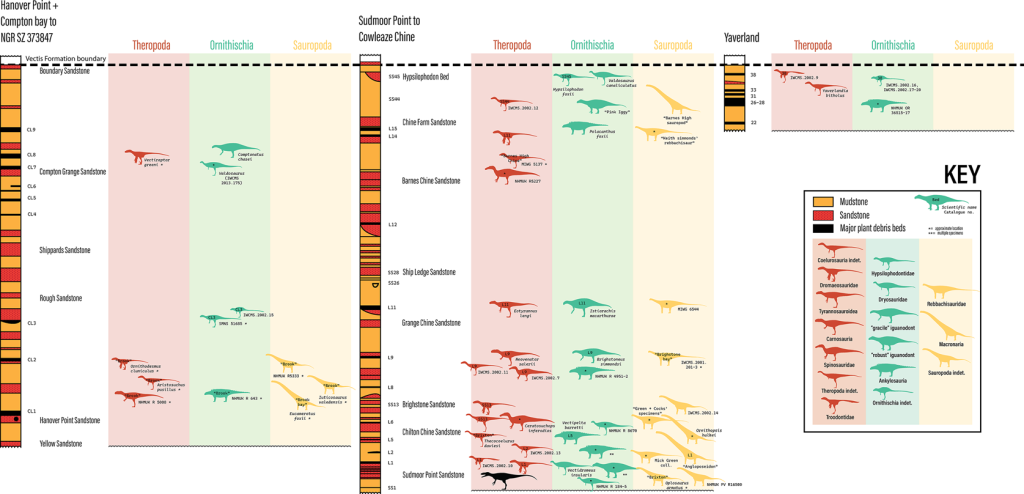
Also known from the Wessex Formation (levels unknown or different from bed L9): material referred to the large Iguanodon, the spinosaurid Ceratosuchops, and the dromaeosaurid Vectiraptor, all of unknown level. Likewise, the megaraptoran Invictibellatrix has no known level, though it most likely came from lower beds. In contrast, the tyrannosauroid Eotyrannus and the possibly sail-backed Istiorachis come from bed L11, a little higher. The spinosaurid Riparovenator comes from lower beds at Chilton Chine, and Hypsilophodon from near the top of the formation. Lockwood and colleagues regarded the exposed formation as entirely Barremian, while a 2026 study gives it a span of 15 million years. Either way, these animals may not all have lived at the same time.
Brighstoneus in its Natural Habitat
The world Brighstoneus roamed was a near-coastal floodplain under a variable, “Mediterranean” climate. Highly sinuous rivers wound across it, laying down varicolored mudstones and channel sands. Conifer and ginkgo forests covered higher ground to the north, alongside ferns, cycad relatives, and early flowering plants. Growth rings in the conifer Pseudofrenelopsis point to a probable yearly swing from hot, drier to cool, wetter weather. Wildfires and floods were common, washing plant debris into the basin. A 2026 study also links bed L9 to a shift toward more upland settings.
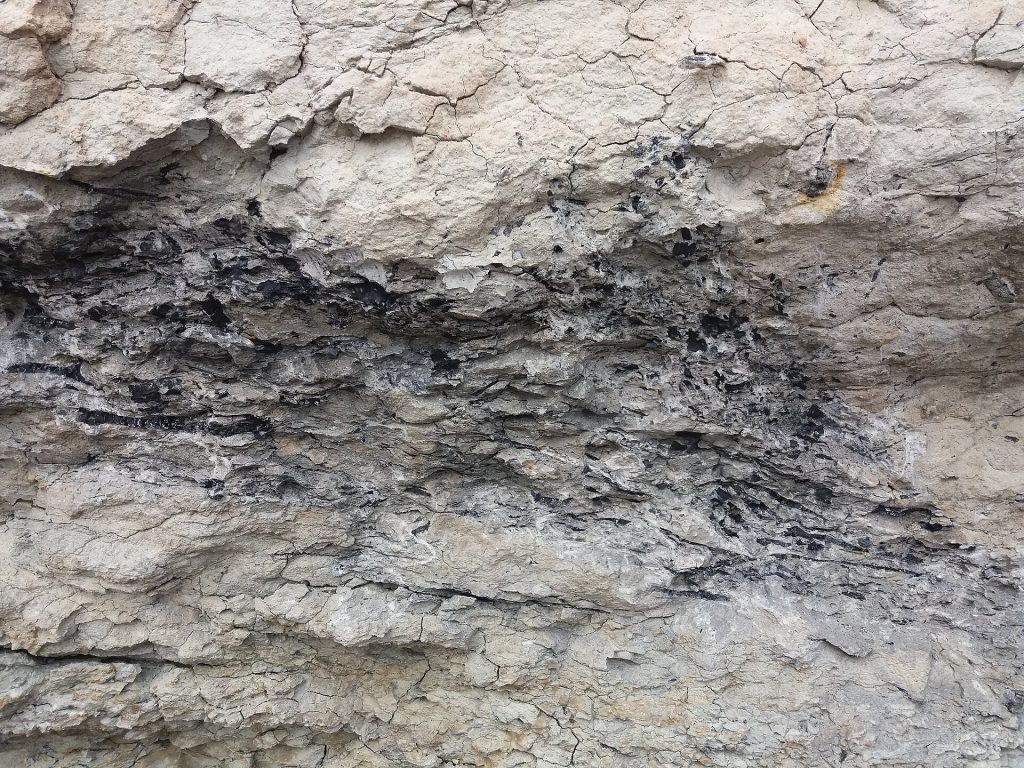
Like other iguanodontians, Brighstoneus was a herbivore, though the original paper says nothing directly about its diet. In general, dinosaur fossils here come mainly from plant debris beds, which geologists interpret as local sheet floods that turned into debris flows.
Large basal iguanodontians dominated this ecosystem, and their remains heavily outnumber those of other tetrapods. Because Brighstoneus rests on a single individual, its social life is unknown. A 2025 study judged tall spines in its wider group probably multipurpose—from mechanical support to visual signaling. Even after death, its bones stayed busy—according to its describers, smooth scooped-out patches possibly record termites. Similarly, small pits on the ribs might represent beetles.
Brighstoneus Gallery
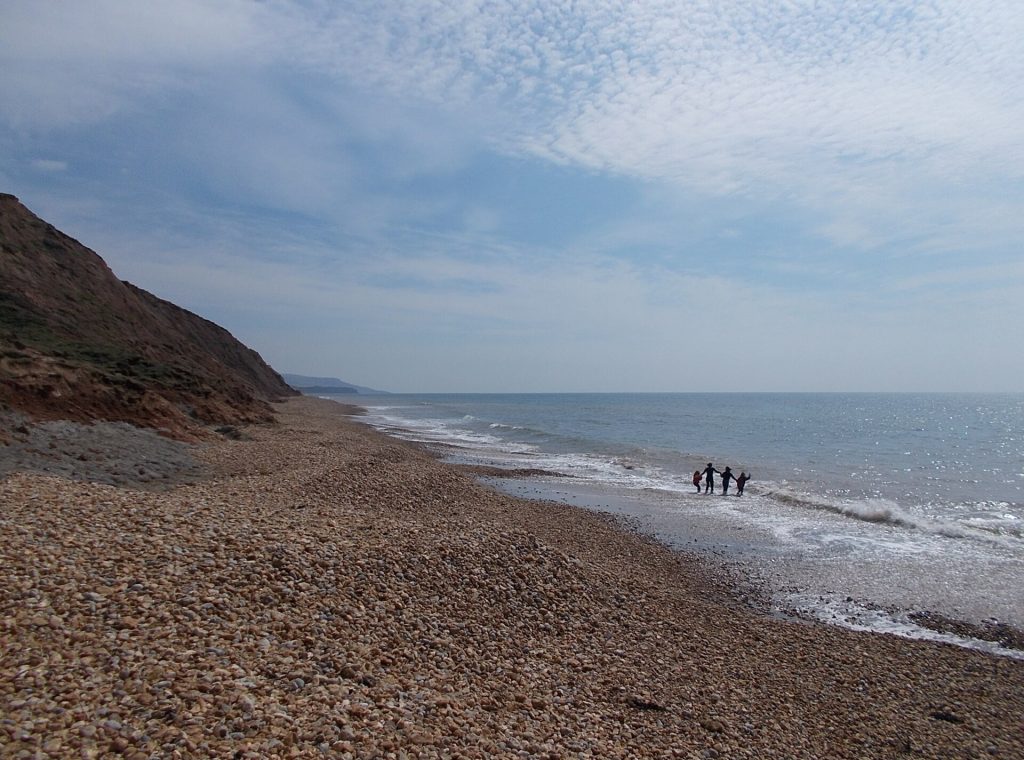
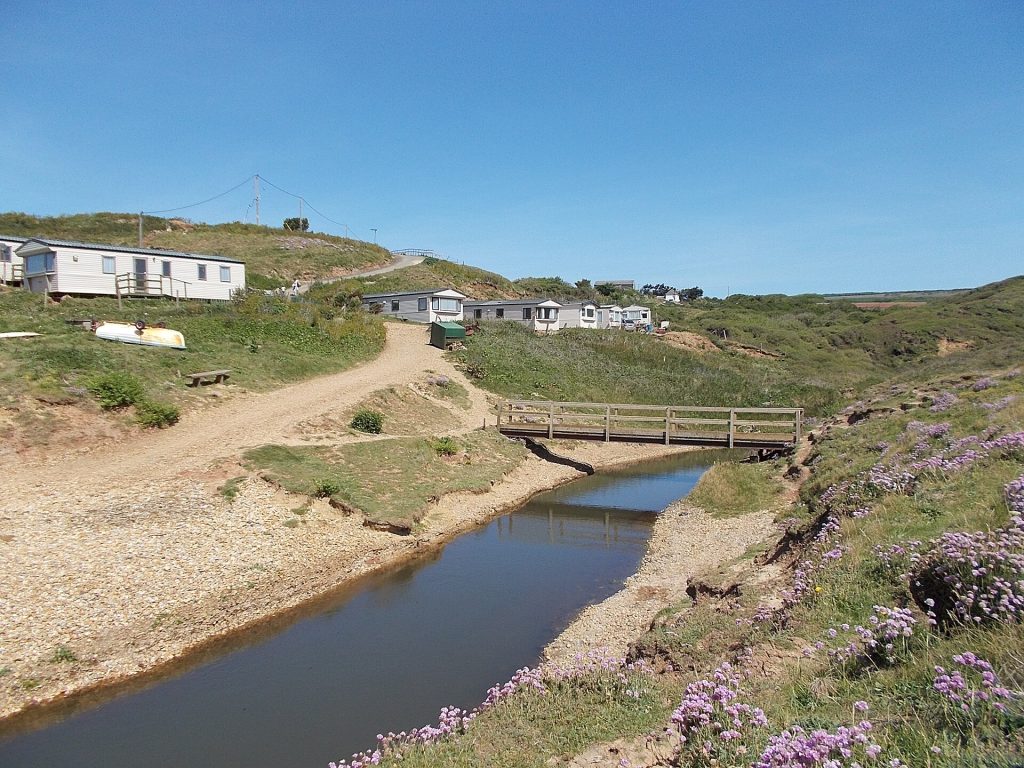
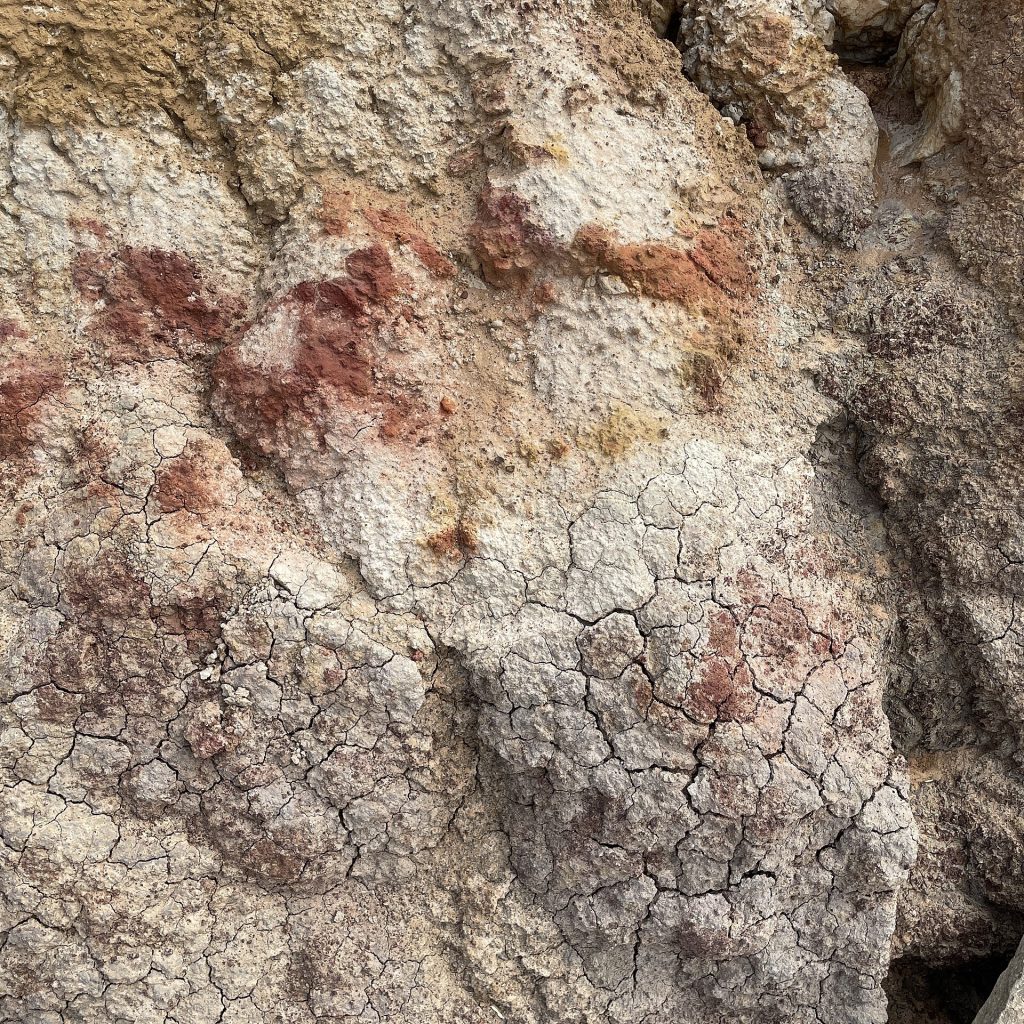
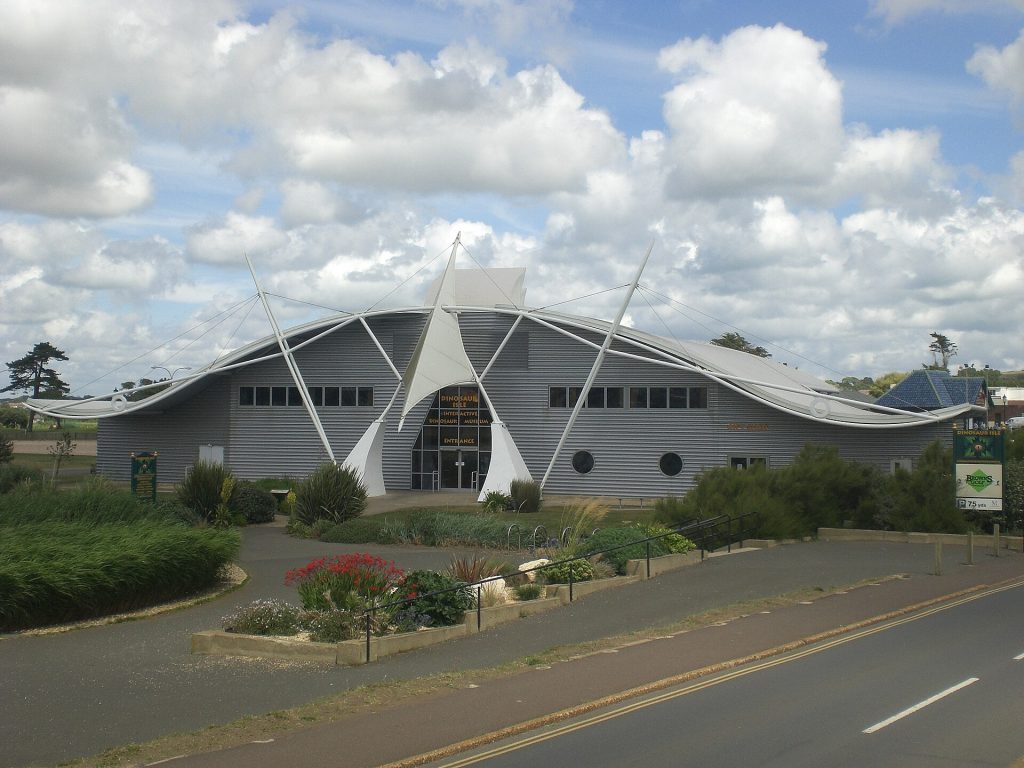
These images show the coast that yielded Brighstoneus, the Wessex Formation’s rocks, and the museum holding its bones.







Frequently Asked Questions
It is named after Brighstone, a village on the Isle of Wight, and the species name honors finder Keith Simmonds.
It lived in the early Barremian stage of the Early Cretaceous, within roughly 126.5 to 121.4 million years ago.
The original description gives no body length or mass. In 2021, the Natural History Museum gave about 26 feet (8 m) and 1,980 pounds (900 kg), without stating a method.
It was a herbivore, like other iguanodontians, though its original description does not discuss its diet.
It came from plant debris bed L9 of the Wessex Formation, west of Grange Chine on the Isle of Wight’s south coast.
Its describers found two features seen in no other iguanodontian. One upper tooth shows a main ridge plus extra ridges on its inner face, and its modest nose bump has convex side walls.
Sources
The information in this article is based on various sources, drawing on scientific research, fossil evidence, and expert analysis. The aim is to provide a comprehensive and accurate overview of Brighstoneus. However, please be aware that our understanding of dinosaurs and their world is constantly evolving as new discoveries are made.
- https://doi.org/10.1080/14772019.2021.1978005
- https://doi.org/10.1127/njgpm/1996/1996/635
- https://zenodo.org/records/5696995
- https://doi.org/10.1111/pala.70057
- https://doi.org/10.3897/fr.29.208273
- https://doi.org/10.1098/rsos.260937
- https://doi.org/10.1038/s41598-021-97870-8
- https://doi.org/10.1098/rsos.260392
- https://doi.org/10.1002/spp2.70034
- https://stratigraphy.org/ICSchart/ChronostratChart2024-12.pdf
- https://nhm.ac.uk/press-office/press-releases/new-species-of-iguanodontian-dinosaur-discovered-on-isle-of-wight.html
This article was last fact checked: TheDinosaurs Team, 25-11-2026
Featured Image Credit: D. J. King, CC BY-SA 4.0, via Wikimedia Commons
