
Near the city of Laiyang in China’s Shandong Province, the river and lake deposits of the Wangshi Group hold a small, puzzling plant-eater. In 1978, paleontologist Dong Zhiming named it Micropachycephalosaurus hongtuyanensis. That is a long name for an animal he estimated at only about 1.6 to 2.0 feet (50 to 60 centimeters) long. It probably lived during the Campanian stage of the Late Cretaceous, roughly 83.6 to 72.2 million years ago. Dong saw it as a flat-headed pachycephalosaur, but later researchers have not agreed on where it belongs.
Dong’s field party collected the bones in the summer of 1972 while studying a rock section at Hongtuya, southwest of Laiyang railway station. The specimen is fragmentary—bits of skull and jaw, part of the hips and hind limbs, and a string of tail vertebrae. Even so, Dong named a new genus and species from it. Decades later, in 2009, Butler and Zhao concluded that the specimen is still diagnosable, although it shows no clear pachycephalosaur features. Its story shows how much a handful of small bones can reveal—and how much they can leave unsettled.
Micropachycephalosaurus Key Facts
| Keyword | Fact |
|---|---|
| Pronunciation | mike-row-pak-ee-keff-ah-loh-sore-us |
| Meaning of name | Tiny Thick-Headed Lizard |
| Group | Cerapoda (exact placement debated) |
| Type Species | Micropachycephalosaurus hongtuyanensis |
| Diet | Herbivore |
| When it Lived | 83.6 to 72.2 MYA |
| Period | Cretaceous |
| Epoch | Late Cretaceous (Campanian stage) |
| Length | About 1.6 to 2.0 feet (50 to 60 centimeters), Dong’s 1978 estimate |
| Height | Not specified |
| Weight | Not specified |
| Mobility | Not specified |
| First Discovery | 1972 by Dong Zhiming’s IVPP field party |
| Described by | 1978 by Dong Zhiming |
| Holotype | IVPP V5542 |
| Location of first find | Hongtuya, southwest of Laiyang railway station, Wangshi Group, Shandong, China |
Micropachycephalosaurus Origins, Taxonomy and Timeline
The name Micropachycephalosaurus grew out of a simple observation. Dong explained that he called it a “small swollen-head” because its body was relatively small. The Natural History Museum renders the name in English as “tiny thick-headed lizard.” Meanwhile, the species name hongtuyanensis refers to Hongtuya, the cliff site that yielded the bones. Together, the name records both a body size and a place.
Dong placed the new genus among the pachycephalosaurs because its thick skull roof carried a shelf-like ridge at the back. He also erected a new family, Homalocephaleridae, for flat-headed forms such as Homalocephale and Wannanosaurus, and left the domed species in Pachycephalosauridae. In 2006, Sullivan followed Sereno (2000) in treating the name as a nomen dubium—a name too poorly founded for reliable use. Butler and Zhao, however, argued in 2009 that the specimen was diagnosable. Finding no clear pachycephalosaur features, they placed it in Cerapoda incertae sedis. Cerapoda is the broad group that unites ornithopods with horned and thick-headed dinosaurs.
Boyd’s 2015 analysis treated it as a marginocephalian—part of the group joining ceratopsians and pachycephalosaurs—whose exact position remains uncertain. Some reference works, including Holtz’s encyclopedia and the Paleobiology Database, lean toward a ceratopsian instead.
As for timing, Dong’s Chinese text says only Late Cretaceous, but his English summary specifies the Campanian stage. Butler and Zhao also gave a Campanian age, while Sullivan, citing Lucas and Estep (1998), placed it in the late Campanian. That stage spans roughly 83.6 to 72.2 million years ago. By contrast, the Paleobiology Database dates the type site to the older Coniacian to Santonian—89.8 to 83.6 million years ago. Holtz’s encyclopedia gives a younger date of about 70.6 to 68.5 million years ago. Until the exact bed is known, this article follows the Campanian age.
Discovery & Fossil Evidence
The story began in the summer of 1972 at Hongtuya. There, Dong’s team from the Institute of Vertebrate Paleontology and Paleoanthropology (IVPP) was examining a rock section. Dong called the Wangshi beds of Laiyang a classic Chinese Late Cretaceous unit long known for dinosaurs. In his view, the new find enriched that fauna. Today geologists rank the unit as the Wangshi Group. However, Dong and later Butler and Zhao name only the “Wangshi Formation,” so the exact formation at Hongtuya remains open. Yan and Chen (2005) did use the name “Hongtuya Formation” for the Jingangkou Formation, yet the locality name alone does not prove the formation.
The holotype, cataloged as IVPP V5542, belongs to the IVPP in Beijing. Dong listed a broken parietal (rear skull roof bone) and an incomplete squamosal and quadrate (bones at the skull’s back corner and jaw joint). Only one right dentary (tooth-bearing lower jaw bone) survived, along with a string of caudal (tail) vertebrae and parts of the pelvis and hind limbs. His plate shows the jaw with its teeth, five fused sacral (hip) vertebrae, three linked tail vertebrae, and the femur and tibia.
Later, Sullivan summarized the material as an incomplete skull, ilium, and sacrum. He also reported that Perle and colleagues considered the specimen an adult in 1982. In 2017, Zhang and colleagues still listed it among the pachycephalosaurs in their Laiyang fauna table. With so little material, every reconstruction of this animal leans heavily on comparison with its relatives.
Micropachycephalosaurus Size and Description
Little of the skeleton survives, yet Dong’s description still records useful details from head to tail.
Short description of Micropachycephalosaurus
Its skull roof was thick yet fairly flat rather than domed. Its supratemporal fenestra—an opening on top of the skull behind the eye—remained open, and Dong noted no obvious knobs or ornament on the head. The surviving rear end of the parietal is about 0.5 inches (1.2 centimeters) thick and ends in a projecting, shelf-like ridge. Its quadrate resembles that of typical ornithopods, the mostly two-legged plant-eaters. Meanwhile, the occipital condyle, the knob where skull meets neck, is complete and four-sided.
The right dentary is deep and thin, with nine tooth sockets and seven complete teeth. Each slender tooth carries a central ridge and small, nearly symmetrical denticles (serrations) along its edges. Further back, six fused sacral vertebrae formed the sacrum, with flat-ended centra (vertebral bodies) and neural spines merged into a plate. Curiously, the plate caption counts five fused sacrals, while the text counts six. The tail vertebrae bore plate-like spines and well-developed transverse processes (side projections). Because the remains include no skin or soft tissue, any discussion of its outer covering is speculative. Dong’s description does not say whether it walked on two legs or four, either.
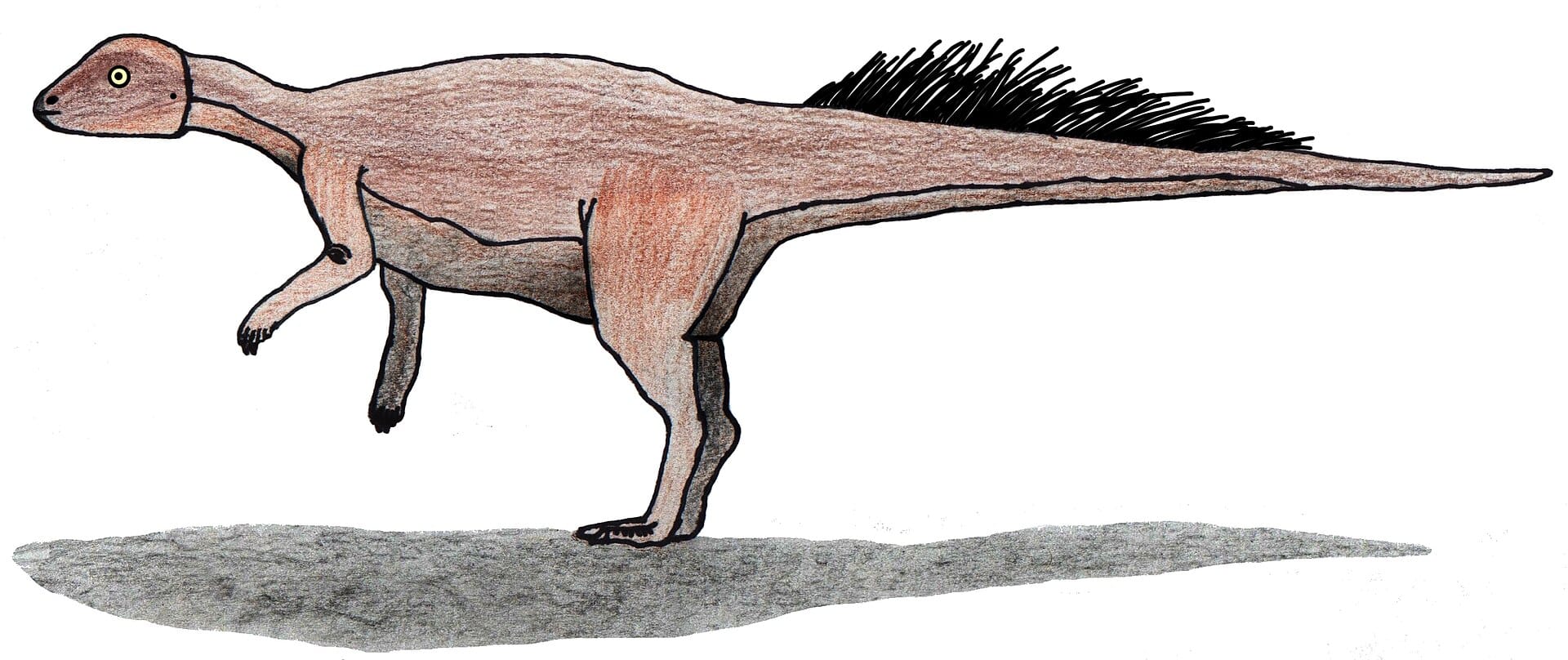

Size and Weight of Type Species
Dong put its body length at about 1.6 to 2.0 feet (50 to 60 centimeters), although he did not explain how he reached that figure. That makes the whole animal shorter than a yardstick. Popular references stay close to his range—the Natural History Museum gives 0.6 meters, while Holtz lists about 50 centimeters.
The one bone Dong measured for length is the complete left femur (thigh bone), at 4.9 inches (12.4 centimeters). That is only about a fifth to a quarter of his estimated body length. The bone was bowed, with a poorly developed lesser trochanter and a high, ridge-like fourth trochanter—both attachment points for leg muscles. The sources reviewed give no hip height or body mass.
For comparison, Dong found its teeth close in size to those of Wannanosaurus, another small Chinese ornithischian. Its tibia (shin bone), meanwhile, resembled that of the early ceratopsian Psittacosaurus.
The Dinosaur in Detail
What sets this dinosaur apart is less any single bone than the long argument over what its bones mean. Dong considered the thick skull roof with its rear shelf decisive—in his words, it was “undoubtedly” a pachycephalosaur. He also argued that flat and domed skull roofs marked different groups, although he did not fully rule out differences between males and females. That view put him at odds with Galton (1971), who, like Brown and Schlaikjer, had linked domed heads to males.
Dong separated his animal from Wannanosaurus. The two matched in size and had very similar teeth, but Wannanosaurus had a skull roof covered in dense tubercles. Beyond that, he found mixed resemblances—teeth like those of Thescelosaurus and vertebrae like those of the Mongolian Homalocephale. He rebuilt the low ilium from an impression of the crushed bone. With its long, slender front process, it resembled those of Psittacosaurus and Homalocephale. In addition, he described a lengthwise groove on the underside of the fourth to sixth sacral vertebrae.
In 2009, Butler and Zhao concluded that prominent grooves under the posterior dorsal (rear back) vertebrae keep the specimen diagnosable. Yet the column Dong described began at the sacrum. They evidently recast some of his grooved “sacral” vertebrae as back vertebrae. Despite that diagnostic feature, they found no clear pachycephalosaur synapomorphies—shared, derived traits that define a group.
Later, Boyd’s 2015 analysis ran into the same gap. Because the skulls of this animal and Stenopelix are poorly known, proposed marginocephalian traits such as the rear skull shelf remain unconfirmed as group hallmarks. In 2025, Yang and colleagues still pruned it from their analysis as an unstable taxon. Taken together, these studies leave Micropachycephalosaurus as a small cerapodan with an open address—possibly a pachycephalosaur, possibly a ceratopsian, and possibly neither.
Interesting Points about Micropachycephalosaurus
- Despite a name built around a thick head, its skull roof is known only from the broken rear end of a parietal and an incomplete squamosal.
- Dong’s team collected the bones in 1972, but Dong did not publish the name until 1978.
- Sereno and Sullivan treated the name as a nomen dubium, but Butler and Zhao later argued that the holotype remains diagnosable.
- Its complete left femur, the one bone Dong measured directly for length, is only 4.9 inches (12.4 centimeters) long.
- Laiyang is one of relatively few areas worldwide that are rich in both dinosaur bones and dinosaur eggs.
Micropachycephalosaurus in its Natural Habitat
The world Micropachycephalosaurus roamed survives in river and lake deposits—red and gray-green siltstones and mudstones, with gravelly glutenites between them. At the type site, the bones came from claystone, according to the Paleobiology Database. Geologists divide the Wangshi Group into the Xingezhuang, Jiangjunding, Jingangkou, and Changwangpu formations, from bottom to top. Researchers have regarded the uppermost of these as absent at Laiyang. Elsewhere at Laiyang, mudflows at Jingangkou buried hadrosauroid carcasses after only a short transport.
The Wangshi Group around Laiyang has yielded several other dinosaurs, although none can yet be tied to the exact beds at Hongtuya. For example, Tsintaosaurus, a lambeosaurine (crested duck-billed) hadrosaur, comes from the Jingangkou Formation at Laiyang. In 2005, Yan and Chen dated that formation to about 73 million years ago, using a basalt near Jiaozhou. Collectors recovered the basal hadrosauroid Tanius sinensis in 1923 from the Jiangjunding Formation—the unit the Paleobiology Database gives for the Hongtuya site. A few specimens of the giant Shantungosaurus have also turned up at Laiyang. Meanwhile, the saurolophine (flat-headed or solid-crested) hadrosaurid Laiyangosaurus youngi comes from the Jingangkou Formation there. Since these are group-level neighbors, any picture of them meeting remains speculative.
The Natural History Museum lists Micropachycephalosaurus as a herbivore. Its slender, finely serrated teeth sat in a single close row. They may have suited cropping plants, but Dong did not discuss how it fed.
While there is no direct evidence of its social life, Dong noted the general view that pachycephalosaurs were herbivorous, gregarious animals. That statement, citing earlier authors Brown and Galton, describes the group as a whole rather than this specimen. For now, its role in the Wangshi ecosystem remains a sketch. Compared with the giant hadrosaurs of the Wangshi Group, such as Shantungosaurus, it stands out simply for being so small.
Frequently Asked Questions
It means “tiny thick-headed lizard,” and the species name refers to Hongtuya, the site near Laiyang that yielded the bones.
It probably lived in the Campanian stage of the Late Cretaceous, roughly 83.6 to 72.2 million years ago.
Dong estimated a length of about 1.6 to 2.0 feet (50 to 60 centimeters). Sources give no height or weight.
Dong first described it as a pachycephalosaur, but later studies class it as a cerapodan ornithischian whose exact placement is still debated.
Dong’s team found it at Hongtuya, southwest of Laiyang railway station in Shandong, China, in rocks of the Wangshi Group.
Butler and Zhao identified prominent grooves beneath its rear back vertebrae, a feature that keeps the fragmentary specimen diagnosable.
Sources
The information in this article is based on various sources, drawing on scientific research, fossil evidence, and expert analysis. The aim is to provide a comprehensive and accurate overview of Micropachycephalosaurus. However, please be aware that our understanding of dinosaurs and their world is constantly evolving as new discoveries are made.
- http://www.vertpala.ac.cn/EN/Y1978/V16/I4/225
- https://doi.org/10.1016/j.cretres.2008.03.002
- https://c4-web.tacc.utexas.edu/UAF/arctos/2010_06_16/sci_bulletin35_43.pdf
- https://doi.org/10.7717/peerj.1523
- https://ivpp.cas.cn/cbw/gjzdwxb/xbwzxz/201704/P020170509332561683701.pdf
- https://doi.org/10.1590/0001-3765201720160920
- https://paleobiodb.org/classic/basicCollectionSearch?collection_no=70958
- https://www.nhm.ac.uk/discover/dino-directory/micropachycephalosaurus.html
- https://stratigraphy.org/ICSchart/ChronostratChart2024-12.pdf
- https://doi.org/10.7717/peerj.19664
This article was last fact checked: TheDinosaurs Team, 01-11-2026
Featured Image Credit: TotalDino, CC BY 4.0, via Wikimedia Commons
