
On the Uncompahgre Upwarp of western Colorado, Dry Mesa Quarry cuts into the Brushy Basin Member of the Morrison Formation. Its river-laid bone beds produced Supersaurus vivianae, a giant diplodocid sauropod with length estimates of 108 to 131 feet (33 to 40 meters). Rock dates near the quarry suggest it lived about 151 to 150 million years ago, in the Late Jurassic. Its first major fossil was a scapulocoracoid (the fused shoulder blade and coracoid) 8 feet (2.44 meters) long.
Paleontologist James A. Jensen of Brigham Young University (BYU) dug the quarry from 1972 to 1981, after prospectors Eddie and Vivian Jones showed him the site. In 1985, he named Supersaurus alongside two other giants from the same quarry—Ultrasaurus and Dystylosaurus. Later work folded both names into Supersaurus, and a partial skeleton from Wyoming filled in much of its anatomy. Most studies since 2011 place it among the diplodocines, although one 2007 analysis grouped it with Apatosaurus. Even its type specimen is still debated—big bones do not always bring simple answers.
Supersaurus Key Facts
| Keyword | Fact |
|---|---|
| Pronunciation | Not specified |
| Meaning of name | Not specified (no translation given by its describer) |
| Group | Sauropoda (Diplodocidae) |
| Type Species | Supersaurus vivianae |
| Diet | Herbivore (inferred for large Morrison sauropods as a group) |
| When it Lived | About 151 to 150 MYA (stage window 152 to 145 MYA) |
| Period | Jurassic |
| Epoch | Late Jurassic (Kimmeridgian to Tithonian stages) |
| Length | About 108 to 112 feet (33 to 34 meters) in 2007, or 115 to 131 feet (35 to 40 meters) in 2015 |
| Height | Not specified |
| Weight | 35 to 40 tons, 2007 estimate (the paper does not say metric or short tons) |
| Mobility | Not specified |
| First Discovery | 1972 by James A. Jensen’s BYU team at a Jones family locality (the holotype entry lists Jensen as collector in 1979) |
| Described by | 1985 by James A. Jensen |
| Holotype | Scapulocoracoid, catalogued as BYU 5500 in 1985, with its current number disputed (BYU 9025 or BYU 12962) |
| Location of first find | Dry Mesa Quarry, near the base of the Brushy Basin Member, Morrison Formation, western Colorado, USA |
Supersaurus Origins, Taxonomy and Timeline
Jensen offered no translation for Supersaurus and instead called the genus name an “internationally published vernacular name”. That label goes back to 1973, when a Reader’s Digest article nicknamed the 1972 shoulder blade “Supersaurus”. The species name vivianae honors Vivian Jones, whom Jensen credited as co-discoverer of all the important Late Jurassic sites on the Upwarp.
In 1985, Jensen placed Supersaurus within Sauropoda but left its family undetermined. Still, he saw a scapula curve closer to Apatosaurus and Diplodocus than to Brachiosaurus. In a companion paper, he wrote that the larger scapulocoracoid “displays diplodocid affinities”. Later teams agreed on Diplodocidae, though not at first on the subfamily. In 2007, Lovelace, Hartman, and Wahl grouped it with Apatosaurus as an apatosaurine. By contrast, Whitlock’s 2011 analysis recovered it as a diplodocine, and Tschopp, Mateus, and Benson agreed in 2015. Their study also moved the Portuguese sauropod Dinheirosaurus lourinhanensis, named in 1999, into Supersaurus as a second species, S. lourinhanensis.
Jensen placed the beds in the Upper Jurassic, but he thought they were younger than classic Morrison sites. He wrote that their fauna “may represent the last expression of Jurassic dinosaur evolution”. Later, Tschopp and colleagues assigned the fossils to the Late Kimmeridgian to possibly Early Tithonian stages. The Paleobiology Database gives a stage window of roughly 152 to 145 million years ago. Radiometric dates near the quarry level—about 150.3 and 151.2 million years—fall inside that span.
Discovery & Fossil Evidence
Around 1943, Eddie and Vivian Jones found a brachiosaur humerus (upper arm bone) on the Upwarp and donated it to the Smithsonian. Jensen saw that bone in 1958 and later tracked down the family, who led him to four major fossil localities, including the humerus site. One was Dry Mesa Quarry, about 20 miles (33 kilometers) west-southwest of Delta, Colorado.
His companion report dates the first giant scapulocoracoid to 1972, though his naming paper lists 1979 for the holotype. Jensen called that holotype, BYU 5500, a right scapulocoracoid 8 feet (2.44 meters) long, but later studies describe it as a left. He also referred a second one 8 feet 10 inches (2.70 meters) long, an ischium (a lower hip bone), and tail vertebrae. Because river currents had moved every bone, position could not show which pieces belonged together. The holotype has since been renumbered, but sources disagree. Tschopp’s team and the 2007 text cite BYU 12962, whereas the 2007 table and a 2019 review give BYU 9025.
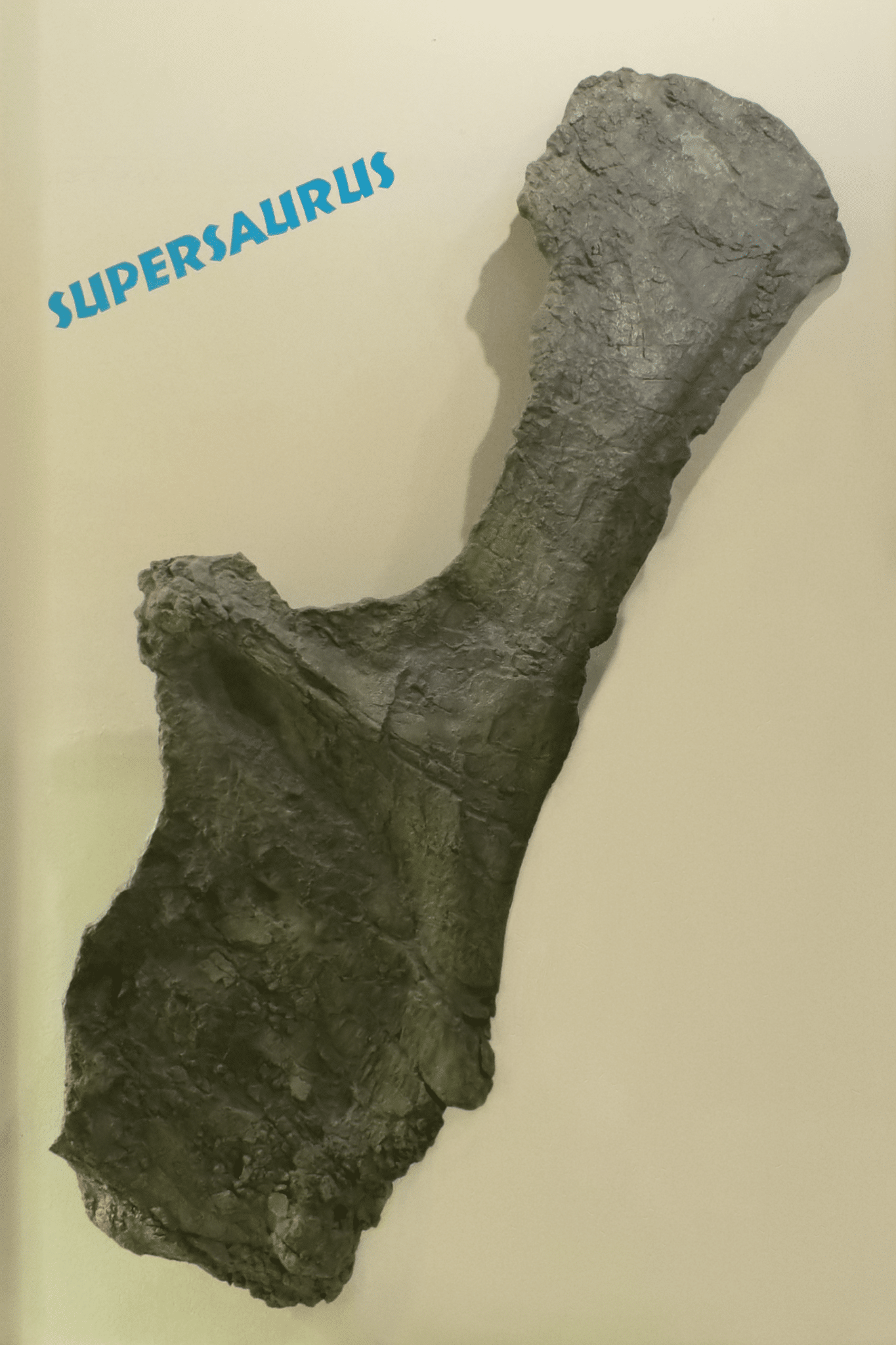

The quarry also held a rival giant. In 1979, during filming for a Japanese documentary, another scapulocoracoid surfaced and was hailed as the “world’s largest dinosaur”. Jensen later named Ultrasaurus macintoshi on a back vertebra and placed it with the brachiosaurids. That name was already taken, so it became Ultrasauros in 1991. A separate vertebra became Dystylosaurus edwini. Brian Curtice and colleagues then sank Ultrasauros (1995–1996) and Dystylosaurus (2001) into Supersaurus vivianae. However, they assigned the 1979 shoulder blade itself to Brachiosaurus—only the named vertebra went to Supersaurus.
A second skeleton, WDC DMJ-021, came from Jimbo Quarry near Douglas, Wyoming. It preserves about 30 percent of one individual, including ribs, shin bones, and parts of 15 neck and back vertebrae. With the BYU bones, it reveals 45 to 50 percent of the skeleton.
Supersaurus Size and Description
Supersaurus is known mostly from its backbone, ribs, shoulders, and hips—no skull or teeth have been reported.
Short description of Supersaurus
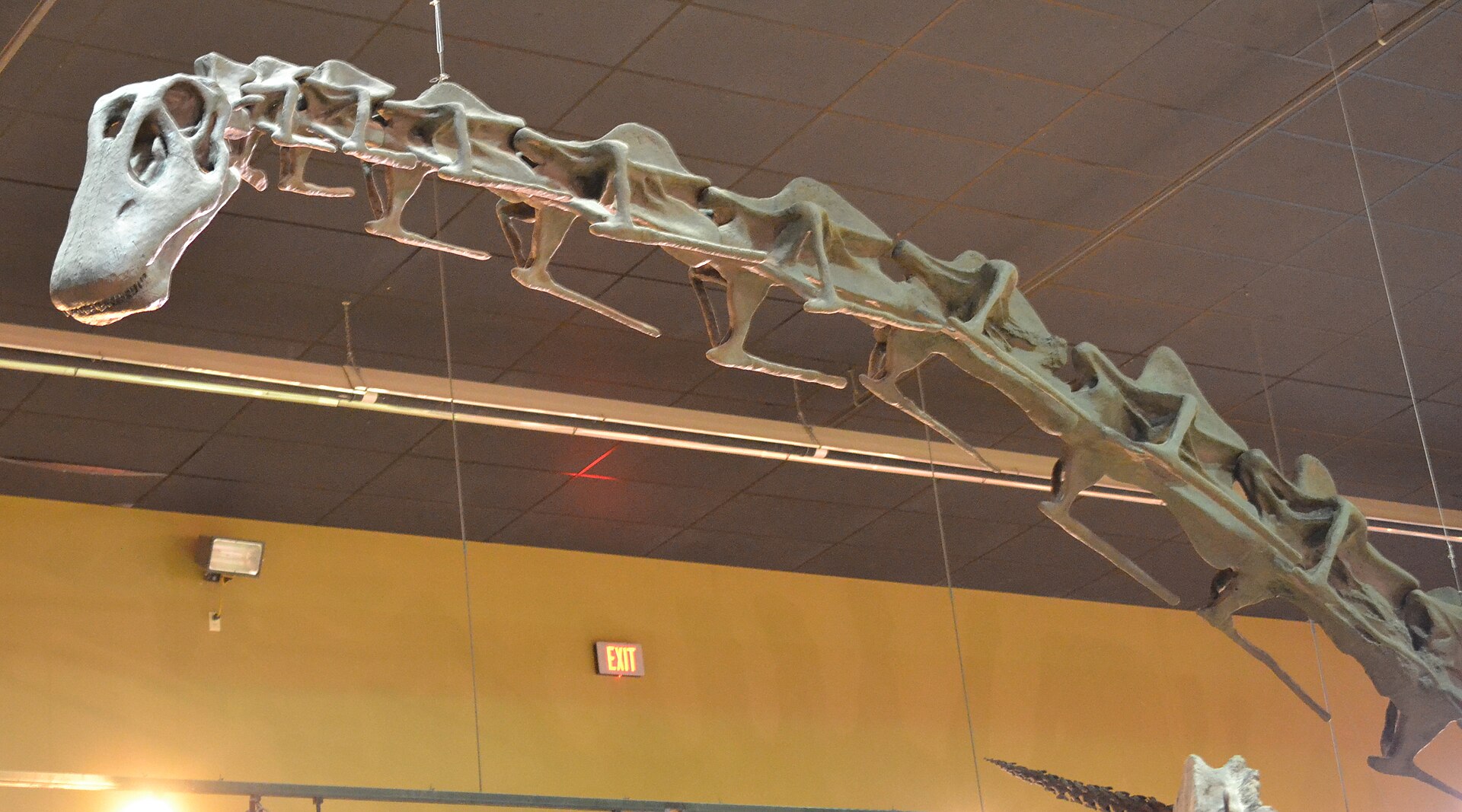
Without a skull, any portrait of Supersaurus starts with the neck. Its cervical (neck) vertebrae were long and sharply narrowed underneath, with parallel keels. One centrum, or vertebral body, measures 1,380 millimeters (4.5 feet), beating the 1,250 millimeters reported for Sauroposeidon. Yet the air-sac openings on the neck were just 30 to 80 millimeters (1.2 to 3.1 inches) across, unlike the elaborate cavities of Diplodocus and Barosaurus.
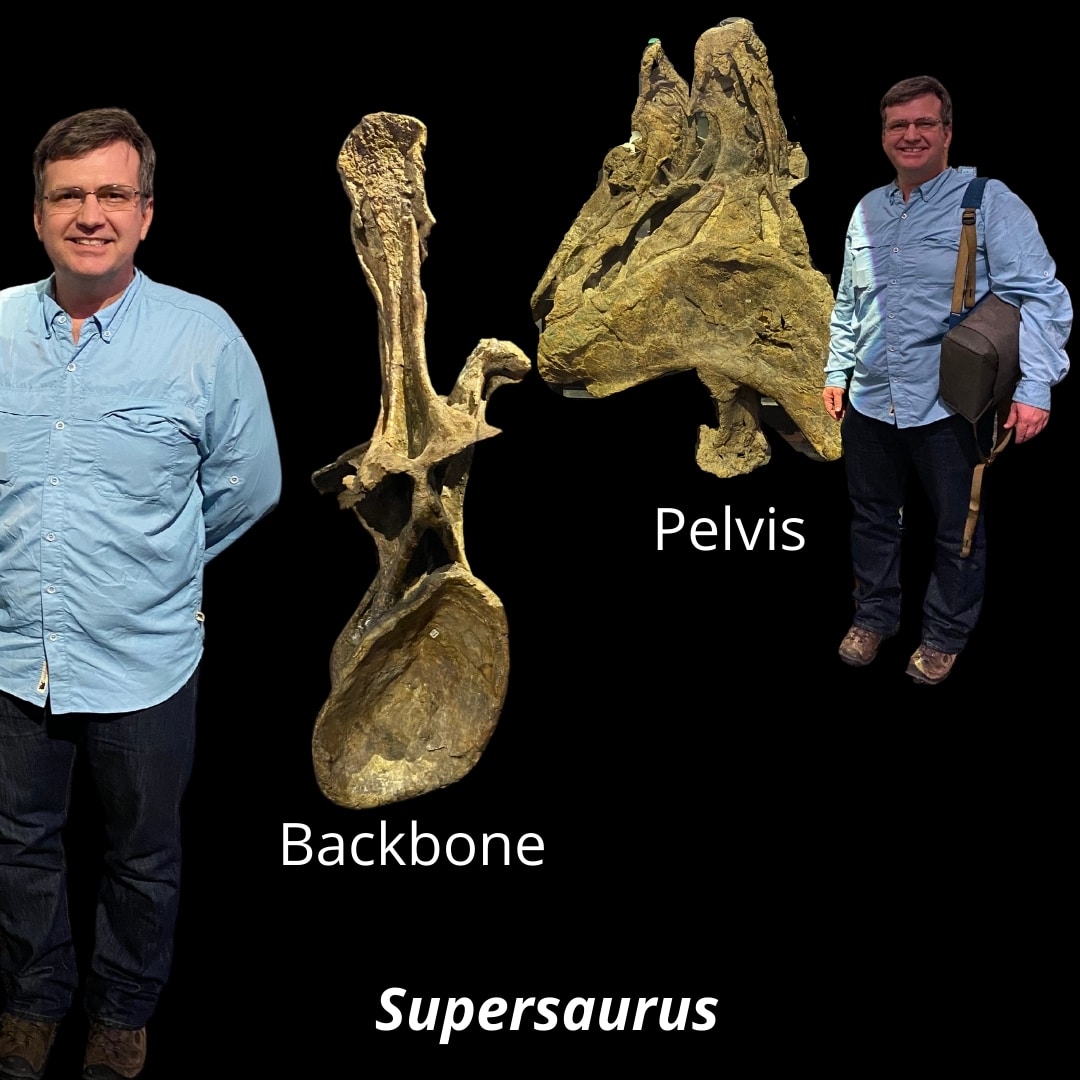
Behind the neck sat a deep chest, with ribs up to 305 centimeters (10 feet) long—a build closer to Apatosaurus than to Diplodocus. Its rear back vertebrae were opisthocoelous, with a ball in front and a socket behind. Along the tail, the first 30 vertebrae kept a similar length while their spines shrank rapidly. Its shin bones were intermediate in robustness between Apatosaurus and Diplodocus.
None of the main studies describes its skin or coloration, so soft-tissue details are speculative—including the back spines shown in some restorations.

Size and Weight of Type Species
Jensen gave no body length or weight, only bone measurements. The “world’s largest dinosaur” publicity of 1979, in fact, attached to Ultrasaurus.
In 2007, Lovelace and colleagues estimated 108 to 112 feet (33 to 34 meters) along the spine, filling missing tail bones with apatosaurine proportions. A sculpted model, measured by water displacement and 3D scan, gave 35 to 40 tons. However, the paper does not say metric or short tons, and none of the main studies gives a hip height.
Tschopp’s team later gave 115 to 131 feet (35 to 40 meters), without stating a method. In 2021, Brian Curtice suggested at an online meeting that it exceeded 128 feet (39 meters). Live Science noted that it was not yet peer reviewed. Back in 2007, Lovelace and colleagues had concluded that Supersaurus was neither the heaviest nor the longest sauropod. Argentinosaurus, they noted, clearly achieved much greater bulk.
The Dinosaur in Detail
What sets this dinosaur apart is a cluster of backbone and rib features. In 2007, Lovelace and colleagues found “unambiguous evidence of pneumatized ribs”—ribs hollowed by air sacs. They suggested the trait may be shared by apatosaurines or may be special to Supersaurus. They also called its opisthocoelous back vertebrae a probable autapomorphy (a trait unique to one taxon). Tschopp’s team later listed the same feature as unique among diplodocoids.
In 2015, Tschopp and colleagues revised the genus diagnosis. Their list includes paired hollows under the neck vertebrae, an extra lamina—a thin bony sheet—on mid-back spines, and air openings in the ribs. For S. vivianae, they counted nine autapomorphies, among them a bony bridge across the canal in every chevron (the small bones beneath the tail). Notably, they conceded that the holotype “might not be diagnostic,” while other bones from the same individual “certainly” are. In 2019, Mike Taylor went further in blog posts that were not peer reviewed. He argued that because the holotype is not clearly diagnostic, Supersaurus is currently a nomen dubium (a doubtful name).

The two main specimens hold together well. In Tschopp’s analysis, the BYU and Wyoming skeletons formed one of the three best-supported groupings in Diplodocidae. Not every referred bone has survived scrutiny, however. Lovelace and colleagues moved a row of 12 tail vertebrae to an unidentified diplodocine and rejected an ulna as about 20 percent too large.
Biogeography once added a wrinkle. Lovelace and colleagues suggested that apatosaurines may have been restricted to North America. That idea mattered less for Supersaurus once Tschopp’s team moved it to the diplodocines in 2015. Today, most work places this giant there, even as its type specimen stays under scrutiny.
Interesting Points about Supersaurus
- A 1973 Reader’s Digest article gave the giant shoulder blade the name “Supersaurus” twelve years before Jensen’s formal description.
- Jensen named three sauropod genera from Dry Mesa in one 1985 paper, and later researchers folded two of them into Supersaurus.
- By 1983, the unprepared fossils Jensen had collected on the Uncompahgre Upwarp for BYU weighed about 100 tons, and only a very small part had been prepared.
- If the 2015 proposal holds, Supersaurus would be one of very few diplodocid genera known from two different continents.
- One Supersaurus neck vertebra is 1,380 millimeters long, which its 2007 describers noted exceeds the figure then reported for Sauroposeidon.
Contemporary Dinosaurs
Four dinosaurs from the same Dry Mesa bone bed as Supersaurus are identified in the literature.
The best-represented predator in the quarry was Allosaurus, an allosaurid theropod. In 1991, paleontologist B. B. Britt counted at least six individuals and nearly 200 of its bones there. No direct evidence links it to Supersaurus.
A second large predator was Torvosaurus tanneri, a megalosaurid theropod known there from at least three individuals and 75 bones. Jensen’s own faunal list for the Uncompahgre beds already included it. Again, no recorded interaction ties it to Supersaurus.
Among the ornithischians—the bird-hipped dinosaurs—Dryosaurus was the most common at Dry Mesa. Britt classed this ornithopod with the hypsilophodontids (it is now placed in its own family, Dryosauridae) and found several individuals. Its bones share the quarry with Supersaurus, though no direct contact is recorded.
Another sauropod, Camarasaurus, was among the genera Britt “positively identified” in the quarry. Jensen had already contrasted the two, finding the Supersaurus scapula unlike that of Camarasaurus. Any competition between these giants remains unrecorded.
Supersaurus in its Natural Habitat
At Dry Mesa, the bone bed is a lens of pebbly, cross-bedded stream sandstone with chunks of torn-up mud. The Paleobiology Database describes it as a channel sand from a shallow but wide braided stream. The region’s climate has been debated, and Britt’s 1991 summary lists proposals of warm and humid, arid to semiarid, and semiarid with seasonal rain. In 2004, Turner and Peterson concluded that the Late Jurassic Western Interior stayed dry and likened the ecosystem to a savanna.
No study addresses the diet of Supersaurus directly, and no skull or teeth are known. Instead, Turner and Peterson proposed a split among large Morrison sauropods. Some browsed higher vegetation along rivers, while others grazed herbaceous groundcover. They judged riverside zones probably the most diverse part of the ecosystem.
No published study has examined the social behavior of Supersaurus, and there is no direct evidence of whether it lived alone or in groups. The Wyoming skeleton was a single animal buried by a debris flow, which records how it died rather than how it lived. At Dry Mesa, its fossils lie among theropods, ornithopods, and other sauropods—a hint of how crowded these riverbanks may have been.
Frequently Asked Questions
Jensen gave no translation and called it a vernacular name, while the species name vivianae honors prospector Vivian Jones.
It lived in the Late Kimmeridgian to possibly Early Tithonian stages of the Late Jurassic, about 151 to 150 million years ago.
A 2007 study estimated 108 to 112 feet long and 35 to 40 tons. A 2015 study gave 115 to 131 feet.
No study addresses its diet directly, but large Morrison sauropods are thought to have browsed tall plants or grazed groundcover.
Its first fossils came from Dry Mesa Quarry in western Colorado, and a second skeleton came from Jimbo Quarry in Wyoming.
It was a diplodocid sauropod. One 2007 study placed it among the apatosaurines, but studies in 2011 and 2015 placed it among the diplodocines.
Sources
The information in this article is based on various sources, drawing on scientific research, fossil evidence, and expert analysis. The aim is to provide a comprehensive and accurate overview of Supersaurus. However, please be aware that our understanding of dinosaurs and their world is constantly evolving as new discoveries are made.
- https://scholarsarchive.byu.edu/gbn/vol45/iss4/7/
- https://archive.org/details/greatbasinnatura45brig
- https://scholarsarchive.byu.edu/gbn/vol45/iss4/8/
- https://archive.org/details/biostor-248729
- https://www.biodiversitylibrary.org/part/279840
- https://doi.org/10.7717/peerj.857
- https://geology.byu.edu/0000017c-f2a9-dd9b-a7ff-f2af65580000/geol-stud-vol-37-britt-pdf
- https://www.usgs.gov/publications/reconstruction-upper-jurassic-morrison-formation-extinct-ecosystem-a-synthesis
- https://paleobiodb.org/data1.2/colls/single.json?id=45975&show=strat,stratext,lith,geo,loc,time
- https://paleobiodb.org/data1.2/occs/list.json?base_name=Supersaurus&show=coords,loc,strat,stratext,ident
- https://www.livescience.com/supersaurus-longest-dinosaur-on-record
- https://www.miketaylor.org.uk/dino/pubs/svpca2019/abstract.html
- https://svpow.com/2019/06/22/supersaurus-ultrasaurus-and-dystylosaurus-in-2019-part-4-what-is-the-holotype-of-supersaurus/
- https://svpow.com/2019/06/25/supersaurus-ultrasaurus-and-dystylosaurus-in-2019-part-5-what-actually-is-supersaurus/
- https://svpow.com/2019/07/02/supersaurus-ultrasaurus-and-dystylosaurus-in-2019-part-6-what-happens-to-supersaurus-now/
- https://palaeo-electronica.org/content/2024/5327-new-diplodocine-sauropod
This article was last fact checked: TheDinosaurs Team, 31-10-2026
Featured Image Credit: LadyofHats, Public domain, via Wikimedia Commons
